

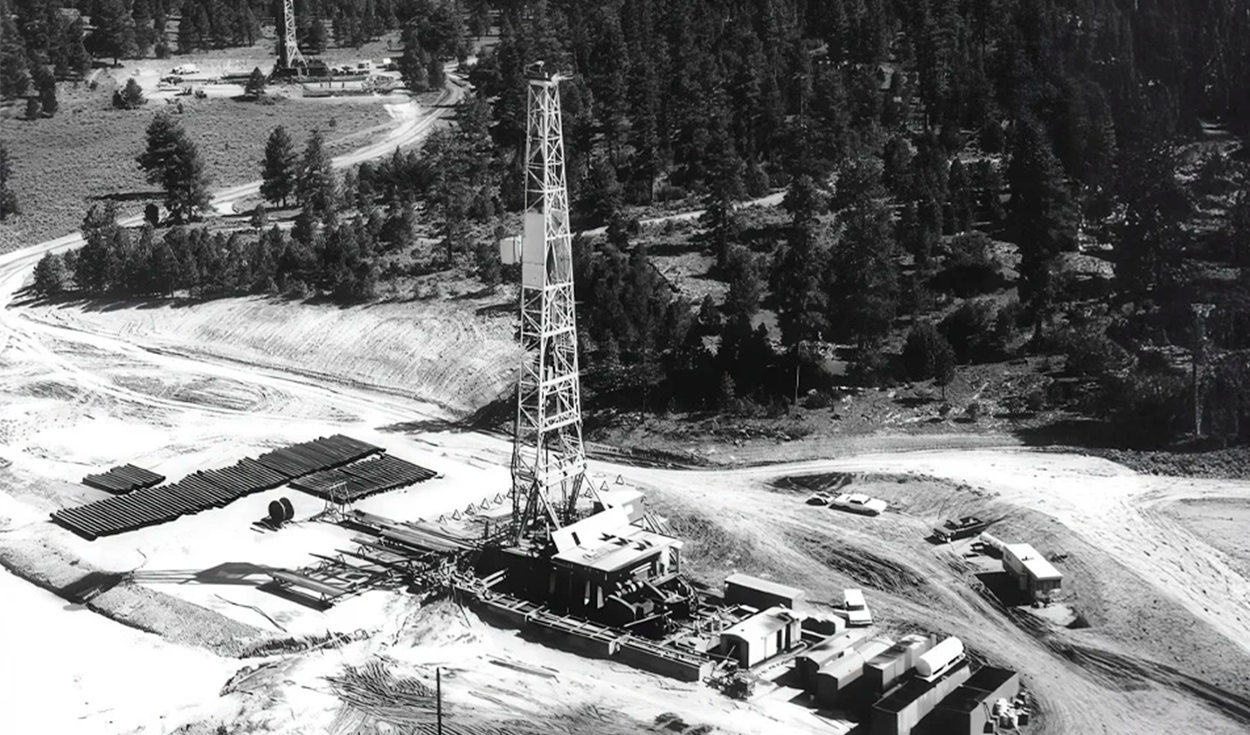
The United States detonated a 29-kiloton nuclear device 1,288 meters underground in Rio Arriba County, New Mexico, on December 10, 1967, in an attempt to fracture rock formations and extract trapped natural gas. The experiment produced 213 million cubic feet of natural gas during production testing, but the extracted fuel contained measurable amounts of radioactive elements, rendering it commercially unusable.
Known as Project Gasbuggy, the test took place inside the Carson National Forest in the north-western region of the state. The initiative was carried out as part of the federal Plowshare Program, a government research effort established to investigate potential peaceful and industrial applications of nuclear energy.
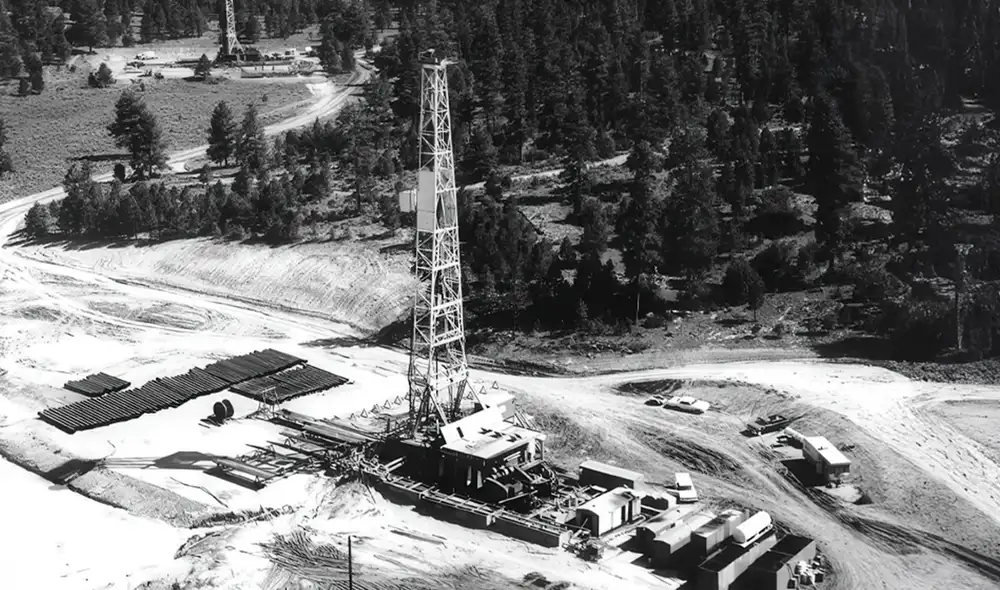
Underground Nuclear Detonation in New Mexico
The concept behind Project Gasbuggy was straightforward in theory. Natural gas trapped in low-permeability subterranean formations cannot flow easily into conventional wells. Engineers reasoned that a nuclear detonation deep underground would shatter the rock surrounding the gas-bearing formation, creating new pathways so that the trapped gas could move more freely toward extraction wells.
To prepare for the experiment, workers installed the 29-kiloton nuclear device, which had an explosive yield equivalent to 29,000 tons of TNT, inside an emplacement well designated as GB-E. The device was positioned 1,288 meters beneath the surface in Rio Arriba County.
When the device was detonated, the explosion generated extreme temperatures that instantly vaporized a portion of the surrounding rock. For a brief moment, the blast formed a massive subterranean cavity enveloped by a wide zone of fractured stone material.
Shortly after the initial blast, the rock layers situated directly above the empty void collapsed downward into the space. This structural collapse created a vertical chamber known as a collapse chimney, which remained packed with coarse rock fragments and geological debris.
As the cavity cooled down, part of the molten and vaporized rock pooled at the bottom of the chamber and solidified into a dense glass material known as melt glass. This glassified rock trapped a large portion of the high-melting-point radionuclides produced by the nuclear fission process, preventing their immediate dispersion into surrounding rock layers.
Gas Production and Radioactive Contamination
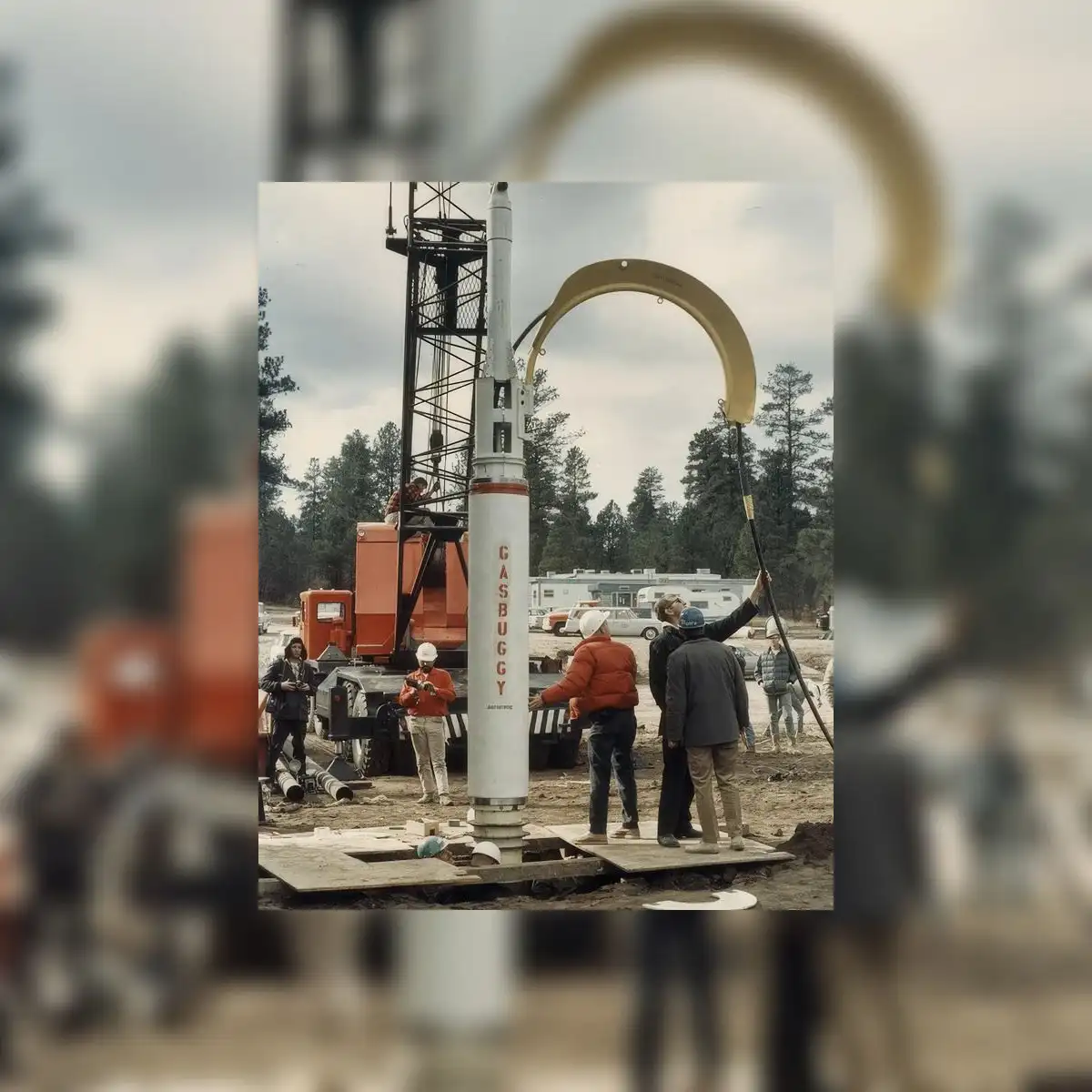
To test whether the nuclear detonation had successfully improved natural gas extraction, workers drilled a second evaluation well, named GB-ER, down into the collapse chimney. Gas drawn from the detonation zone was piped to the surface and burned off in flaring tests during production trials.
Production testing began in July 1968 and continued through October 1969. Across five distinct production tests, Project Gasbuggy produced a total of 213 million cubic feet of natural gas, an amount equivalent to approximately 6 million cubic meters.
The nuclear blast did manage to increase gas output compared to some conventional wells operating in the nearby area. However, the overall results fell far short of what project developers had anticipated.
The extracted fuel contained measurable amounts of radioactive components, posing health and safety risks. Furthermore, the gas exhibited a significantly lower heating value than standard commercial natural gas, reducing its effectiveness as an energy source.
Underground fracturing also failed to meet technical expectations. The cracks generated above the cavity did not extend through the gas formation as far as predicted by engineers, leaving the reservoir without the level of stimulation the project leaders sought. Following an evaluation of the test results, officials decided in 1976 that no further tests would take place at Gasbuggy.
Site Decommissioning and Waste Management
The Atomic Energy Commission, the federal agency responsible at the time for overseeing nuclear energy development, began dismantling the Gasbuggy experimental site in 1978. Surface structures and equipment used during the project were removed, and any materials requiring decontamination were treated prior to their removal from the location.
Radioactive waste generated by the trial was handled through two separate disposal methods based on its physical state. Liquid radioactive waste was injected directly back down into the former underground cavity created by the blast. Solid radioactive waste was removed from the site and transported to the Nevada National Security Site, a federal nuclear reservation in Nevada, for permanent disposal. Both the GB-E emplacement well and the GB-ER evaluation well were subsequently plugged and sealed.
Although surface cleanup was performed, radioactive contamination remained deep underground near the GB-E well site. The United States Department of Energy later used computer models to evaluate whether the subsurface contamination could travel toward nearby commercial gas wells. The modeling estimates indicated that the radioactive material should remain confined within the zone impacted by the original explosion.
Environmental water monitoring began in 1972 and continued for several decades. Technicians routinely collected and analyzed water samples from local springs, ponds, surface drainage areas, private ranch wells, and livestock watering locations across the area. No Gasbuggy-related radionuclides were ever detected at any of the monitored water points, and the water surveillance program was formally concluded in 2015.
Subsurface Restrictions and Project Lessons
Surface remediation of the Carson National Forest location was officially completed in September 2004, after cleanup crews excavated and removed 5,562 cubic yards of contaminated soil from drilling mud pits across the site.
Today, the land surface above the former experiment is fully restored and available for public use. However, access to the subsoil in the area of the old trial remains strictly restricted to prevent disturbance of the buried contamination.
Project Gasbuggy left a clear lesson regarding the limits of using nuclear explosions to alter subterranean formations. Although the detonation liberated millions of cubic feet of natural gas, it produced radioactive contamination and failed to achieve the level of reservoir stimulation required for commercial success.



