


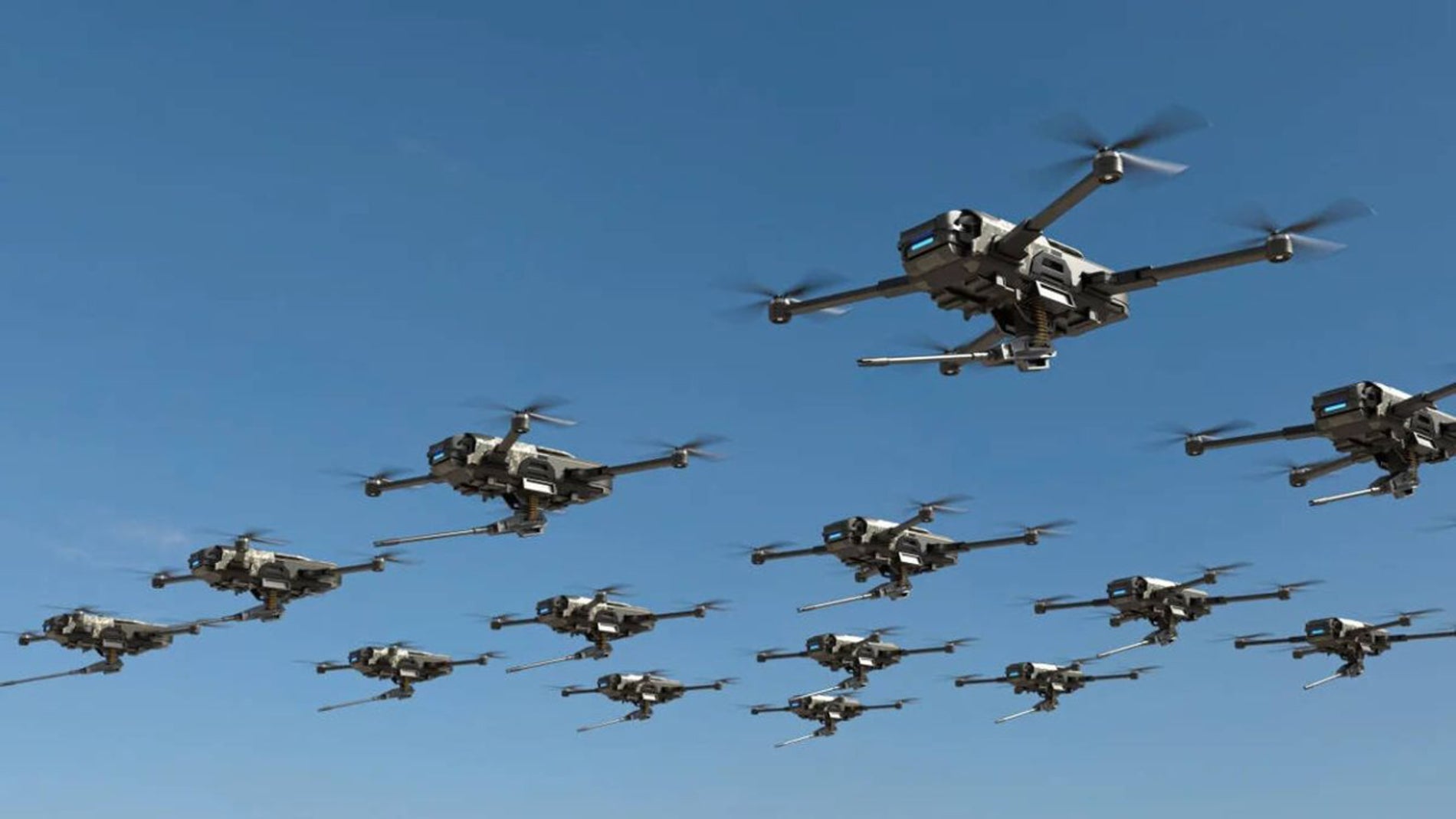
The United States military lacks the sensors and equipment needed to neutralize massive drone swarm attacks, Army Lieutenant General Joseph Jarrard admitted at a defense conference in Alabama.
Speaking at the Space and Missile Defense Symposium, General Jarrard, the deputy commander of United States Northern Command and North American Aerospace Defense Command, gave a blunt response when questioned on current domestic defensive capabilities. He acknowledged that military forces currently do not possess the necessary sensors or components to stop a coordinated swarm strike.
United States Northern Command was established in 2002 to consolidate homeland defense efforts following the September 11 terrorist attacks, operating alongside North American Aerospace Defense Command, a binational military organisation formed by the United States and Canada in 1958 to monitor and defend North American airspace.
Airspace vulnerability inside the United States has emerged as a primary concern for senior military leadership. Commanders fear that a drone swarm hidden inside the country could launch an attack before defense systems are able to detect or track the incoming threat.
Unlike military units deployed in foreign combat zones, sensitive bases and high-value installations within the United States operate under significantly lower alert levels. Domestic sites suffer from a scarcity of integrated defenses and have limited surveillance capabilities to detect short-range incursions or longer-range drones operated from within American borders.
Global drone threat
The rapid proliferation of unmanned aerial systems in global conflicts has forced the Pentagon to urgently re-evaluate the physical security of strategic facilities. Ukrainian forces demonstrated the tactical impact of low-cost aerial swarms during Operation Spiderweb, using truck-launched drones operated from close range to destroy Russian bombers and vital infrastructure before air defenses could react.
Similar vulnerabilities have been exposed in the Middle East, where first-person-view drone strikes against American helicopters confirmed the immediate danger facing strategic infrastructure, high-value assets, and senior personnel. First-person-view drones use onboard cameras to stream live video back to operators, allowing precise maneuvering at low altitudes.
The growing danger comes as foreign powers advance their own automated aerial warfare capabilities. China recently demonstrated an autonomous swarm system capable of managing 96 drones simultaneously and launching a new aircraft every three seconds.
Defense coordination challenges
To counter the evolving threat, US military leaders are attempting to adapt tactics, techniques, and procedures initially developed under Operation Noble Eagle. Launched immediately after the 2001 terrorist attacks, Operation Noble Eagle established continuous air defense patrols over North American cities and sensitive government sites.
Military commanders emphasize that early detection and interoperability represent the central hurdles to protecting the homeland. Defense systems cannot be limited to military perimeters, but must extend across critical civilian infrastructure and major urban centers.
Achieving effective protection requires integrating military radar networks and defense installations with local and federal law enforcement agencies and emergency response teams. Military planners point to joint security frameworks used during major public gatherings, such as the FIFA World Cup, as a model for ensuring all radar platforms and detection sensors share real-time threat data.
Emergency measures and new guidelines
The Department of Defense has implemented emergency countermeasures at select locations following unauthorized drone incursions over sensitive facilities that store nuclear components. The military deployed portable anti-drone kits to high-priority bases to provide immediate point defense.
However, defense officials acknowledge that portable kits offer limited protection against unannounced strikes. Rapid-deployment teams require time to request, transport, and assemble equipment, rendering them ineffective against surprise incursions unless military intelligence provides advance warning. The military also lacks the structural capacity to deploy permanent defensive systems across every priority site and civilian utility.
The threat has driven a major policy shift within the Department of Defense. Historically, Pentagon officials resisted funding physical hardening for military installations due to high financial costs and doubts regarding cost-effectiveness. In response to rising swarm risks, the Pentagon issued updated directives ordering facilities to install passive physical protections, including containment nets, structural barriers, and high-tensile cables designed to intercept incoming drones.
In addition to physical barriers, American military researchers are pursuing technological countermeasures against aerial threats. The Armed Forces are testing specialized defense platforms, including the HAVOC counter-drone system, alongside US Air Force initiatives focused on developing military drone swarms capable of remaining airborne indefinitely by recharging mid-flight using directed energy beams.



