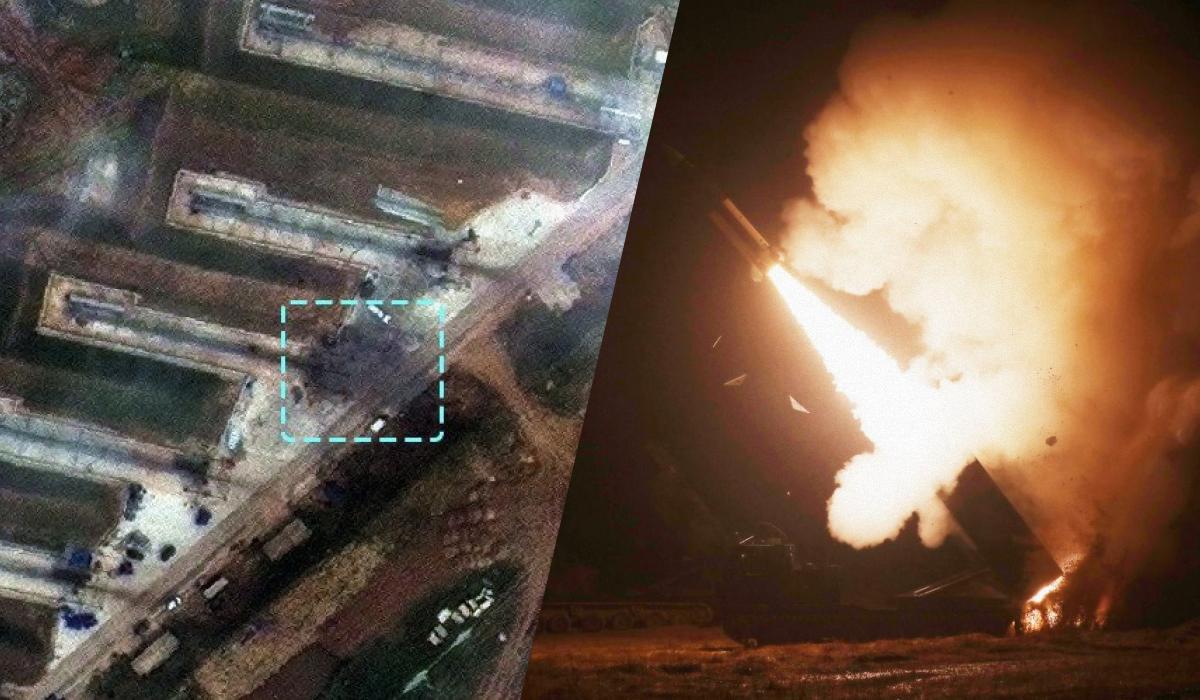
Ukrainian forces have struck the Tsymbulova droneport in Russia's Orel region, damaging a launcher for jet-powered Geran drones, defense analysts reported.
Satellite imagery published by specialized communities confirmed the attack on the Russian site, showing visible traces of fire across the facility, according to Ukrainian military publication Defense Express.
The Tsymbulova launch facility is located in Orel Oblast in western Russia, roughly 180 kilometres from the Ukrainian border. The complex is significantly larger than initial assessments suggested, spanning more than 3.5 kilometres from west to east, over 1.5 kilometres in width, and covering a total area exceeding 2.5 square kilometres.
Orel Oblast is an administrative region in western Russia that serves as a key area for military infrastructure and logistics. Ukraine's Defense Forces have targeted Russian drone sites across border regions to reduce incoming long-range aerial strikes.
ATACMS strike requirements
Defense Express analysts noted that given the vast dimensions of the Tsymbulova droneport, an ideal weapon for neutralization would be ballistic missiles carrying cluster warheads, though even cluster munitions might face operational limitations.
The MGM-140 Army Tactical Missile System, known as ATACMS, is a US-designed surface-to-surface ballistic missile system used by Ukrainian forces. Defense Express analyzed two cluster variants of the missile to determine their potential effectiveness against the drone site.
The M39 Block I variant of ATACMS carries 950 M74 submunitions and covers an area of 0.033 square kilometres. However, analysts ruled out this model because its operational range is limited to 165 kilometres, leaving it unable to reach the Tsymbulova complex.
Reaching the target requires the M39A1 Block I missile variant, which has an extended range of 300 kilometres. That version features a lighter payload containing 300 submunitions, with an estimated effective coverage area of approximately 0.0104 square kilometres.
Analysts calculated that guaranteeing full cluster submunition coverage across the entire 2.5-square-kilometre site would require around 250 M39A1 missiles. If Ukrainian forces chose instead to target individual launchers directly, approximately 20 missiles would be needed.
Russian defensive countermeasures
Russian military planners have anticipated potential cluster missile strikes by dispersing launch points and constructing earth embankments around them. These fortifications were built around an estimated 100-metre blast zone for cluster warheads such as the M39A1 Block I.
Defense Express noted that launchers for Geran-4 and Geran-5 drones are simple, low-cost structures rather than unique installations. Consequently, analysts assessed that high-priority targets at the Russian droneport are storage areas and launcher maintenance facilities.
Escalating Russian drone strikes
The attack on the Tsymbulova facility occurred amid an intensified aerial campaign against Ukrainian infrastructure. Yurii Ihnat, head of communications for the Air Force Command of the Armed Forces of Ukraine, stated that Russian forces launched more than 1,500 unmanned aerial vehicles over a four-day period, including about 800 jet-powered models.
Ihnat stated that the primary target of these attacks was Kyiv. He reported that Ukraine's overall drone interception rate remains high at 88 percent to 90 percent, but the shootdown rate for jet-powered drones is lower because of their high flight speeds.
Ihnat recalled that Russian forces significantly expanded their use of jet-powered drones in July, launching five times more jet units than in June.
Frontline pressure and psychological warfare
Addressing broader conflict dynamics, Yevhen Dykyi, a former company commander in the Aidar Battalion, stated that Russian forces are attempting to exert psychological pressure on Ukrainian citizens to weaken morale during difficult frontline conditions.
The Aidar Battalion is a Ukrainian military unit established during the early stages of the conflict in eastern Ukraine. Dykyi dismissed false claims of an impending famine in Ukraine, calling them part of an informational campaign.
Dykyi stated that famine in Ukraine has historically occurred only under Russian occupation, adding that such a condition would only be possible if Russian forces captured Ukrainian territory. He concluded that psychological resilience has become a strategic resource for Ukraine alongside missiles and fuel.