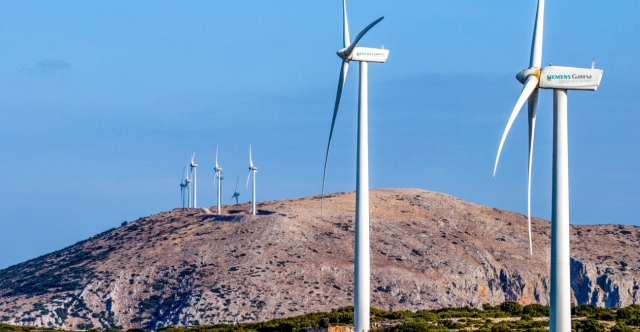
Turkey has rejected Greece's newly enacted spatial planning framework for renewable energy, claiming that regulations covering the Aegean Sea carry no legal weight for Ankara.

Turkish Foreign Ministry spokesman Öncü Keçeli declared on Wednesday that the decision signed by Greek officials creates no legal consequences for Turkey regarding long-standing Aegean territory disputes.
Keçeli stated that the Special Spatial Framework for Renewable Energy Sources, published by Athens on August 19, cannot affect Turkey's legal position on geographical formations whose sovereignty was not transferred to Greece under international treaties.
The spokesman argued that coastal states in closed or semi-closed seas such as the Aegean and the Mediterranean must refrain from unilateral actions. He cited international maritime law to emphasize that coastal nations are encouraged to cooperate in shared waters.
Keçeli added that Turkey, as one of the two coastal states in the Aegean Sea, remains ready to collaborate with Greece. He called for a sincere and comprehensive approach based on equity, international law, and the Athens Declaration on Friendly Relations and Good-Neighborliness signed on December 7, 2023.
The diplomatic challenge follows Ankara's declaration days earlier of two national marine parks in the Aegean and Eastern Mediterranean, an action that drew an immediate official response from Athens.
Greek renewable energy rules
The new Special Spatial Framework for Renewable Energy Sources came into force on August 19 following a Ministerial Decision signed by Minister of Environment and Energy Stavros Papastavrou, alongside Deputy Ministers Nikos Tsafos and Marilena Soukouli.
The framework establishes binding conditions for locating renewable energy projects and energy storage facilities across Greece, introducing stricter environmental standards and expanded exclusion zones.
Under the updated rules, wind turbine installations are banned in Attica, the Thessaloniki Metropolitan Area, and all geographical areas situated at an altitude higher than 1,200 metres.
Exclusion zones for wind developments include Ramsar wetlands, small island wetlands, Landscapes of Outstanding Natural Beauty, and the core zones of national parks. Construction is also prohibited in specific nature protection zones, Roadless Areas, bathing beaches, drinking water supply points, and protected pristine beaches.
Following public consultation, Greek authorities prohibited new wind farms in category A and category B zones under the national tourism spatial framework. Restrictions also extend to off-plan areas designated for tourism and recreation, as well as active quarrying, mining, and extraction sites.
Island restrictions and wind energy limits
A dedicated chapter of the framework governs island territories, setting strict wind energy restrictions for islands with a surface area smaller than 300 square kilometres.
Exceptions for small islands are allowed only when wind projects serve essential public infrastructure, such as water desalination plants, or when necessary to preserve electrical grid stability.
Developers seeking environmental approval for island wind farms must submit a special landscape study examining turbine dimensions, local terrain characteristics, and visual impacts on surrounding views.
Mountainous areas on islands will undergo case-by-case evaluations based on specific morphological and ecological features, while total land coverage for wind turbines remains capped at four per cent per Municipal Unit.
The regulations allow an exception for locations with high wind potential in Municipal Units where the overall average wind speed falls below four metres per second. In those areas, wind turbines may be permitted if localized measurements prove wind speeds exceed 7.5 metres per second.
To qualify for the exception, developers must submit certified wind measurements to the Regulatory Authority for Waste, Energy and Water. Exceptionally approved installations cannot exceed one per cent of the Municipal Unit's total carrying capacity and must comply with all general exclusion zones.