

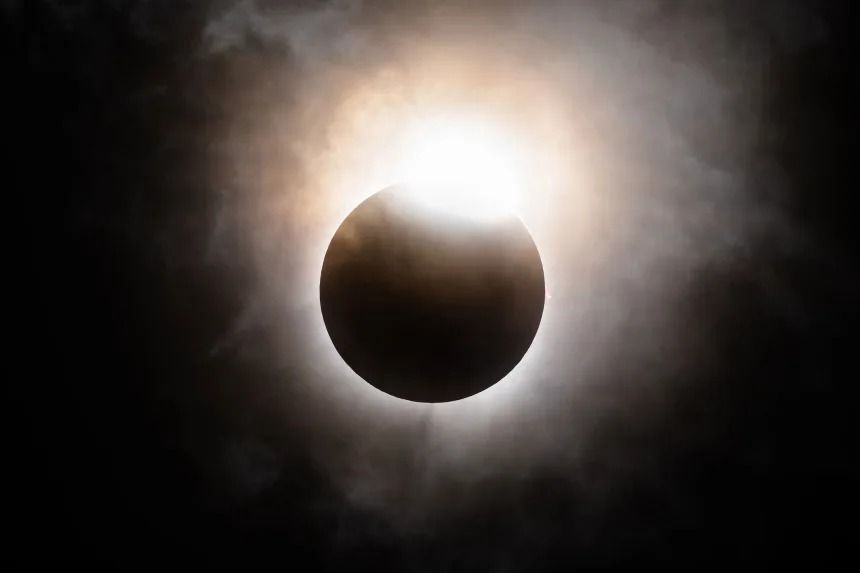
A total solar eclipse crossed parts of the Northern Hemisphere on Wednesday, August 12, as the Moon passed between the Earth and the Sun and, in certain locations, completely blocked the solar disc for several minutes.
The path of totality ran across northern Russia, parts of the Arctic, Greenland, Iceland and Spain. Outside that band, other locations were able to watch the Sun partially covered by the Moon.
The eclipse was not visible in Brazil. According to the Observatório Nacional (National Observatory), no region of the country could observe the eclipse, not even partially. CNN Brasil broadcast the event live.
Eclipse timeline
Based on Brasília time, the National Observatory set out the following stages of the eclipse:
- Start of partial eclipse: 12:34
- Start of totality: 13:58
- Maximum eclipse: 14:46
- End of totality: 15:34
- End of partial eclipse: 16:57
The timing of the eclipse varied depending on the observer's location, since the Moon's shadow moved across the Earth's surface as the phenomenon unfolded.
What causes a total solar eclipse
A solar eclipse happens when the Moon passes between the Earth and the Sun and casts its shadow over part of the planet.
During a total eclipse, anyone standing within a specific band of the Earth's surface sees the Moon completely cover the disc of the Sun. For a few minutes, the sky darkens and the outermost layer of the Sun's atmosphere, known as the corona, becomes visible. Anyone outside the band of totality but still within reach of the Moon's partial shadow sees a partial eclipse instead.

Where the eclipse reached totality
An observer's location made a major difference, since only those inside the narrow path of totality saw the Sun completely covered. The countries where the eclipse was visible included:
- Greenland - total eclipse: approximately 14:07 to 16:50
- Iceland - total eclipse: 13:42 to 15:49
- Spain - total eclipse: approximately 14:30 to 15:46
- Portugal - total eclipse: approximately 14:30 to 16:42
- United Kingdom - partial eclipse: 13:59 to 16:10
- France - partial eclipse: 14:18 to 16:16
- Germany - partial eclipse: 14:11 to 16:03
- Italy - partial eclipse: 14:24 to 15:46
- Ireland - partial eclipse: 14:08 to 16:09
- Morocco - partial eclipse: 14:44 to 16:40
How many people could see the eclipse
According to the specialist website Time and Date, about 980 million people, equivalent to 12.08% of the world's population, live in regions where at least some phase of the eclipse could be observed.
That figure fell as the proportion of the Sun covered increased. Around 283 million people were able to watch an eclipse of at least 90% coverage. Totality, when the Moon fully covers the solar disc, could be observed by about 15.2 million people, just 0.19% of the world's population.
How long totality lasted
Although the eclipse crossed different regions over several hours, its most anticipated phase was far shorter. The length of totality varied by observation site: the closer an observer was to the centre of the path traced by the Moon's shadow, the longer the Sun tended to remain completely covered.
Eye safety during the eclipse
Looking directly at the Sun without adequate protection can cause serious eye damage. Ordinary sunglasses, cameras, binoculars or telescopes without proper solar filters do not offer enough protection. Proper solar viewing equipment is required during the partial phases of an eclipse.

Ophthalmologist Sara Vaz-Pereira told CNN Portugal that people have been warned since childhood not to look at the Sun, and that the warning is correct. She said people should never look directly at the Sun, with or without an eclipse taking place, because direct exposure can burn the retina, the area at the back of the eye responsible for turning light into images.
In Brazil, even though Wednesday's eclipse was not visible, the Observatório Nacional stressed that direct observation of the Sun should always be carried out with appropriate protection. Welder's glass filter number 14, a cheap item that is easy to find in hardware stores, is the tool the observatory recommends.


