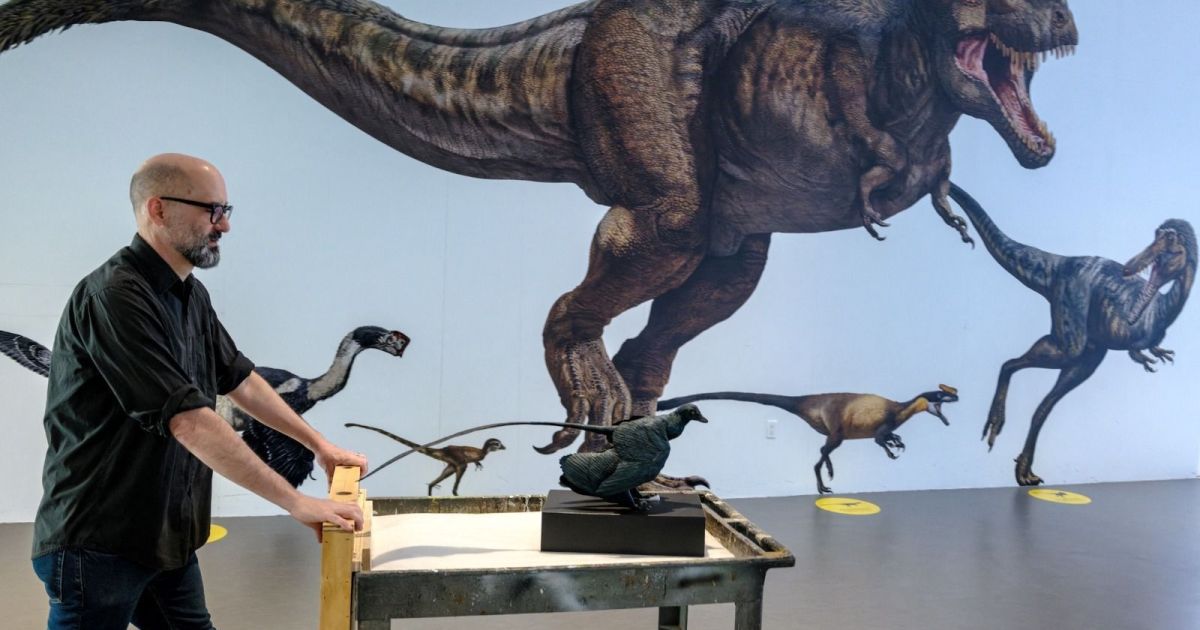
Early mammals prevented dinosaurs from evolving into mouse-sized creatures by filling small ecological niches, according to a study co-led by paleontologist Stephanie Lechki. Researchers used mathematical models to explore body size evolution across vertebrate groups, seeking to explain why no truly tiny dinosaurs ever existed outside of their avian descendants.
The study, published in the scientific journal Evolution, determined that energy availability and physiological limits explain the sizes of mammals, flying birds, and turtles. However, those same factors fail to account for the total absence of rodent-sized dinosaurs in the fossil record.
Lechki is a postdoctoral researcher at Princeton University in New Jersey, a private Ivy League research university. The study was published in Evolution, a peer-reviewed scientific journal published on behalf of the Society for the Study of Evolution.
Mathematical models of body size
Based on observations of living animals and fossil records, most animal groups include species that reach extremely small body sizes and dominate their ecosystems, Lechki said. She noted that a small animal typically requires fewer resources and can reach reproductive maturity and reproduce faster than a large-bodied animal.
Even the smallest known non-avian dinosaurs were far larger than today's tiny vertebrates. The crow-sized Microraptor weighed 430 grams, while Fruitadens weighed 730 grams and Anchiornis weighed 530 grams. In contrast, the smallest living bird, the bee hummingbird, weighs about 1.75 grams. The Etruscan shrew, the world's smallest mammal, weighs approximately 1.8 grams, and the dwarf gecko weighs about 0.15 grams.
Microraptor was a genus of small four-winged feathered dinosaur that lived during the Early Cretaceous period. The bee hummingbird is native to Cuba, while the Etruscan shrew is widely recognized as the smallest known mammal by mass.
Comparison with smallest living species
Most living species are small, measuring much less than humans and smaller than even the smallest dinosaurs, according to study co-lead Roger Benson. Benson, curator of dinosaur paleobiology at the American Museum of Natural History in New York, noted that this pattern applies to roughly 90 percent of existing bird species and 75 percent of living mammal species.
The American Museum of Natural History, founded in 1869 in New York City, is one of the largest natural history museums in the world, holding renowned paleontology collections.
Benson pointed to rodents, shrews, bats, songbirds, most lizards, and frogs as examples of small animals that dominate modern ecosystems. He said the abundance of tiny species indicates that many ecological niches exist for small-bodied creatures, but those niches remained closed to dinosaurs throughout their existence.
Ecological niches and mammal competition
Dinosaurs first emerged approximately 230 million years ago during the Triassic period and became the dominant land animals on Earth. Throughout the dinosaur era, early mammals thrived in small ecological niches as seed eaters and insectivores.
Lechki explained that early small-bodied mammals likely outcompeted dinosaurs in those small niches, preventing dinosaurs from evolving into reduced body sizes. At the same time, large dinosaurs likely outcompeted early mammals, preventing mammals from evolving larger body sizes during the Mesozoic Era.
Some herbivorous dinosaurs reached massive proportions. Long-necked sauropods were the largest land animals in Earth's history, exemplified by Argentinosaurus, which measured over 30 metres in length and weighed between 70 and 90 metric tons.
Evolution after the asteroid impact
The ecological balance shifted dramatically 66 million years ago when a massive asteroid struck Earth, triggering a mass extinction event that wiped out non-avian dinosaurs. Following the impact, mammals expanded into ecological niches previously held by dinosaurs, eventually evolving into large herbivores and apex predators.
The researchers also evaluated whether tiny dinosaurs might have existed without leaving discovered fossils. They concluded that missing fossils are unlikely to explain the gap, as fossil deposits containing dinosaur remains regularly preserve the delicate bones of numerous other small animals.