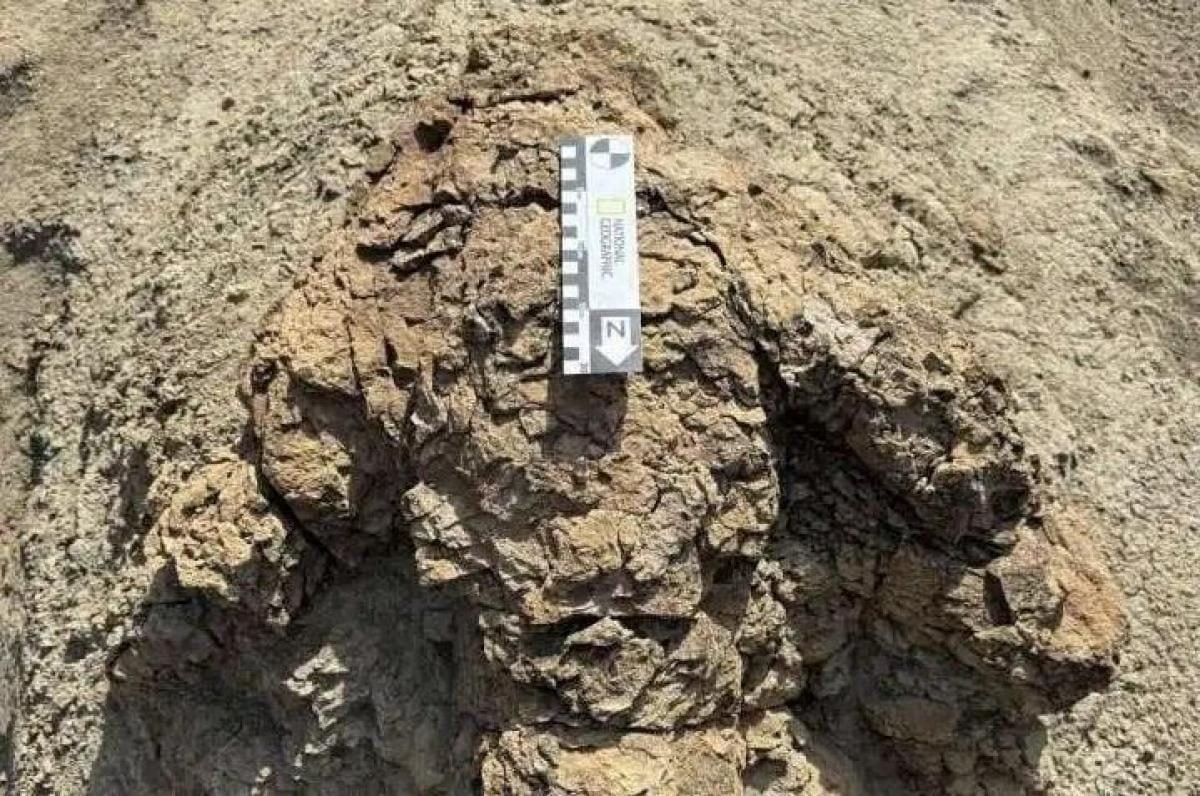
A chain of four footprints left by an adult Tyrannosaurus rex roughly 66.5 million years ago has been identified in North Dakota, giving paleontologists a rare direct record of how the giant predator moved. The find was made in the Hell Creek Formation and is described in the Journal of Vertebrate Paleontology.
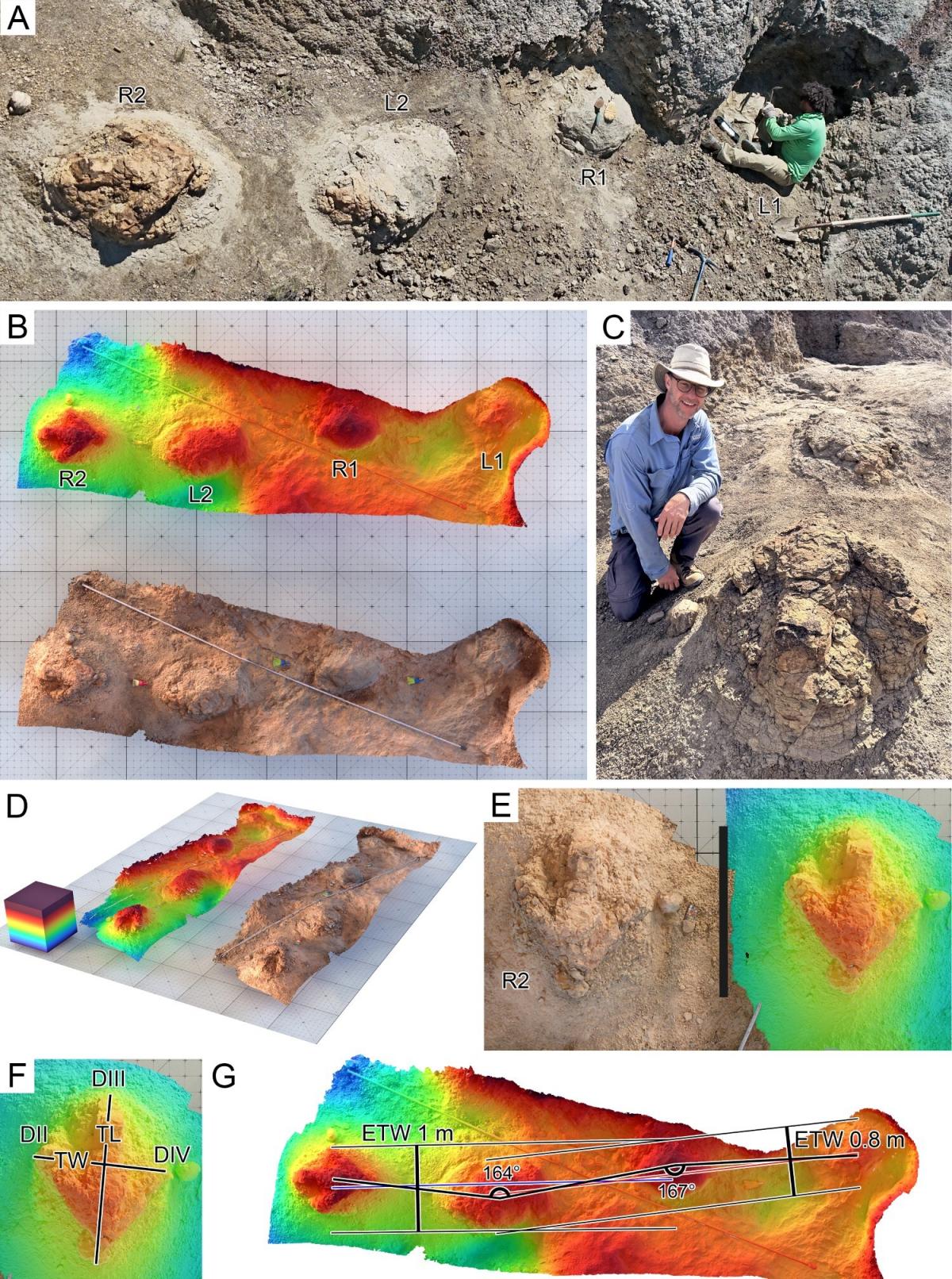
The track chain stretches about 7 meters and consists of four three-toed footprints, each around 0.9 meters long. It includes two left and two right prints, with a stride length, the distance between successive prints, of about 4 meters.
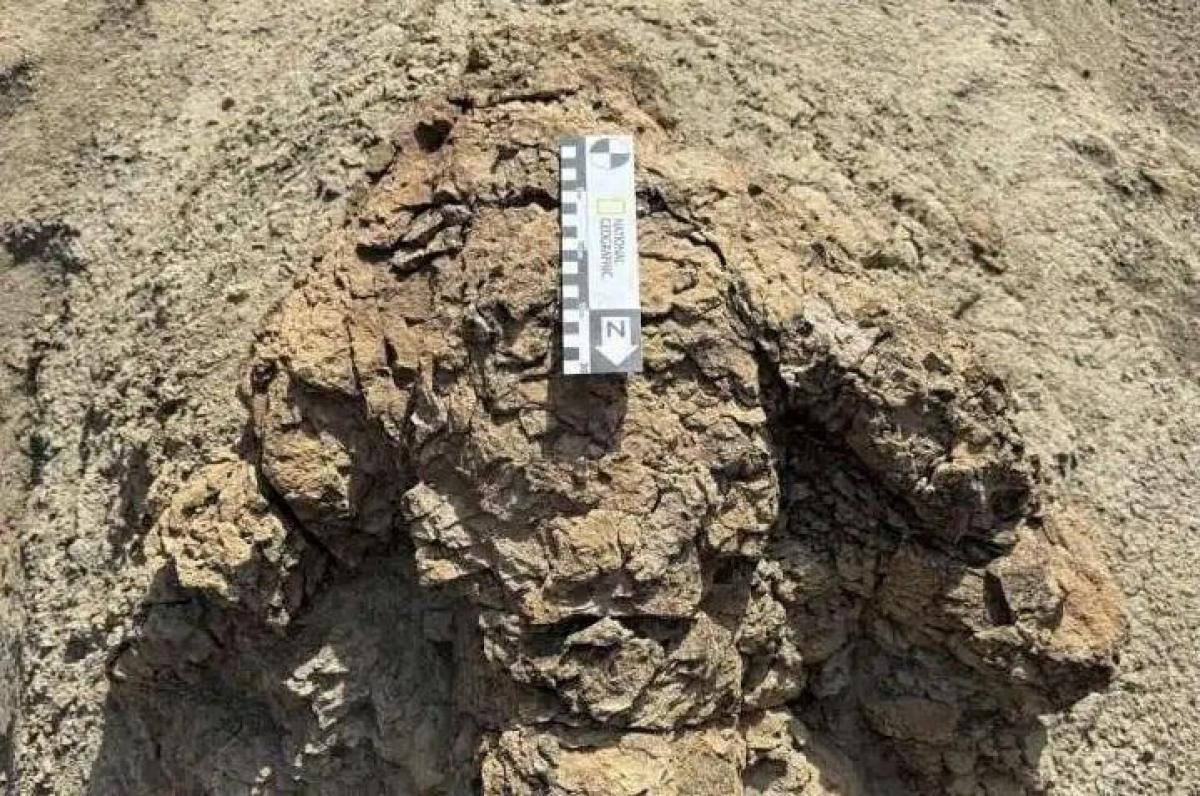
Researchers used the spacing of the prints to estimate that the animal was moving at roughly 5.6 to 7.2 kilometers per hour, a pace comparable to a brisk human walk. Because the tracks have suffered significant erosion, the researchers stressed that the speed estimate is approximate rather than exact.
The discovery was made by a team from the Denver Museum of Nature and Science in the United States and Liverpool John Moores University in England. While individual footprints have previously been attributed to adult T. rex, the researchers say this is the first time a full sequence of tracks left by the species has been described.
Skeletal remains, even the most complete ones, offer only a limited picture of how an animal behaved while alive. A trackway, by contrast, captures the animal in motion in real time, letting scientists reconstruct a fleeting moment from the distant past rather than inferring behavior indirectly from bone structure.
How the tracks were identified as T. rex
The researchers attributed the tracks to the species based on their exceptional size and the narrow shape of the toes, combined with the large number of T. rex fossils already documented in the area. No other animal known from the Hell Creek Formation matches this combination of size and foot shape, the team said.
Tyler Lyson, senior curator of vertebrate paleontology at the Denver Museum of Nature and Science, who led the fieldwork, said bones tell researchers a great deal about these animals, but tracks capture a moment of behavior. He said the trackway let the team literally follow how the animal moved across the landscape, calling that an incredible rarity for T. rex.
Digital scanning let a co-author study the tracks remotely
To document the find, the team used high-precision 3D surface scanning, capturing both the individual footprints and the trackway as a whole. Evan Tamez-Galvan, a research associate at the museum, carried out the scanning on site, producing digital models detailed enough to be studied closely and later reproduced physically.
The digital data proved central to preparing the scientific paper. Peter Falkingham, a professor of paleobiology at Liverpool John Moores University and a specialist in dinosaur tracks, served as lead author of the study despite never visiting the site in person.
Falkingham said that thanks to digital-era technology, his colleagues were able to scan the tracks on site and then send him the 3D data to examine on a computer and in virtual reality, letting him study them in as much detail as if he had been there himself.
A science teacher's chance discovery
The story behind the find is unusual, departing from the familiar image of academic paleontology teams combing badlands for fossils. The tracks were not found by a professional researcher but by Kent M. Hups, a science teacher at Northglenn High School.
Hups's close attention to the surrounding landscape led him to the site in 2025, on federal land managed by the U.S. Forest Service near the town of Marmarth, North Dakota. He went on to become a co-author of the scientific paper prepared with the museum's research team.
Hups said that as a teacher, he always tells his students that science begins with curiosity, enthusiasm and the ability to observe the world closely, adding that he could never have imagined it would lead him to a discovery like this one.
What happens next
According to the museum, three of the four footprints are due to be removed by helicopter this autumn and transported to the Denver Museum of Nature and Science.