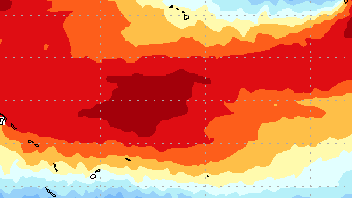
Latin American governments have launched emergency preparations after meteorologists confirmed the arrival of a major El Niño climate event in the tropical Pacific Ocean.
The warming phenomenon, popularly called Super El Niño, is expected to rank among the most intense in decades and could affect millions of people across Central and South America.
The United States National Oceanic and Atmospheric Administration issued an alert on June 11 after detecting the formation of El Niño in the tropical Pacific. Forecasters at the agency predicted a 63 percent probability that sea surface temperatures in the monitored region will rise more than 2.0 °C above normal, crossing the threshold for a very strong event.
Central American drought and hunger risks
In Central America, regional experts forecast a severe rainfall deficit and rising temperatures across most countries. The warning followed the conclusion of the 81st Climate Forum and 32nd Hydrological Forum of Central America on July 23, which brought together weather officials and specialists from Belize, Costa Rica, El Salvador, Guatemala, Honduras and Panama.
Guatemala's National Coordination for Disaster Reduction hosted the meetings to generate solid data for civil protection agencies. Organisers said the information will help national authorities plan emergency measures and guide decision-making as weather conditions deteriorate.
Carl Skau, the acting executive director of the United Nations World Food Programme, told CNN that El Niño could affect about 16 million people across Latin America and the Caribbean. Skau noted that temperatures could rise by up to 3.0 °C in parts of Guatemala, threatening crop yields, driving up food prices and worsening hunger. In response, the governments of El Salvador, Guatemala and Honduras are drafting plans to help farmers protect their crops.
Mexico prepares hurricane and cell alerts
Mexico is bracing for higher temperatures and increased rainfall, particularly during the Pacific hurricane season. Officials from the National Meteorological Service and the National Civil Protection Coordination outlined their forecasts during a press conference hosted by President Claudia Sheinbaum on July 9.
Authorities estimate that between 18 and 21 hurricanes will form in the Pacific coastal region during 2026, a higher number than recorded in previous years. To manage the heightened risk, the Mexican government is strengthening coordination between federal, state and local agencies while inspecting temporary shelters.
Federal officials also plan to deploy a new early warning system within two months. The system will send emergency alerts directly to mobile phones, focusing on residents living in high-risk areas.
South American farming and weather shifts
Brazil, the largest country in Latin America covering more than 8.5 million square kilometres and home to over 213 million residents, faces severe agricultural disruptions. Gilvan Sampaio, a meteorologist at the National Institute for Space Research, stated in an interview released by the Ministry of Science, Technology and Innovation that El Niño will bring drought to the northern and eastern Amazon while triggering heavy rainfall in the south.
Sampaio explained that both extreme dry spells and intense rains could severely damage agricultural output. The ministry announced it will issue a dedicated bulletin to closely monitor the development of the climate pattern.
In Argentina, the National Meteorological Service issued a report on July 1 predicting above-normal sea water temperatures through the July to September quarter. The agency stated there is a very high probability that warmer waters will persist in subsequent quarters, potentially increasing rainfall and temperatures in both northern and southern regions.
Water supplies and forest fire risks
Colombia's Institute of Hydrology, Meteorology and Environmental Studies released a detailed impact assessment on July 9 warning of higher temperatures and reduced rainfall across the Pacific, Andean and Caribbean regions. The agency warned that falling river and lake levels could strain water supplies for human consumption, agriculture and hydroelectric power generation while increasing the risk of forest fires and health issues related to insect proliferation.
In Chile, the National Disaster Prevention and Response Service issued regional guidelines tailored to local geographic threats. Authorities urged residents in the northern highlands to store water and plan farming around potential drought. In central and south-central Chile, residents were advised to maintain roofs and ensure proper drainage, while southern residents were urged to conserve water and protect crops and livestock from cold weather.
Ocean tracking and Peruvian measures
Ecuador's Naval Oceanographic and Antarctic Institute announced on July 22 that it had conducted offshore monitoring along the coasts of Esmeraldas, Manta and Santa Elena provinces. The naval institute had previously tested an autonomous underwater vehicle off the Galapagos Islands on June 30 to strengthen its ocean tracking capabilities.
Peru's National Meteorological Service maintained an active alert on July 17, warning that El Niño conditions could extend until April 2027. Weather officials expect temperatures along the coast to remain well above normal from July to September, accompanied by localized rain episodes. Warmer ocean waters are also expected to disrupt commercial fishing as target species move into deeper, cooler waters.
In her first speech as president of Peru on Tuesday, Keiko Fujimori declared that mitigating the impacts of El Niño will be an immediate priority for her administration. Fujimori emphasized that her government will focus on timely prevention rather than the delayed responses seen during previous climate crises.