American defence firm Splash Industries has launched the Airstrike Pack, an upgrade allowing its Typhoon autonomous surface vessel to deploy aerial drones at sea.
The modular pack turns the 3.4-metre vessel into a mobile launch platform capable of releasing single-use unmanned aerial vehicles with a single command from an operator.
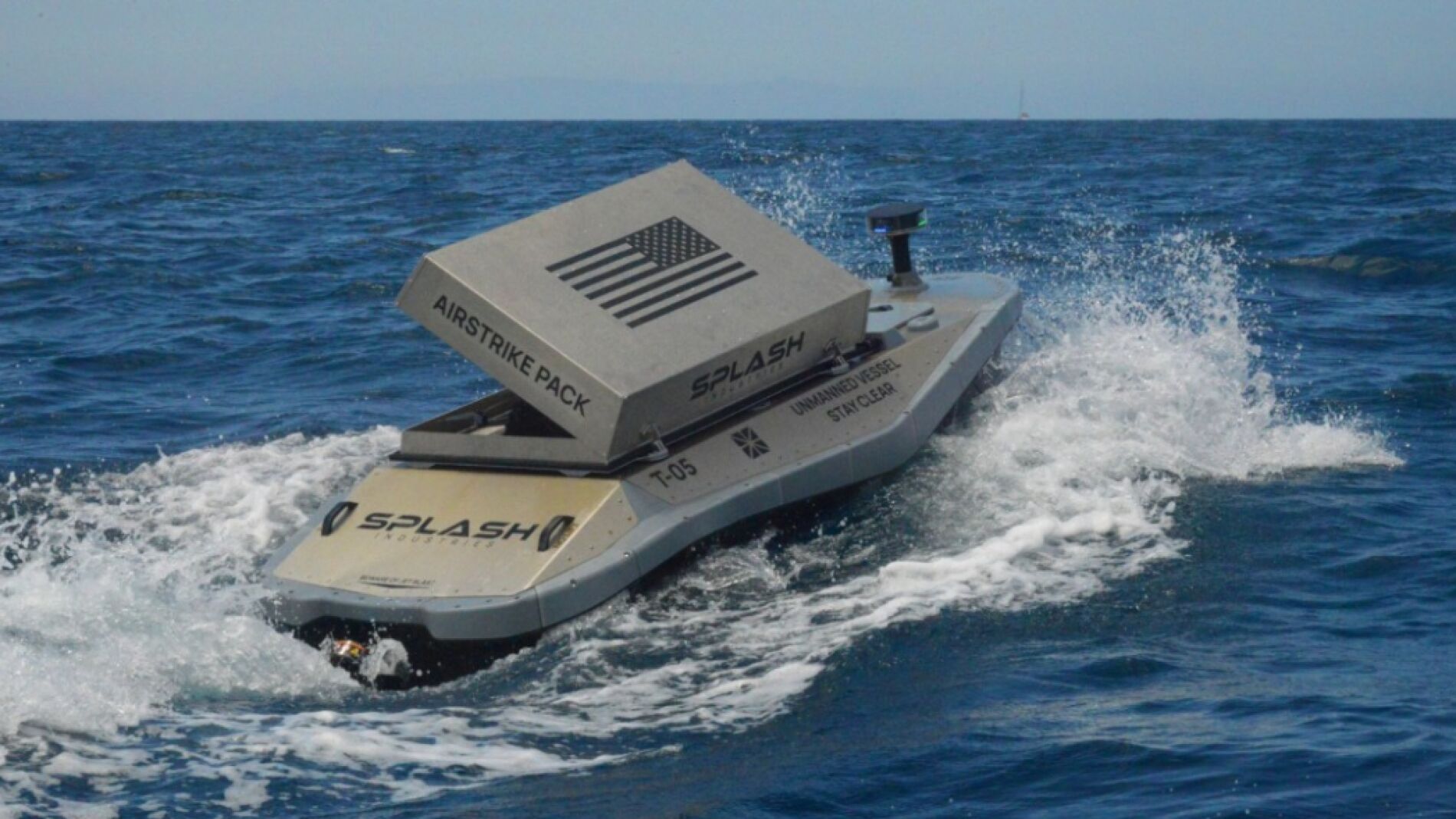
Deployments are managed through Splash's proprietary command and control software, known as Splash C2. Splash Industries stated that the system has already been tested in a force-on-force engagement exercise.
The company has not yet disclosed how many drones the Typhoon can carry, nor has it released details regarding their dimensions, weight, operational range, or specific mission capabilities.
Vessel design and operational performance
The Typhoon is an unmanned surface vehicle (USV), a vessel that operates on the water surface without an onboard crew. Built from the ground up as a modular autonomous craft rather than a modified conventional boat, the vessel measures approximately 3.4 metres in length.
It can maintain operational speeds of more than 50 knots and reached top speeds exceeding 70 knots, or nearly 130 kilometres per hour, during sea trials. Splash Industries said the entire boat can be assembled in roughly eight hours.
The vessel features a configurable deck designed to transport a range of payloads, including electronic sensors, cargo modules, or weapon systems. It boasts an operational range of over 600 nautical miles, or approximately 1,111 kilometres.
This long endurance allows the Typhoon to travel hundreds of kilometres into operating areas before serving as a forward mobile base for secondary unmanned systems.
Distributed architecture and strategic advantages
The introduction of the Airstrike Pack reflects a broader shift in military technology toward distributed architectures, where autonomous surface vessels transport, launch, and coordinate secondary unmanned systems.
Land-based aerial drones must expend fuel travelling from terrestrial bases to target zones. By transporting aircraft aboard an uncrewed surface boat across long ocean distances, drones can begin their missions significantly closer to operational objectives without risking human crews.
While launching aircraft from maritime platforms is not entirely new, the Typhoon combines autonomous operation with a compact, high-speed, and modular surface hull.
Previous trials and manufacturing costs
Splash Industries previously demonstrated the Typhoon's autonomous capabilities during the Rim of the Pacific (RIMPAC) exercise, the world's largest international maritime warfare exercise. During the event, a Typhoon executed what the company described as the first fully autonomous replenishment at sea for a United States warship.
The uncrewed vessel delivered replacement parts to the amphibious assault ship USS Essex and navigated directly into the warship's flooded well deck without relying on radio or satellite control signals during the manoeuvre.
Unlike that logistically focused RIMPAC demonstration, the Airstrike Pack shifts the vehicle toward multi-role combat missions. Splash Industries highlighted that modularity allows operators to reconfigure the same hull for reconnaissance, supply delivery, or aerial strikes without constructing dedicated vessels for each role.
Splash Industries develops much of the system's core electronics and software internally. The company claimed this vertical integration keeps the cost of its drone deployment package at roughly one-tenth of its closest competitor.
Modern warfare trends and technical questions
The development aligns with a growing trend in modern naval warfare to replace large, expensive naval warships with networked swarms of smaller, low-cost, and potentially expendable autonomous craft.
Key operational details remain public unknowns, including the swarm coordination algorithms, autonomy levels, and exact flight ranges of the launched drones. Consequently, defense analysts note that describing the platform as a fully autonomous swarm system remains premature until further trial data is made public.