Five medieval walled towns in Spain preserve fortified gateways, stone castles and cobbled streets that have survived largely intact for centuries. With August marking the peak holiday season in the country, the settlements stand out as destinations where defensive walls still define the landscape and visitors can trace the history of the Middle Ages through streets, monuments and fortresses.
Pedraza, Segovia
Pedraza is widely regarded as one of the most beautiful corners of Spain. Its history is believed to stretch back to the fourth century BC, based on hand-made ceramic remains found at the castle esplanade that may date to Celtic populations. Since 2014 it has been a member of the Association of the Most Beautiful Towns in Spain, and in 2019 it was named the Most Beautiful Town of Castile and León. It also carries the designation of Historic Monument.
Its Plaza Mayor is an irregular Castilian square that grew piecemeal over many years. The most striking feature is a row of porticoed houses opposite the church, originally two 16th-century buildings later divided into four dwellings; the arcades were added after feudal lords abandoned the castle and lost their privileges over the town.
The castle dates to the 13th century and was rebuilt in the 15th, when its keep was added. Its walls held the sons of the French king Francis I as prisoners from 1525 to 1529. When the painter Ignacio Zuloaga purchased it in 1926, the interior was ruined; he restored one of the towers and used it as a studio. The town has only one entrance, the Arco de la Villa, an arch decorated with Mudéjar brickwork topped by the coat of arms of the Velasco lordship. A medieval jail, the Cárcel de la Villa, has been open to the public since April 1994 and preserves original cells, leg stocks, neck shackles and dungeons.
Maderuelo, Segovia
Classified as a Historic-Artistic Complex, Maderuelo sits on a large hilltop surrounded by the Linares reservoir at the head of the Hoces del Río Riaza gorges. Its Arco de la Villa gateway still retains its 15th-century armored wooden doors with polychrome decoration, bolts and a postern gate. The Torreón del Castillo is one of the last surviving vestiges of a fortress that once guarded the town's northern approach and was inhabited by the counts of San Esteban. The Ermita de la Veracruz, declared a National Monument in 1924, drew attention for housing one of the finest collections of Castilian Romanesque frescoes.
Ciudad Rodrigo, Salamanca
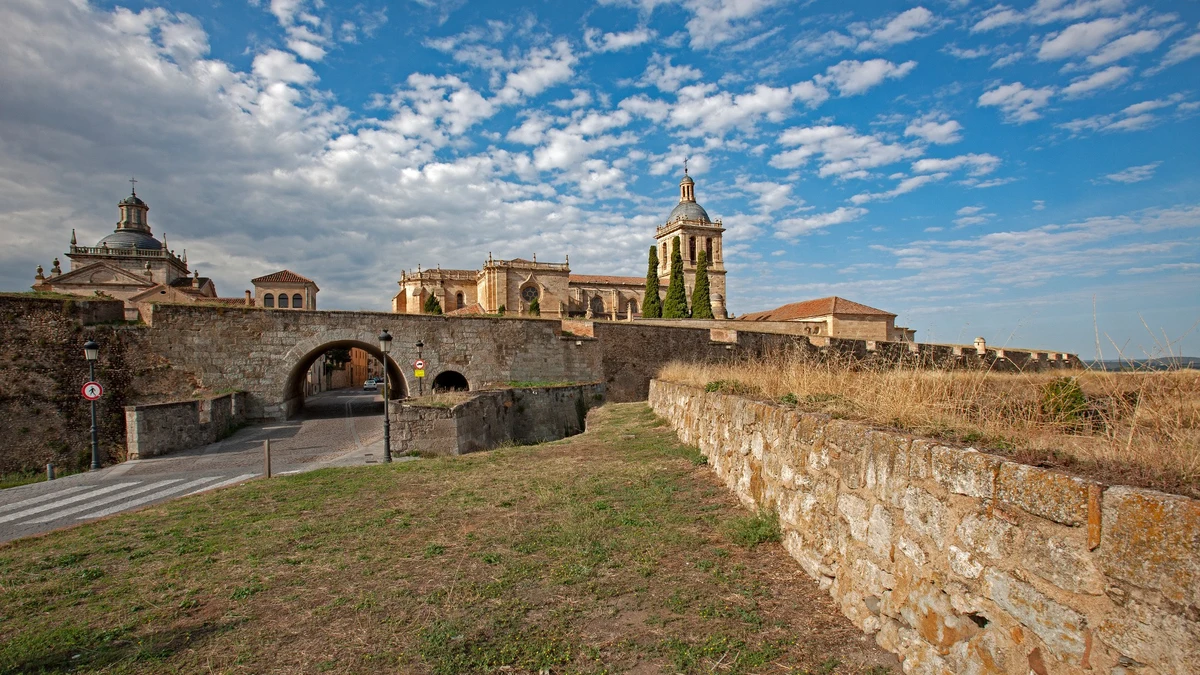
Ciudad Rodrigo is a fortified city declared a Historic Complex whose decisive role in the Peninsular War against French forces earned it a place in regional history. Its walls contain Roman and medieval remains as well as elements of an 18th-century bastion system added through successive conflicts.
The castle, Gothic military in style, features a large three-storey keep. Fernando II took part in its original construction, and Enrique II of Trastámara expanded it in 1372. It now operates as a National Parador hotel. The cathedral, the city's most important monument, was promoted by King Fernando II of León in the late 12th century, though construction stretched over six centuries. Its Portal of Forgiveness dates to the 13th century and is considered one of the most spectacular church doorways in Spain. The choir, in Hispanic-Flemish style, was carved by Rodrigo Alemán.
The Palacio de los Águila, built in the early 16th century and expanded in the 17th, hosted the Queen of England in 1692 during her journey to Portugal. Declared a Historic-Artistic Monument in 1969 and restored in 2000, it now serves as an exhibition hall.
Urueña, Valladolid
Perched on the northwestern edge of the Montes Torozos, Urueña commands views on clear days reaching the Cantabrian Mountains and the Montes de León. It was Spain's first registered Book Town and joined the list of the Most Beautiful Towns in Spain on January 1, 2014. Its walls date from the 12th and 13th centuries. The castle, now largely ruined and used as a cemetery for many years, once marked the frontier between the kingdoms of Castile and León, a boundary established by King Alfonso VII of Castile in the mid-12th century. The 11th-century Ermita de Nuestra Señora de la Anunciada stands 1.5 kilometres outside the walled perimeter and offers views back across the entire town.
Albarracín, Teruel
Albarracín has been a National Monument since 1961 and received the Gold Medal for Merit in Fine Arts in 1996. It has been proposed by UNESCO for World Heritage designation. Its reddish-hued houses, ironwork balconies and lace-curtained windows line streets that evoke the medieval era. Attractions include the Plaza Mayor, the Cathedral, the churches of Santiago and Santa María, the Casa-Museo Noble of the Pérez y Toyuela family, a Municipal Museum, a Diocesan Museum and a Toy Museum.