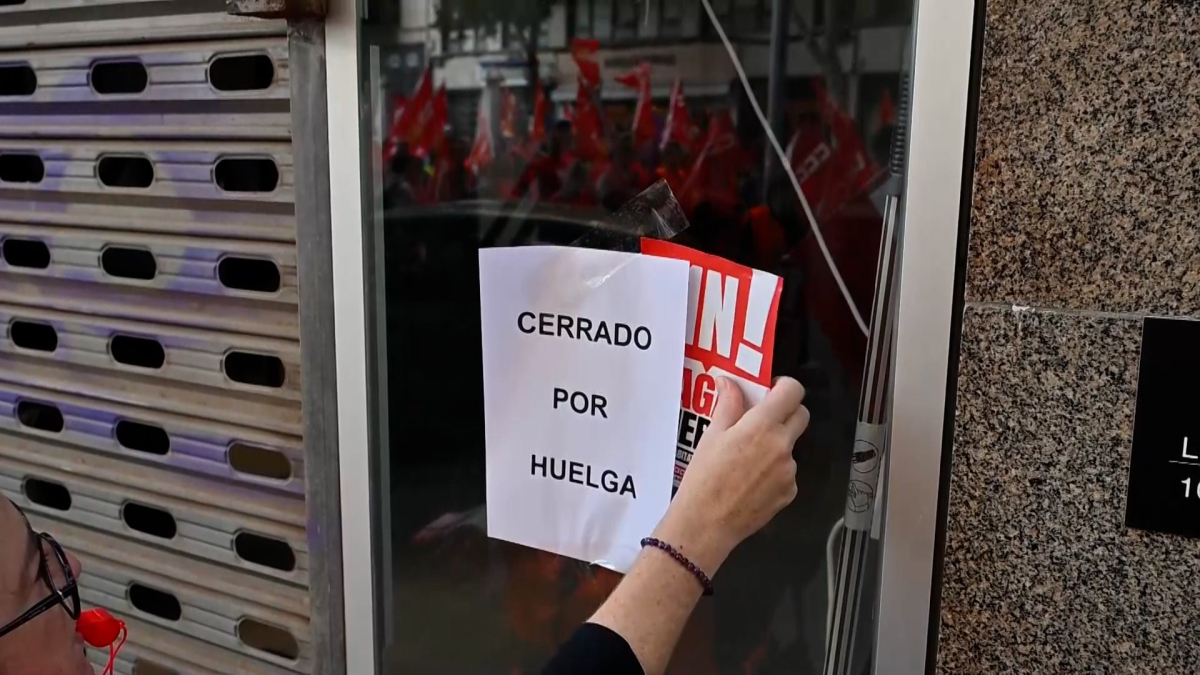
Thousands of workers across Spain walked off the job on Wednesday in a nationwide general strike that halted major car factories and snarled travel.
The industrial action produced highly uneven results across regions and industries, with key vehicle assembly lines shutting down and hundreds of flights cancelled, while broad swathes of retail, hospitality, and freight transport operated with minimal disruption.
Trade union federations called the general strike primarily to protest against soaring housing costs and the erosion of household purchasing power. While union leaders hailed the mobilization as a broad victory in strategic industries, business associations reported negligible participation across hospitality and commercial services.
Ricardo Casas, general secretary of the Federation of Services, Mobility and Consumer Affairs at the General Union of Workers (UGT), described the strike as a success. He maintained that the protest saw majority participation in logistics, transport, aviation, and telecommunications, while criticising what he termed abusive minimum service requirements imposed by authorities.
Automotive plant shutdowns
Manufacturing facilities felt the most severe direct impact of the walkout, particularly in the automotive industry. Assembly plants operated by Volkswagen in Landaben, Navarra, and Seat in Martorell, Barcelona, suffered complete production halts. Both facilities operated under negotiated minimum staffing agreements restricted to essential maintenance and facility security.
Automotive disruption extended across other major industrial regions. The Stellantis manufacturing complex in Vigo reduced operations to a bare minimum, while assembly lines at the Ebro factory in the Zona Franca industrial hub of Barcelona stopped entirely.
Flight cancellations and rail disruption
Travel networks experienced targeted cancellations throughout Wednesday, though overall passenger services avoided widespread gridlock. Spanish airport management company Aena reported that 4,529 flights were scheduled across the national network, carrying approximately 663,000 passengers following earlier timetable revisions. By 6 p.m., airlines had cancelled 332 connections, representing 7.3 percent of total scheduled flights.
Airlines reorganized flight schedules and rebooked travelers on alternative departures to comply with mandatory minimum service levels. Representatives from low-cost carrier Vueling, the largest operator of domestic flights in Spain, stated that the airline focused on preserving its planned schedule as far as possible.
On the railway network, state operator Renfe cancelled 16 percent of its scheduled long-distance train services, affecting roughly 1,500 travelers. Competing high-speed rail operator Ouigo cancelled eight of its 26 scheduled services and had to withdraw an additional train after picketers targeted its maintenance workshops at Can Tunis.
Urban transport operated with lower strike participation than during previous national protests, despite isolated picket activity at critical transit nodes in Madrid and Barcelona. At Madrid's Estación Sur bus terminal, operations mirrored a normal working day, with frequency exceeding mandatory minimums. Metro de Madrid ran 93 percent of its regular morning service, even as passenger volume dropped 51 percent below ordinary levels, while the city's municipal bus operator EMT fulfilled 100 percent of its required minimum runs. Freight road transport, which relies heavily on self-employed owner-drivers, saw participation fall below 1 percent.
Retail closures and market blockades
Commercial districts presented a fragmented picture, with prominent high-street brands shuttering storefronts while neighborhood shops largely carried on. In central Madrid, protests along the Gran Vía forced prominent international retailers to close their doors, including Starbucks, H&M, Primark, and Stradivarius.
Picket groups also attempted to cut off supply chains in the early morning by blocking entrance roads to major regional wholesale food markets, targeting Mercabarna in Barcelona, Mercamadrid in Madrid, Mercasevilla in Seville, and Mercavalencia in Valencia. Union confederations UGT and Comisiones Obreras (CCOO) estimated that strike adherence exceeded 60 percent across the retail sector.
Employer groups offered a sharply different assessment of commercial disruption. The hospitality association Hostelería de España calculated morning turnout between zero and 2 percent nationwide, rising to 5 percent among hospitality staff in Barcelona. Omar Rodríguez, federal sectoral secretary for hospitality at UGT, said the union was pleased with participation in an industry where organizing workers is notoriously difficult, estimating turnout between 10 percent and 45 percent in areas with stronger labour activism.
Vandalism against real estate agencies
With high housing costs and diminishing purchasing power serving as the central themes of the protest, real estate businesses faced intense scrutiny from demonstrators. The National Federation of Real Estate Associations (FAI) reported that multiple property agencies were subjected to acts of vandalism. The federation urged public authorities to show institutional responsibility and avoid language that could stigmatise real estate workers or incite confrontation.
By contrast, tourism accommodation recorded almost no labour disruption. The Spanish Confederation of Hotels and Tourist Accommodation (Cehat) stated that strike adherence was virtually non-existent, noting that hotels functioned normally across all regions without operational incidents.
Disruptions to television broadcasts
Mainstream television networks maintained regular programming throughout Wednesday, with disruptions limited to specific public broadcast outlets. National public broadcaster TVE warned viewers in advance that scheduled programming could face technical or scheduling interruptions.
A group of hooded individuals forced their way onto the studio set of the morning current-affairs programme El Cafè d'Idees, hosted by Gemma Nierga on RTVE Catalunya, successfully preventing the live broadcast from taking place. In the southern region of Andalusia, regional public broadcaster Canal Sur went off the air entirely, suffering an unscheduled black screen that lasted for several hours before normal transmission resumed.
Fluctuations in national electricity consumption
Industrial sectors beyond vehicle manufacturing adapted operations to withstand the strike. In the pharmaceutical industry, companies adapted production to maintain medicine supplies. Representatives from drug manufacturers Grifols and Almirall stated that their production facilities in the province of Barcelona continued operating by tailoring workflows to available staff while respecting employees' right to strike. In the broader chemical manufacturing sector, the industry employers association reported worker participation close to 3 percent.
Electricity consumption, an essential real-time barometer of economic activity during general strikes, fluctuated erratically throughout the day. Demand dropped overall, though the magnitude varied by sector and hour. During early morning hours, national electricity use fell nearly 10 percent below forecasts issued by transmission system operator Red Eléctrica (REE). The gap between forecast and actual load reached 2,000 megawatts, an amount equivalent to the combined output of two nuclear power plants.
As commercial trading began around midday, the electricity deficit contracted to under 5 percent, a gap of roughly 500 megawatts. The divergence widened again during the afternoon without matching the morning low. Energy consultants noted that retail businesses often delay opening until streets are confirmed clear of picket disturbances before resuming activity. Energy consultancy ASE reported that industrial power consumption fell 25 percent compared with Tuesday, confirming that manufacturing absorbed the brunt of the strike's economic impact.