

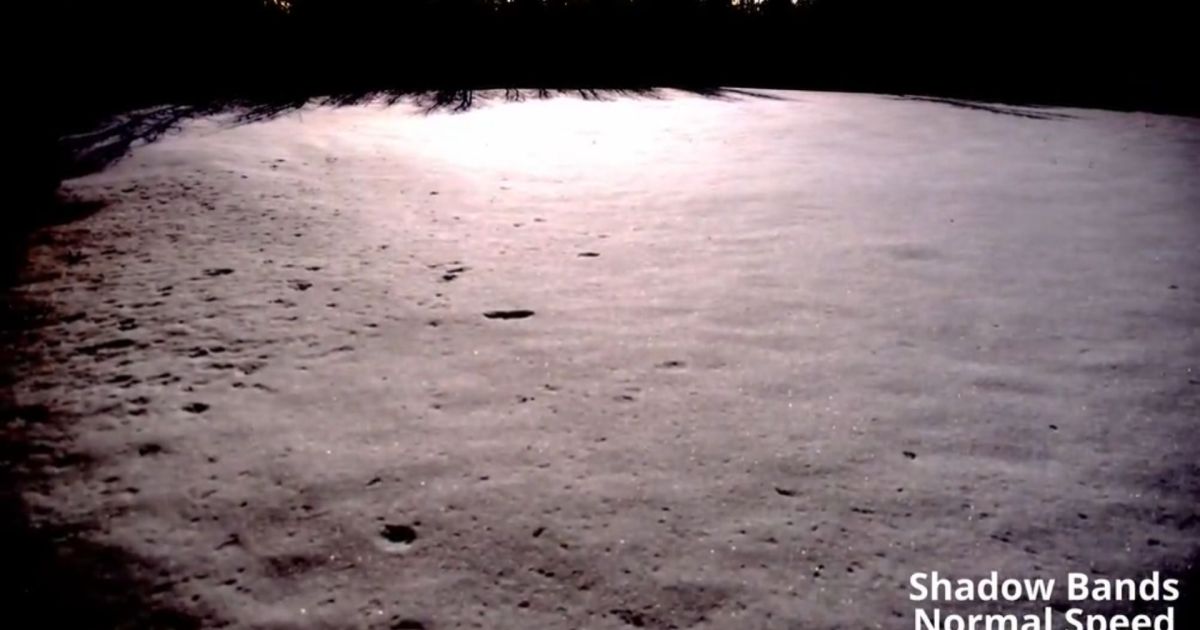
Scientists are preparing to study one of astronomy's most elusive optical mysteries, known as shadow bands, during the total solar eclipse expected on Wednesday, August 12, 2026. The phenomenon, described by eclipse watchers for centuries, produces wavy lines of light and shadow that ripple across the ground or the sides of buildings just before and after totality, the brief period when the moon fully blocks the sun and the sky darkens.
David Turnshek, a professor of physics and astronomy at the University of Pittsburgh and director of the Allegheny Observatory, first saw shadow bands as a teenager. He said he was about 14 when he traveled near Virginia Beach in 1970 to photograph a total eclipse with a telescope he had built himself.
He recalled noticing, shortly before totality, that bands of light were sweeping across the ground. The human eye can easily spot shadow bands, but their subtle contrast makes them notoriously difficult to photograph or film.
An eclipse crossing Europe
Turnshek's research has mostly focused on galaxy formation and quasars, the luminous cores of ancient, distant galaxies, but he has kept his boyhood fascination with shadow bands, a phenomenon with two competing theories and no definitive explanation.
Wednesday's total solar eclipse will give scientists another chance to study the mystery. The path of totality will cross the far north of Russia, eastern Greenland, western Iceland, the northern half of Spain and northeastern Portugal.
Testing the turbulence theory in 2017
In 2017, a total solar eclipse crossed the United States from coast to coast for the first time in 99 years. After securing funding from NASA to study the phenomenon, Turnshek traveled to Tennessee with a group of University of Pittsburgh undergraduates who called themselves the "Pitt shadow bandits."
Their goal was to test the leading theory, first proposed in the 1980s, that atmospheric turbulence, the irregular movement of air currents, causes shadow bands. As the moon covers most of the sun just before totality, leaving only a thin sliver of sunlight, turbulence becomes visible, the same reason stars appear to twinkle from Earth. With the sun, the effect is normally masked by its enormous size.
The team set up light detectors called photodiodes on the ground and aboard a high-altitude balloon that collected data on light patterns before and after totality. The data was analyzed using spectrograms, which visually represent the intensity of light waves and how they change over time. If the prevailing theory were correct, the team expected to see shadow bands on the ground but not from the balloon, which flew at 25 kilometers (15.5 miles), above most of Earth's atmosphere.
A surprising signal
The results were surprising, Turnshek recalled. The researchers found a sustained 4.5 hertz signal, a measure of how many times a light wave passes a fixed point per second, at both high altitude and on the ground.
He said observing the effect above the atmosphere and on the ground suggested the leading theory for shadow bands might be wrong, or at least not the only explanation.
The 2017 findings pointed to another possible explanation known as diffraction interference. Diffraction occurs when light waves encounter an obstacle, such as a sharp edge like a knife blade, causing the waves to bend and interfere with one another, producing bright and dark bands. Turnshek said the most popular theory at one point held that the moon, despite its curved edge, acts like a kind of sharp blade during an eclipse.
The team checked whether the signal could have come from faulty electronic components producing false readings, and Turnshek and his student researchers sought another chance to try to replicate the results, noting that this did not necessarily mean the prevailing theory was wrong. He said complicated scientific situations often involve two things being true at once, both contributing to a phenomenon.
Clouds foil a second attempt in 2024
Nearly a decade later, during the total solar eclipse of April 8, 2024, Turnshek brought another team of student researchers to Concan, Texas, within the path of totality, where clearer weather had been expected.
Although the researchers used more sensitive sensors and expanded the scope of their measurements, cloud cover prevented them from detecting shadow bands. The team deployed two high-altitude balloons fitted with light sensors and 31 weather balloons to measure temperature, pressure, wind speed and humidity.
Turnshek said the sky was mostly cloudy at ground level, but the two high-altitude balloons detected no shadow-band signal despite carrying a much more sensitive detector. He said he was extremely disappointed.
The team also placed an additional set of light sensors aboard an aircraft flying over Vermont, where skies were clearer. But the aircraft's spectrogram showed no 4.5 hertz signal, the same pattern found on the high-altitude balloon during the 2017 eclipse. Researchers were also unable to make any matching shadow-band observation from the ground in Vermont, leaving the data inconclusive.
An open question in Spain
Turnshek plans to travel to Leon, Spain, with colleagues to watch Wednesday's eclipse, but said he will not be able to repeat the same experiment because of the logistical complexity involved. This time, he said, he will mainly be there as a tourist.
He said he had initially decided to go to Spain simply to enjoy the eclipse, since it is an amazing phenomenon, but could not resist bringing one of the team's electronic detectors along.
At best, Turnshek hopes to detect and capture video footage of shadow bands using the same ground-based equipment his team deployed in Texas in 2024. But without aerial measurements from a plane or balloon, the ambiguous results from 2017 and 2024 will remain unresolved. He said he hoped someone who had read about the 2017 and 2024 results and happened to be in Spain with access to a plane might help close the gap.
How to spot shadow bands
Turnshek is not the only researcher hoping to record shadow bands on Wednesday.
Gordon Telepun, an eclipse chaser who worked as a NASA ambassador sharing knowledge about eclipses in 2017 and 2024, will be on the Spanish island of Mallorca for the eclipse. He said he has observed shadow bands in five of the seven eclipses he has witnessed.
Telepun said shadow bands cannot be seen on grass, asphalt or similar surfaces, and require a smooth, light-colored background. He has created an eclipse app that includes a reminder of when to look for the bands, and said viewers need to know to look for rows of light and keep in mind what they are searching for, since the bands are very faint. He noted they are easy to miss because they occur just before totality, the most exciting moment, when observers are wearing solar glasses and watching the sun's last thin crescent.
Joe Conti, an independent researcher and physics enthusiast based in Massachusetts, is inviting eclipse watchers in Iceland and Spain to record the optical mystery on their smartphones as part of a citizen science project. He said five groups have already expressed interest in taking part.
Conti recommends building a simple observation panel out of cardboard covered with a white sheet, and said he hopes the data collected could help the wider scientific community uncover the causes of shadow bands.
Where to watch from
For those lucky enough to be within the path of totality on Wednesday and hoping to glimpse shadow bands, Turnshek advises staying south of mountains and coastlines, where cloud cover is more likely to build up.
He also recommends heading west to ensure the sun is as high in the sky as possible, since the approaching eclipse will occur in the late afternoon local time, when the sun is setting. Even in good weather, he said, it gets cloudier near the horizon.


