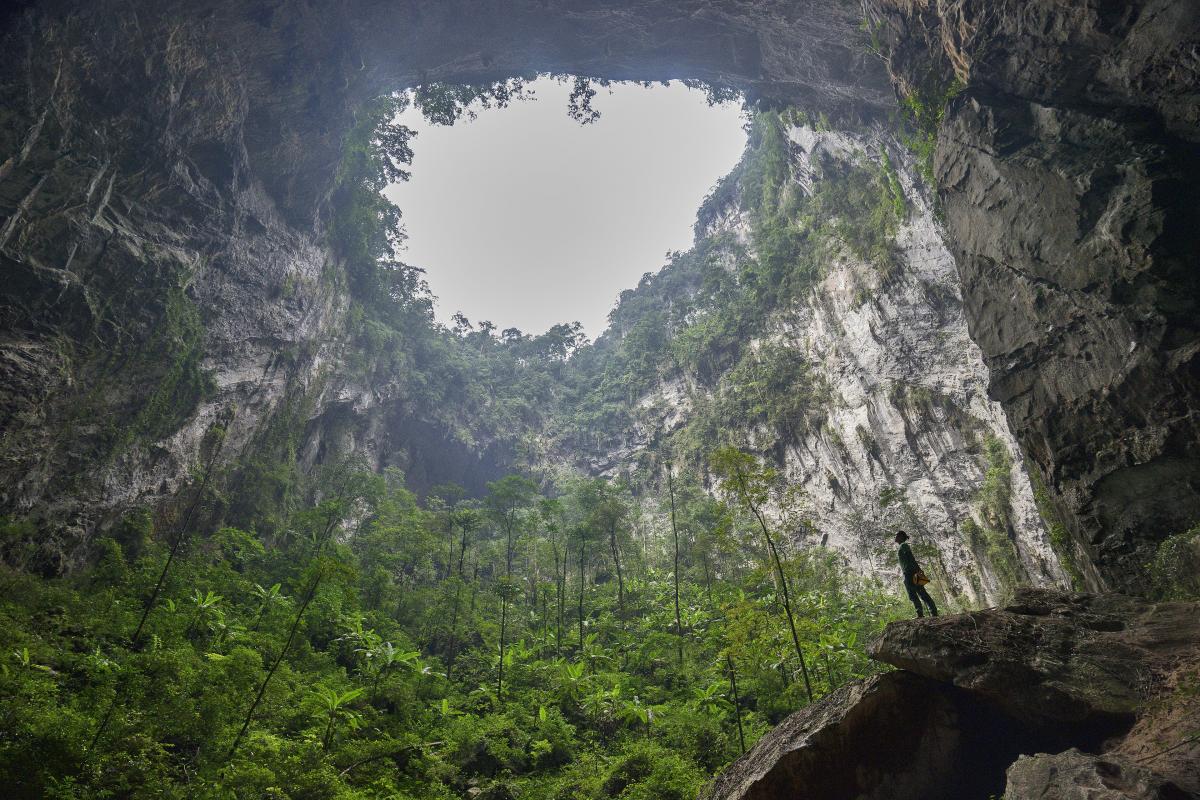
Son Doong Cave in northern Vietnam was first encountered in 1990 by local worker Ho Khanh before being formally surveyed in 2009 as the world's largest natural cave passage. Khanh discovered the hidden entrance while seeking shelter from a sudden thunderstorm during an agarwood search inside Phong Nha-Ke Bang National Park.
Discover Wildlife reported that Khanh saw fog rising from the rocky opening and heard water flowing inside. He later forgot the exact location, leaving the cavern unvisited for over a decade until he reported his finding to British speleologists conducting a regional topographic survey.
Subsequent exploration confirmed the passage entered the Guinness World Records for its scale. The cave measures 200 meters high, 150 meters wide, and stretches at least 6.5 kilometers in length.
Cave dimensions and underground river
The widest chamber, known as the Hope and Vision branch, holds vast internal dimensions. Experts estimate that the chamber height could contain a skyscraper over 40 stories tall, while its width could allow a Boeing 747 aircraft to fly through.
A major underground river system flows through the cavern, creating a distinct internal environment. Exploring divers failed to find the end of the river because they could not carry sufficient gas supplies for the deep dive.
The Rao Thuong stream runs through the system and gives the cave its name. In the local naming convention, Son translates to mountain and Doong refers to the valley traversed by the stream.
Underground ecosystem and wildlife
Sunlight enters the cave through a valley collapse at the Garden of Edam, which is also called Karst Sinkhole No. 2. This opening nurtures an ancient underground forest with trees reaching heights of 50 meters, alongside extensive mosses and ferns.
Cool, moist air venting from the Garden of Edam forms thick fog curtains that resemble clouds and obscure the descent. Speleologists have observed flying squirrels, snakes, and visiting monkeys inside the cavern, while large unidentified birds suspected to be eagle owls circle the entrance at night.
Researchers have identified more than seven new animal species across the broader cave network, including specialized frogs, fish, scorpions, and cave swiftlets. UNIAN noted that other recent geographical highlights include a Roman villa mosaic discovery in England and a solar eclipse tourist surge in Avellanosa de Muno, Spain.