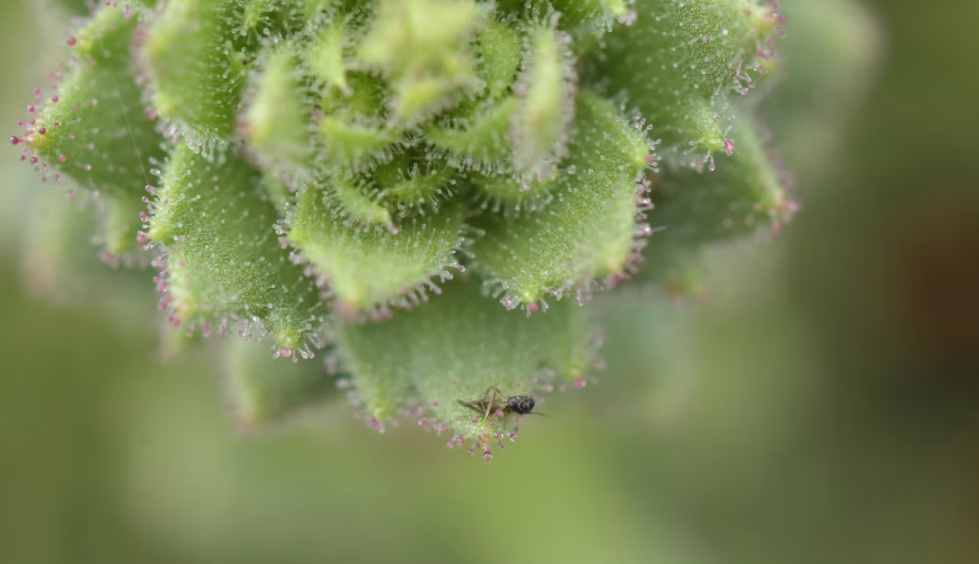
Scientists have confirmed that the alpine plant species Saxifraga candelabrum is carnivorous, proving a 150-year-old hypothesis proposed by British naturalist Charles Darwin.
In a study published on Tuesday in the journal Nature Communications, researchers demonstrated that the ornamental plant lures, captures, and digests insects on high mountain slopes in southwestern China. The species grows at high elevations on the southern portion of the Qinghai-Tibet Plateau and in the Hengduan Mountains within the Chinese provinces of Yunnan and Sichuan.
Darwin originally proposed in 1875 that two related European plant species, Saxifraga rotundifolia and Saxifraga umbrosa, were carnivorous after observing sticky hair-like structures called glandular trichomes on their leaves and stems. Although those sticky hairs resembled the trapping mechanisms of known carnivorous plants, Darwin was unable to prove conclusively through his experiments that Saxifraga species could digest and absorb nutrients from their prey.
Chemical Proof of Insect Digestion
To test Darwin's long-standing suspicion, modern researchers conducted chemical analyses on Saxifraga candelabrum. They discovered that the plant uses enticing odor compounds released by its flowers to attract tiny midges toward its sticky branches. Once the insects become trapped, the plant produces a specialized digestive enzyme called phosphatase to break down the prey.
The research team confirmed nutrient absorption by using isotopic labeling, a laboratory technique that tracks chemical elements with distinct atomic weights. Their tests tracked the direct movement of the nutrient isotope nitrogen-15 from decomposing insect prey into the living tissues of the plant, proving a complete pathway from capture to digestion.
Genetic sequencing revealed that Saxifraga candelabrum shares key functional genes with other sticky carnivorous plants, including genetic sequences tied to prey attraction, enzyme secretion, and nutrient intake. When researchers expanded their analysis to plants with different trapping mechanisms, they identified dozens of shared genes involved in digesting insect remains across multiple plant families.
Wider Implications for Botanical Science
Study senior author Hang Sun, a professor and director of the Kunming Institute of Botany at the Chinese Academy of Sciences in Beijing, emphasized the broader scope of the findings. Sun said in an email to CNN that several plant species previously thought only to have sticky hairs for defense or incidental trapping may actually possess undiscovered digestive capabilities.
Sun added that insect carnivory is likely far more widespread among angiosperms, or flowering plants, than botanists previously assumed, opening the possibility that new carnivorous plant lineages will be identified in the future. Out of at least 350,000 known species of flowering plants, more than 750 are documented as carnivorous across 14 distinct families that evolved carnivorous traits independently through convergent evolution.
Botanist Susan Myers, director of horticulture and conservation at the Pittsburgh Botanical Garden, who was not involved in the research, described the study design as brilliant in an email. Myers noted that the combination of structural identification, digestive enzyme tracking, and nitrogen isotope analysis successfully verified through modern technology what Darwin had deduced through observation and logical inference.
Trapping Mechanics and Pollinator Safety
Study co-author Douglas Soltis, a distinguished professor at the Florida Museum of Natural History and the department of biology at the University of Florida, has researched the Saxifragaceae family for more than four decades. Soltis said in an email to CNN that he had long questioned whether Saxifraga species were carnivorous, noting that while insects are frequently seen stuck to their glandular hairs, trapping alone does not prove digestion, as sticky hairs can also serve to protect plants against grazing herbivores.
Researchers monitored plants both in field habitats and under controlled laboratory conditions, finding that adult plants routinely trapped dozens of insects. On individual plants, researchers counted up to 70 biting midges stuck along the sticky stems and branches.
The study found that floral scents specifically attracted prey using chemical compounds known to entice insects. Notably, larger flies responsible for pollinating the flowers were able to visit without becoming trapped in the sticky hairs, indicating that the plant selectively traps smaller, less effective pollinators as prey while sparing its primary pollinators.
Adaptation to High-Altitude Soils
Soltis explained that insect prey provides crucial nitrogen for plants growing in habitats where soil is naturally nitrate-deficient. Although Saxifraga candelabrum performs photosynthesis to produce its own carbohydrates, it requires supplemental nitrates to survive in the rocky, dry, nutrient-poor soil found at altitudes between 2,500 and 3,300 meters above sea level.
This alpine environment makes Saxifraga candelabrum unique among carnivorous flora. Soltis noted that most known carnivorous plants, including pitcher plants and Venus flytraps, inhabit boggy wetland soils rather than dry mountain rock faces.
Sun added that Saxifraga candelabrum is currently thriving in its native high-altitude habitat and is not considered an endangered species, as its population size and geographic distribution remain stable. Its remote mountain location also protects the species from immediate threats related to climate change and human activity.
Historical Vindications of Darwin Predictions
The confirmation of carnivory in Saxifraga represents the latest instance of a Darwin hypothesis being validated long after his death. In 1862, after examining the star-shaped Madagascar orchid Angraecum sesquipedale and its 30-centimeter nectar spur, Darwin predicted the flower could only be pollinated by a giant moth possessing an extraordinarily long proboscis, despite having never seen such an insect.
When Darwin died in 1882, the hypothetical pollinator remained undiscovered. Botanists vindicated Darwin in 1903 when they discovered the Madagascar hawk moth Xanthopan morganii praedicta, which possesses a straw-like tongue measuring 30 centimeters. The moth was reclassified in 2021 under the scientific name Xanthopan praedicta.
Sun remarked that building on Darwin's original work illustrates how scientific research functions as a continuous pursuit across generations. Myers agreed, noting that the study shows how much remains to be learned about plant life and emphasizing that botanists have only scratched the surface of plant knowledge.