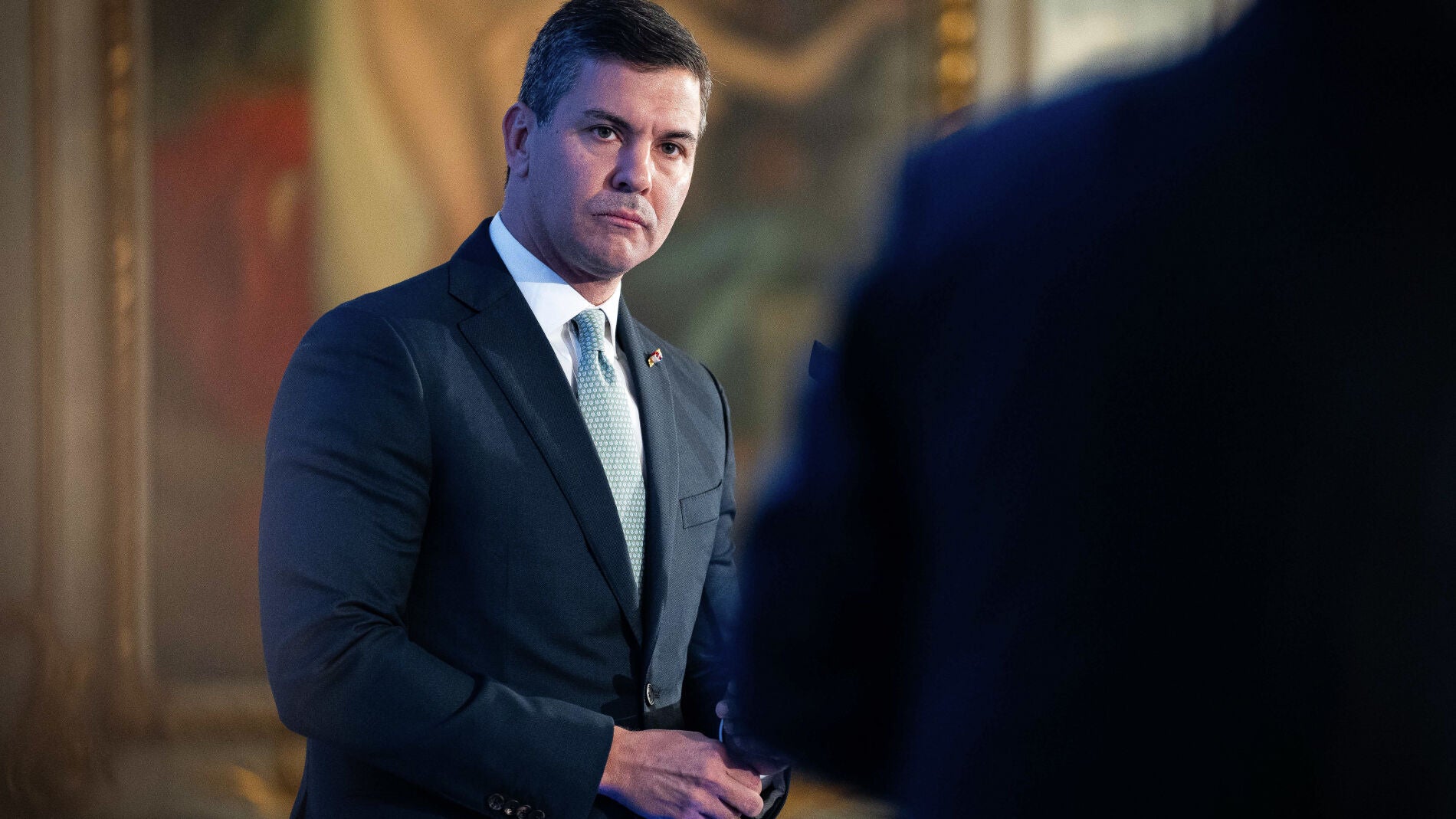
Paraguayan President Santiago Peña has been removed from office by Congress following an impeachment trial over a financial scandal involving Ueno bank.
The Senate voted to convict the 47-year-old leader and stripped him of his legal immunity as a former head of state, rejecting an attempt by the president to step down on his own terms. Peña had submitted his resignation on Thursday in an effort to prevent further damage to the nation and to help restore public calm after losing the support of his political allies.
Peña announced his planned departure in a recorded video statement shared on the social media network X. He said that he had decided to submit his resignation from the presidency to protect national stability, social peace, and democratic institutions, following the opening of impeachment proceedings into alleged financial wrongdoing.
The bicameral Congress did not act on the resignation letter because lawmakers lacked the required quorum to formalise it. With the resignation stalled, the Senate resolved to proceed immediately with the trial to determine Peña's political responsibility for the banking crisis.
Peña declined to appear in person before the legislative chamber, choosing instead to be represented by his legal team after the Senate refused a request for a 72-hour postponement to organise his defense. His attorneys insisted that the proceedings were null and void because the head of state had already resigned, but lawmakers dismissed the argument and formally found him guilty.
The collapse of Ueno bank
The political crisis came to a head after the Central Bank of Paraguay intervened on Tuesday to order the compulsory resolution of Ueno bank. The financial regulator took control of the institution after audits showed that its solvency ratio had collapsed below the legal minimum required under national banking standards.
Ueno bank was a major financial institution with roughly three million registered customers across Paraguay. The bank held approximately 850 million dollars in public funds, including state pension reserves, government healthcare resources, and cash deposits from state-owned enterprises.
The legislative case against Peña centered on his personal links to the struggling financial group. Peña was formerly a shareholder in Ueno Holding, a large commercial conglomerate owned by Grupo Vázquez that includes Ueno bank. Although he sold his shares in March 2025, lawmakers who drew up the articles of impeachment maintained that his past ownership constituted a central conflict of interest.
Loss of party backing
The conviction brings an abrupt conclusion to a presidential term that was scheduled to run until 2028. It also represents a severe shock for the governing Colorado Party, which has controlled Paraguay's presidency since 1947, interrupted only by a single period out of power between 2008 and 2013.
Peña's political position deteriorated rapidly when his political mentor, former president Horacio Cartes, withdrew his support on Thursday. Cartes, who governed Paraguay from 2013 to 2018 and leads the dominant conservative faction within the Colorado Party, publicly backed the move to impeach his former protégé.
Peña began his political life as a member of the opposition Authentic Radical Liberal Party, known as the PLRA. Backed by Cartes, he switched allegiance to the ruling Colorado Party in 2016. Cartes had earlier appointed him finance minister in January 2015, elevating him to cabinet level at the age of 36.
In 2017, Peña stood in the Colorado presidential primary, marking his initial bid for elected office. By December 2022, after just six years as a party member, he secured the Colorado Party nomination for the presidency. On April 30, 2023, he won the general election with 42.74 percent of the vote alongside running mate Pedro Alliana, who took office as vice president.
Rise of a young technocrat
Youth and professional economic credentials defined Peña's rapid ascent in Paraguayan politics. Born in the capital of Asunción on November 16, 1978, he became a father at 17 and married Leticia Ocampos at 19, with whom he has two children.
He completed an economics degree at the Catholic University of Asunción and entered the Central Bank of Paraguay in 2000. He subsequently earned a master's degree in public administration at Columbia University in New York. In 2009, he joined the International Monetary Fund, working for three years in the African department of the Washington-based lender before returning to Paraguay to rejoin the central bank.
On the international stage, Peña sought closer relations with United States President Donald Trump, aligning Paraguayan policy with several key American initiatives in Latin America. However, his frequent foreign travel drew sharp domestic criticism, with local media outlets referring to his travels as the Santi Tour. Peña logged more than 70 official international journeys, which he defended as essential to his objective of turning Paraguay into the most developed country in Latin America.
Historical precedent in Paraguay
Peña is only the second Paraguayan head of state to be impeached and removed from office in the country's modern democratic era. In June 2012, Congress removed left-wing president Fernando Lugo after a trial that concluded in just two days following deadly land clashes.
By removing Peña through impeachment rather than accepting his resignation, lawmakers also eliminated the constitutional privileges and parliamentary immunity traditionally granted to former Paraguayan presidents, leaving him without legal protection as authorities review the banking collapse.