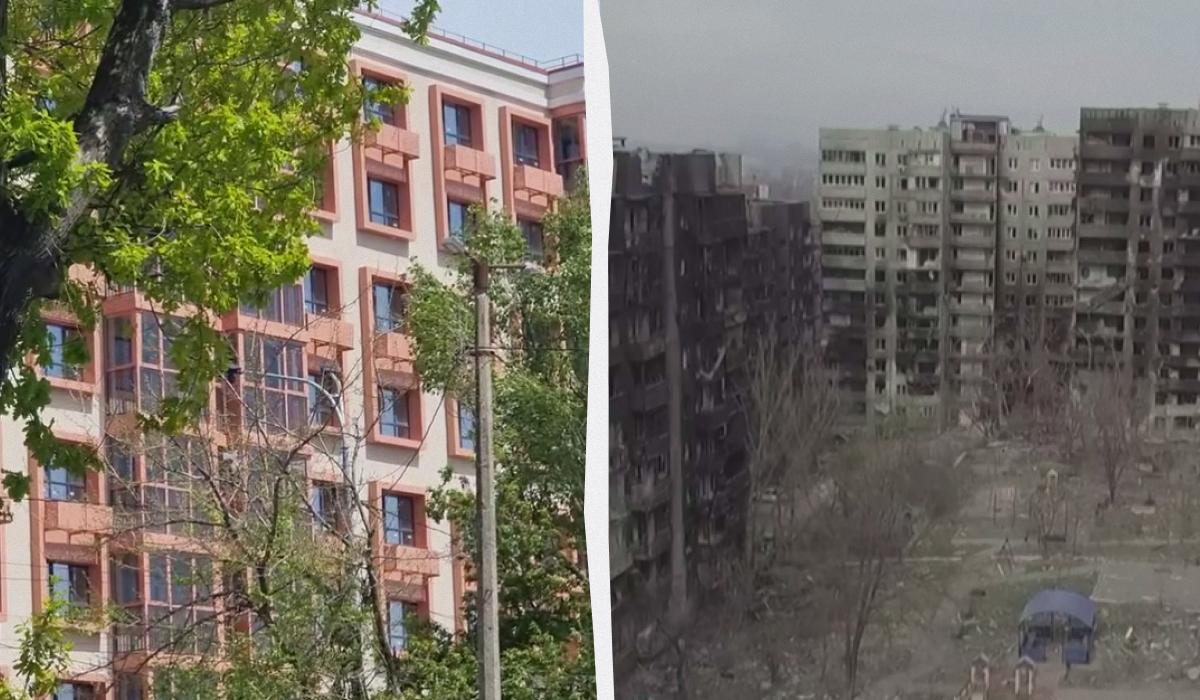
Russian citizens are buying new apartments built by occupation forces on the sites of destroyed residential buildings in Mariupol, Deutsche Welle reported.
Buyers are moving into newly constructed complexes on Metalurhiv Avenue and communicating in local online forums about settling in the occupied port city. Most purchasers bought the properties either to live in themselves or to lease to tenants.
Forum participants regularly post inquiries about ordering furniture deliveries from Russia and choosing local schools or kindergartens for their children. Chat rules remind applicants that submitting documentation proving Russian origin is the most important requirement.
Vyacheslav Shiryaev, an economist, said the buyer demographic consists mostly of incoming Russian security forces, state bureaucrats, and military logistics personnel. He added that other buyers simply want to live near the sea but cannot afford property in Crimea or Sochi.
Subsidized Mortgages and Rising Prices
Russia is offering preferential mortgage loans in occupied regions at an annual interest rate of two percent for the full term of the loan. To qualify, borrowers must hold Russian citizenship.
The mortgage scheme caps the maximum loan amount at six million rubles, worth roughly 63,000 euros or 72,000 dollars, with a minimum down payment requirement of two percent. Russian banks report that Mariupol leads all cities in the occupied regions for total mortgage loan volume, as dozens of apartment complexes are built and occupied.
Property prices in the seaside city rose by one third over a single year. Shiryaev said that while such coastal locations are unavailable within Russia itself, the structural quality of the new apartments is extremely low because construction companies cut costs wherever possible while charging sky-high prices.
One major development, the Leningradsky Kvartal complex, comprises 15 towers between 12 and 15 storeys tall located near the city center and ten minutes from the coast. One-room and two-room flats in the complex cost between 7.5 million and nearly 10 million rubles, or about 104,000 euros, while three-room units start at 10 million rubles. New arrivals to the region are offered discounts of up to 12 percent.
War Insurance and Destructive Legacy
Resident chat logs show that buyers have insured their mortgage loans against military risks. Under these insurance policies, buyers are released from debt obligations if their building is destroyed, though they lose the property. DW noted that no online forum posts mention the previous residents who lived on the site of Leningradsky Kvartal prior to its destruction.
United Nations data indicates that 90 percent of all buildings in Mariupol were damaged or destroyed during the Russian siege in 2022. Media estimates indicate that tens of thousands of civilians died during the assault.
The construction push follows the reopening of the Mariupol Drama Theatre on December 28, 2025. Russian forces destroyed the theatre in a 2022 strike while civilians sheltered inside, despite the word Children being painted in large letters in front of the building. Pro-Kremlin media reported that the facade was preserved while the interior was updated to modern standards.
The opening ceremony was attended by Denis Pushilin, head of the self-proclaimed Donetsk People's Republic, Alexander Beglov, the governor of Saint Petersburg, Igor Rudenya, a Russian presidential envoy, and Vladimir Mashkov, a Russian actor.
Demographic Shifts in Occupied Territories
The population changes in Mariupol align with broader demographic shifts across occupied regions. Ukrainian military intelligence reported that between 200,000 and 300,000 ethnic Russians were residing in occupied Crimea and Sevastopol as of July 2026, with Moscow planning to relocate another 130,000 Russians to Sevastopol alone by 2042.
The Main Directorate of Intelligence of the Ministry of Defence of Ukraine stated that Russia is executing a deliberate policy of ethnocide aimed at erasing Ukrainian identity. Intelligence officials warned that local populations are being systematically replaced by Russians and migrants from Central Asia and the North Caucasus, while living conditions for remaining Ukrainians have deteriorated to catastrophic levels with extremely low birth rates and high mortality.