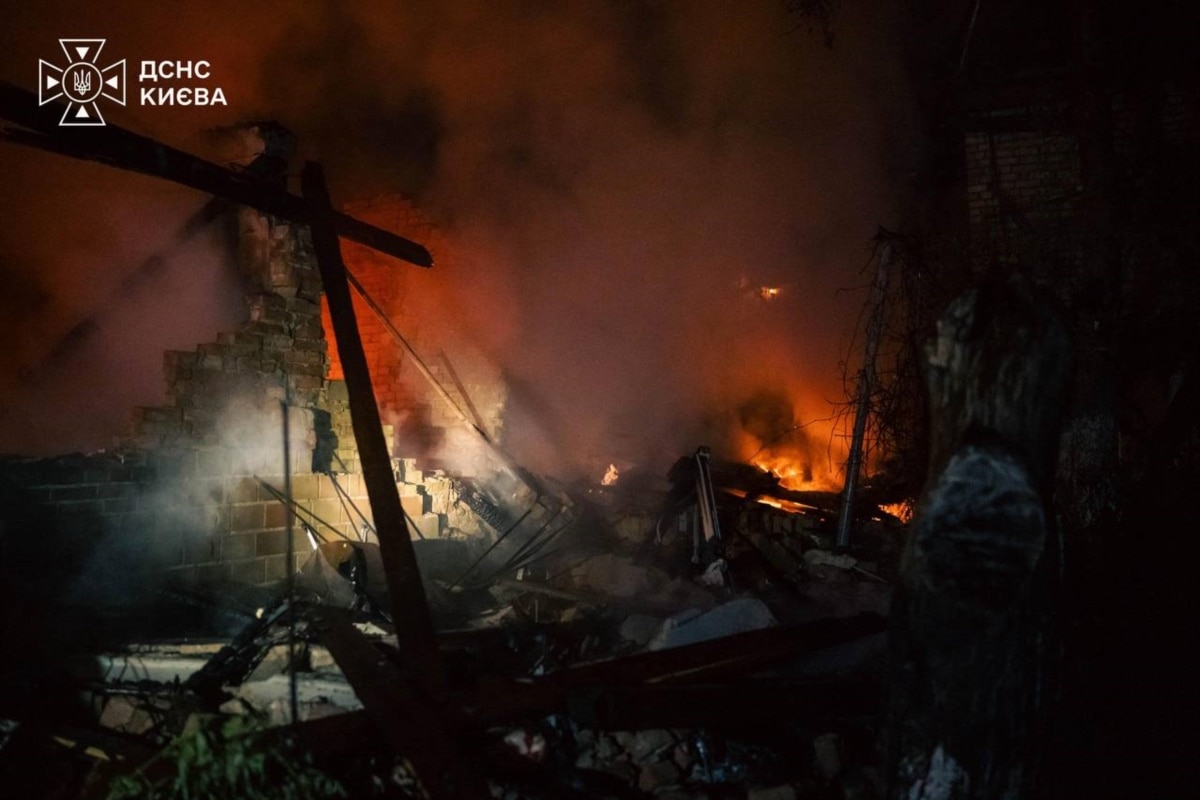
A massive overnight Russian missile and drone attack primarily targeting the Kyiv region killed two people in the capital and left a child dead in the surrounding area, local authorities reported on September 30.
The Ukrainian Air Force announced on the Telegram messaging app that air defense systems had neutralized 160 targets by 08:00 local time. The assault, which the military said was still ongoing, began at 18:00 the previous evening.
Advanced missiles and attack drones
Russian forces utilized a diverse array of advanced weaponry for the bombardment. The barrage included Zircon and Onyx anti-ship missiles, as well as Iskander-M and S-400 ballistic missiles.
The Zircon and Onyx are typically deployed against naval vessels, but Russia has increasingly repurposed them for land strikes during the conflict. The Iskander-M is a mobile short-range ballistic missile, while the S-400 is primarily a surface-to-air defense system that Russian forces frequently adapt for ground attacks.
In addition to the missiles, the military reported the launch of 188 attack drones of various types. The swarm included 86 jet-powered drones, representing a significant technological shift in the aerial campaign.
Ukrainian air defenses successfully shot down five of the Iskander-M, S-400, Zircon, and Onyx missiles. They also intercepted 155 drones, including Iranian-designed Shaheds, Gerberas, and other unspecified models. Shahed drones are relatively inexpensive loitering munitions that detonate upon impact and have been a staple of Russian air attacks.
Despite the high rate of interception, the Ukrainian military recorded hits in 18 separate locations across the country.
Casualties in Kyiv and Vyshhorod
In the capital city of Kyiv, the Russian attack killed two people and injured four others, according to local authorities. Officials reported that the consequences of the strikes were recorded across four different districts of the city.
The broader Kyiv region, which encompasses the towns and suburbs surrounding the capital, also suffered casualties. The Regional Military Administration reported that a child was killed during the bombardment.
The State Emergency Service specified that a private residential home was destroyed by a strike in Vyshhorod, a city situated just north of the capital on the Dnipro River. During search and rescue operations at the site, emergency workers discovered a child, born in 2012, trapped under the structural debris.
Rescuers attempted to save the child, but the child succumbed to their injuries. Three people in total, including the child, had been pulled from the rubble of the home.
The Regional Military Administration noted that infrastructure facilities were also attacked in the Bucha, Vyshhorod, and Obukhiv districts of the Kyiv region. The Bucha district gained international prominence early in the full-scale invasion when Russian forces were accused of massacring hundreds of civilians during their month-long occupation.
The jet-powered drone threat
The widespread use of jet-powered drones in the latest assault highlights an evolving tactical challenge for Ukrainian defenders. The Defense Ministry reported that Khmara has called on the European Union to help finance interceptors specifically designed to counter the jet-powered Shahed variants.
Russia has actively deployed these faster jet drones in recent months, subjecting Kyiv and several other Ukrainian cities to almost round-the-clock aerial attacks.
According to data from the Ukrainian Air Force, the interception rate for classic propeller-driven attack drones stands at approximately 90 to 95 percent. However, the success rate drops significantly to about 60 percent when engaging the jet-powered drones.
Anatoliy Khrapchynskyi, the development director of a defense enterprise and a reserve Air Force officer, told Radio Donbas Realii that countering the jet drones currently requires the use of expensive military hardware. He noted that defenders are forced to rely on aviation, surface-to-air missile systems, and man-portable air-defense systems to bring them down.
Kyrylo Budanov, the head of the Office of the President of Ukraine, stated recently that achieving the mass interception of the jet-powered Shaheds is a matter of a few months.
The overnight barrage on the capital is part of a broader, ongoing campaign. Russian military forces regularly attack Ukrainian cities and civilian infrastructure in all regions of the country using a wide range of weapons, including attack drones, missiles, guided aerial bombs, and multiple launch rocket systems.
War crimes and genocide accusations
Ukrainian authorities and international organizations have consistently classified these strikes as war crimes, emphasizing that the attacks on civilian areas are targeted and deliberate.
Officials point out that strikes on life-support systems and healthcare facilities are designed to deprive the civilian population of electricity, heating, water supply, communications, medical care, and other essential conditions for survival. These actions, they argue, are a clear sign of genocidal acts.
Lawyers, genocide researchers, and human rights activists assert that during the full-scale war, Russia has committed all types of crimes against Ukrainian citizens that could fall under the legal definition of genocide.
These experts cite explicit declarations of intent to destroy the Ukrainian people. The Russian president and other government officials have repeatedly stated that Ukrainians do not exist as a distinct ethnic group, referring to them as an artificially created nation. These officials have publicly declared that those who disagree with this view must be destroyed, and that Ukraine and its people should not exist in the future.
The accusations are further supported by public calls for the destruction of Ukrainians and the targeted strikes on essential civilian infrastructure.
Researchers also point to the systematic persecution and extermination of people with pro-Ukrainian stances in occupied territories. This includes the targeted killing of the intelligentsia, such as teachers, artists, and individuals who carry and teach Ukrainian culture.
In occupied areas, Russian authorities have reportedly introduced an educational and upbringing system explicitly aimed at altering the identity of children. This is coupled with the deportation of unaccompanied minors to Russia for the purpose of erasing their Ukrainian identity.
International law on genocide
Cultural destruction is also cited as evidence of genocidal intent. This includes the removal and destruction of Ukrainian books from libraries, the widespread looting of museums, and the targeted theft of historical artifacts that demonstrate the ancient history of the Ukrainian people.
The legal framework for these accusations is rooted in the Convention on the Prevention and Punishment of the Crime of Genocide, which was adopted by the United Nations General Assembly in 1948 in the aftermath of World War II.
The 149 countries that are party to the convention are legally obligated to prevent and punish acts of genocide in both times of war and peace.
The convention defines genocide as acts committed with the intent to destroy, in whole or in part, a national, ethnical, racial, or religious group.
Recognized indicators of genocide under the convention include killing members of the group, causing serious bodily or mental harm, deliberately inflicting conditions of life calculated to bring about the group's physical destruction, imposing measures intended to prevent births, and forcibly transferring children from one group to another. Public incitement to commit any of these acts is also a crime.
The Russian leadership routinely denies that its army deliberately targets civilian infrastructure or kills civilians during the full-scale war. Moscow maintains that it does not attack hospitals, schools, kindergartens, or energy and water facilities, despite extensive evidence to the contrary.