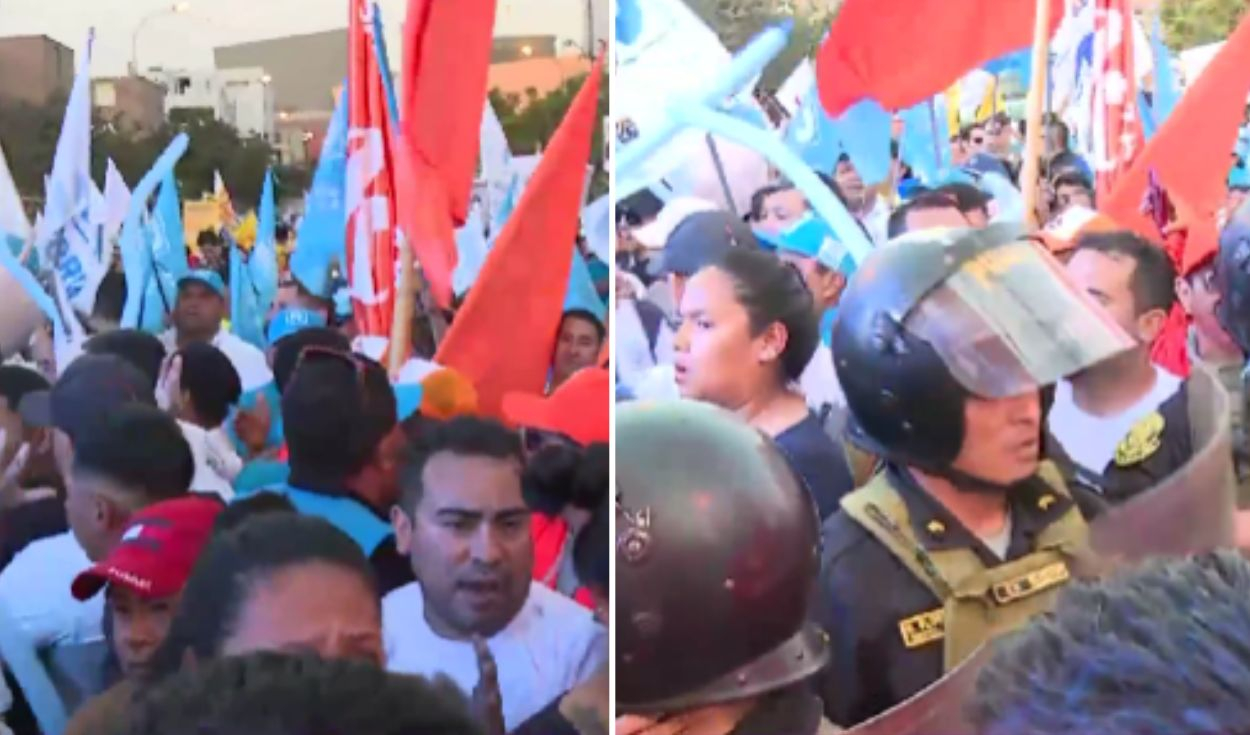
Supporters of rival political parties Renovación Popular and Fuerza Popular clashed on Tuesday outside the National Library of Peru in Lima, where candidates were gathering for the second session of the official 2026 municipal election debate.
Officers from the National Police of Peru intervened to separate the opposing groups after tensions escalated outside the venue, allowing the scheduled mayoral debate to proceed without further disruption.
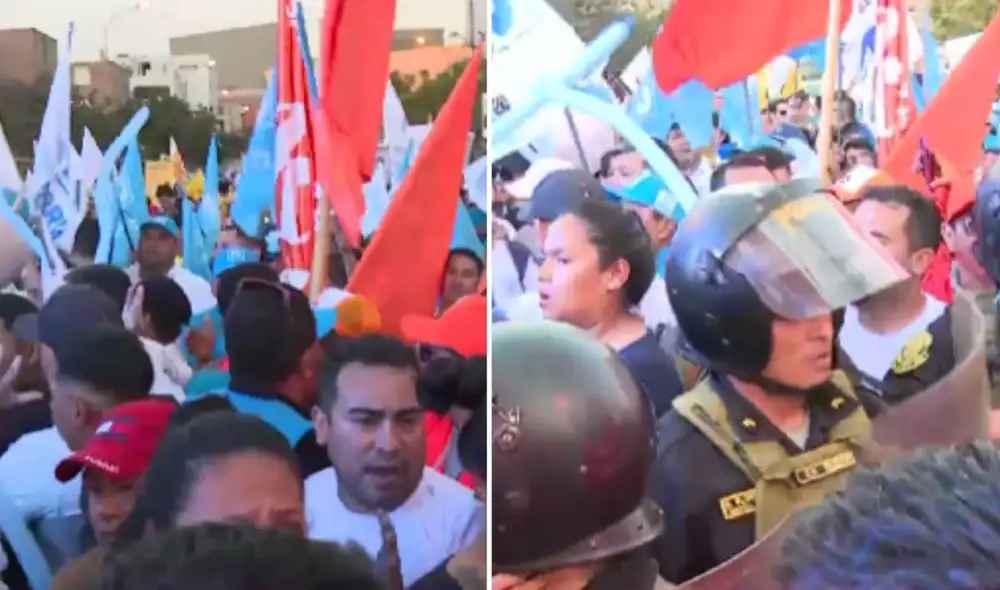
According to Peruvian television news network Canal N, the confrontation began when an organized campaign group supporting Renovación Popular arrived at an area near the library entrance.
Supporters of Fuerza Popular, commonly known in Peru as the orange party due to its official campaign colors, had occupied the location since early Tuesday morning and attempted to block the incoming Renovación Popular supporters from approaching the perimeter.
In Peruvian politics, organized groups of campaign supporters mobilized to showcase party presence outside major public events are known as portátiles. Fuerza Popular, led nationally by former presidential candidate Keiko Fujimori, and Renovación Popular, led by political figure Rafael López Aliaga, represent two of the country's main conservative political movements.
Dispute Outside the Debate Venue
Police officers formed a security barrier between the rival political factions to restore order outside the National Library of Peru, located in the San Borja district of the capital city. Following the police intervention, security was re-established and attendees entered the facility as scheduled.
The National Police of Peru is the sole national law enforcement agency responsible for maintaining public order across the South American country. The National Library of Peru, a major cultural institution and architectural landmark in Lima, frequently serves as the designated venue for official candidate forums during national and municipal election cycles.
Metropolitan Lima is the capital city of Peru and home to nearly ten million residents, making the Lima mayoralty one of the most prominent political offices in the nation. The election debate brought together candidates competing in the 2026 Peruvian regional and municipal elections.
Samuel Marcos Daza Taype represented Fuerza Popular during the event, while Rafael López Aliaga appeared on behalf of Renovación Popular.
The lineup also featured candidates from across Peru's political spectrum, including Rubén Daniel Bonilla Espinoza of Fuerza Ciudadana, Luis Miguel Llanos Carrillo representing Progresemos, and Edgardo Renán De Pomar Vizcarra of the Partido Popular Cristiano, one of Peru's historic center-right political parties.
Other contenders participating in the second session included Francis Allison Oyague for Avanza País, Carlos Alberto Tejada Noriega representing Acción Popular, a party historically founded by former president Fernando Belaúnde Terry, Santiago Rosendo Abarca León of Visión Perú, and Carlos Gallardo Neyra for the Partido del Buen Gobierno.
The candidate roster for the evening was completed by Elizabeth León Chinchay of Frente de la Esperanza 2021, Mónica Yadira Yaya Luyo representing the Partido Aprista Peruano, Peru's oldest active political organization, and Juan Carlos Alvarado Mestanza of the Alianza Electoral Venceremos coalition.
Structure of the Municipal Debate
The election forum was organized by the National Jury of Elections, the constitutional body tasked with administering electoral justice, supervising voting procedures, and hosting official candidate debates across Peru. Electoral officials structured the municipal debate into four distinct segments designed to evaluate the candidates and present their proposals to voters.
In the opening block of the debate, each candidate received one minute and thirty seconds to present their core policy vision and platform for the future governance of Metropolitan Lima.
The second block focused on direct interaction between the participants. Candidates were divided by electoral officials into pairs and trios to ask questions, deliver answers, and present immediate rebuttals to their political opponents.
The third segment presented questions submitted directly by members of the public, which were selected by election officials from a pool of 4,921 inquiries submitted through the Ask Your Candidate campaign. This segment included a mandatory straight-to-the-point section where candidates were required to start their responses with a direct yes or no before expanding on their policy positions.
In the fourth and final block, each candidate was allocated one minute and thirty seconds to deliver a concluding message to voters across the capital. The National Jury of Elections confirmed that all speaking orders and candidate matchups were established prior to the event through a public lottery draw.