Peru's National Infrastructure Authority (ANIN) requires 2.255 billion soles in additional funding from the Ministry of Economy and Finance to complete 12 priority flood prevention projects in regions facing severe risks from the ongoing El Niño phenomenon. The Center for Estimation, Prevention and Reduction of Disaster Risk (Cenepred) has classified the northern and central coastal regions of Tumbes, Piura, Lambayeque, La Libertad, Áncash, and Ica at very high risk.
The warning coincides with forecasts from the National Meteorology and Hydrology Service (Senamhi). Grinia Ávalos Roldán, Director of Meteorology and Atmospheric Environmental Assessment at Senamhi, explained to La República that rainfall could rise far above normal levels along the northern coast, reaching maximum intensity starting in the final quarter of 2026.
Slow progress under the infrastructure authority
The urgent need for prevention infrastructure stems from the disaster caused by the 2017 Coastal El Niño, which generated losses exceeding 4 billion US dollars. That catastrophe led to the creation of the Authority for Reconstruction with Changes (ARCC). In July 2023, the Peruvian government established ANIN to absorb ARCC and accelerate pending projects.
Three years after its creation, ANIN has delivered poor results. Out of 194 interventions transferred from ARCC, ANIN has completed only 50, representing 26 percent of the total. Of those completed projects, 35 correspond to educational institutions, six to health facilities, and only nine to flood and climate protection structures.
Infrastructure delays and river sediment in Piura
In Piura, where devastating floods occurred nine years ago, severe vulnerabilities persist. On March 27, 2017, following 15 consecutive hours of rain, the Piura River overflowed and flooded Catacaos, Castilla, Cura Mori, and the city center. According to the National Institute of Civil Defense (Indeci), more than 427,000 people were affected and 97,000 were left homeless.
Architect and urban planner Julio Gianella Silva stated that the Piura Riverbed currently holds nearly four additional meters of accumulated sediment. He noted that the Andrés Avelino Cáceres bridge, which was declared in poor condition by the Provincial Municipality of Piura, remains a critical point of failure if an overflow happens.
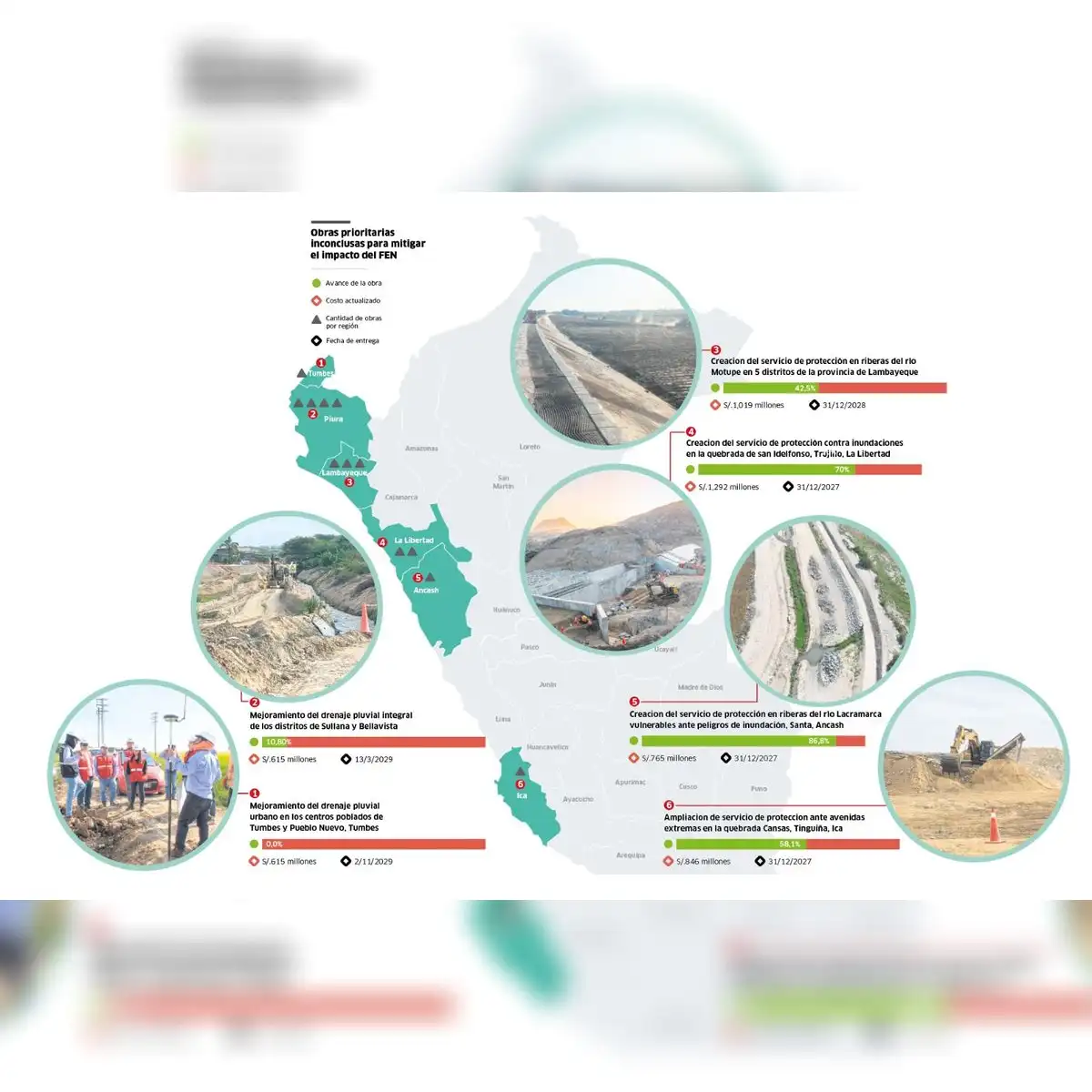
Major drainage works across Piura face long delays. A major stormwater drainage project in Sullana, launched in 2021 with an investment exceeding 615 million soles, has reached only 10.8 percent physical progress after five years. ANIN requires an additional injection of 80 million soles for the project, which is executed by Argentine firm Benito Roggio e Hijos under a Government-to-Government agreement, with completion scheduled for November 2029.
Gianella criticized the approach in Sullana, noting that the original Sullana Channel Way functioned for decades following the 1982 to 1983 Mega-Niño. He said authorities should have maintained, cleaned, and expanded sections of the existing canal rather than replacing it with a far more expensive project. In Piura, the project site has turned into a garbage dump.
In Talara, a stormwater drainage project valued at over 300 million soles requires an additional 70 million soles. Executed by Consorcio S&P, comprising Chinese company Sinohydro Buró & Co. and Peruvian firm Proyecta, it registers 35.4 percent progress since starting in May 2023, with delivery planned for late 2029. In Paita, the stormwater drainage project stands at zero percent physical progress and remains in the design stage, with completion set for April 2030.
Cost overruns and corruption audit in Trujillo
In March 2017, the San Ildefonso ravine overflowed seven times, flooding districts including El Porvenir, Florencia de Mora, and Víctor Larco, as well as the historic center of Trujillo in La Libertad region. Indeci reported more than 300,000 people affected and 53,000 left homeless.
The project to control the San Ildefonso ravine represents the largest cost overrun in ANIN's priority portfolio. Executed by Consorcio Besalco Stracon, the project was originally budgeted at 222 million soles. The total investment has now surpassed 1.292 billion soles, marking an increase of nearly 500 percent.
Although physical progress on the San Ildefonso ravine has reached 70.8 percent, ANIN warned that it requires an additional 400 million soles to prevent work suspensions across multiple construction fronts.
The Comptroller General's Office also detected 16.3 million soles in economic damage. An audit report determined that five officials face alleged criminal, civil, and administrative liabilities for approving agreements without technical justification that reduced penalties, extended deadlines, and authorized extra payments. The case was submitted to the Anti-Corruption Prosecutor's Office.
Unpaid contractors and structural risks on dikes
The funding shortfall affects all 12 priority projects. ANIN acknowledged to La República that the required 2.255 billion soles were scheduled to be spent between August and December 2026 to reduce risks ahead of the 2026 to 2027 El Niño. The agency confirmed that several contractors suspended operations in August 2025 due to unpaid valuations.
ANIN admitted that there is a high risk of losing portions of already constructed infrastructure. The agency stated to the newspaper that several work sections, window openings, and dike sections remain uncompleted or lack wet-face armoring, preventing the structures from fulfilling their protective purpose.
Gianella warned that leaving compacted earth dikes unfinished significantly increases failure risks. He explained that earthen dikes are fragile compared to rock fill structures, noting that 40-year-old rock fill defenses in Poechos remain functional while current earthen dikes could be overtopped. He added that previous river desilting works carried out after 2017 became re-covered in sediment just months after completion.
Widespread project delays across coastal regions
In Lambayeque region, protection works along the Motupe River require 260 million soles in additional funds and remain suspended at 42.5 percent progress. Works on the Zaña River require 250 million soles with progress at 26 percent, while the Olmos River project demands 380 million soles and stands at 51.6 percent. All three river projects are scheduled for completion at the end of 2028.
Major urban stormwater drainage systems face even longer timelines. Chiclayo's drainage project registers zero percent physical progress, with completion planned for February 2031. Trujillo's urban drainage system also stands at zero percent, with an official target delivery date of May 2035. Tumbes' drainage system has not started, with completion scheduled for March 2029.
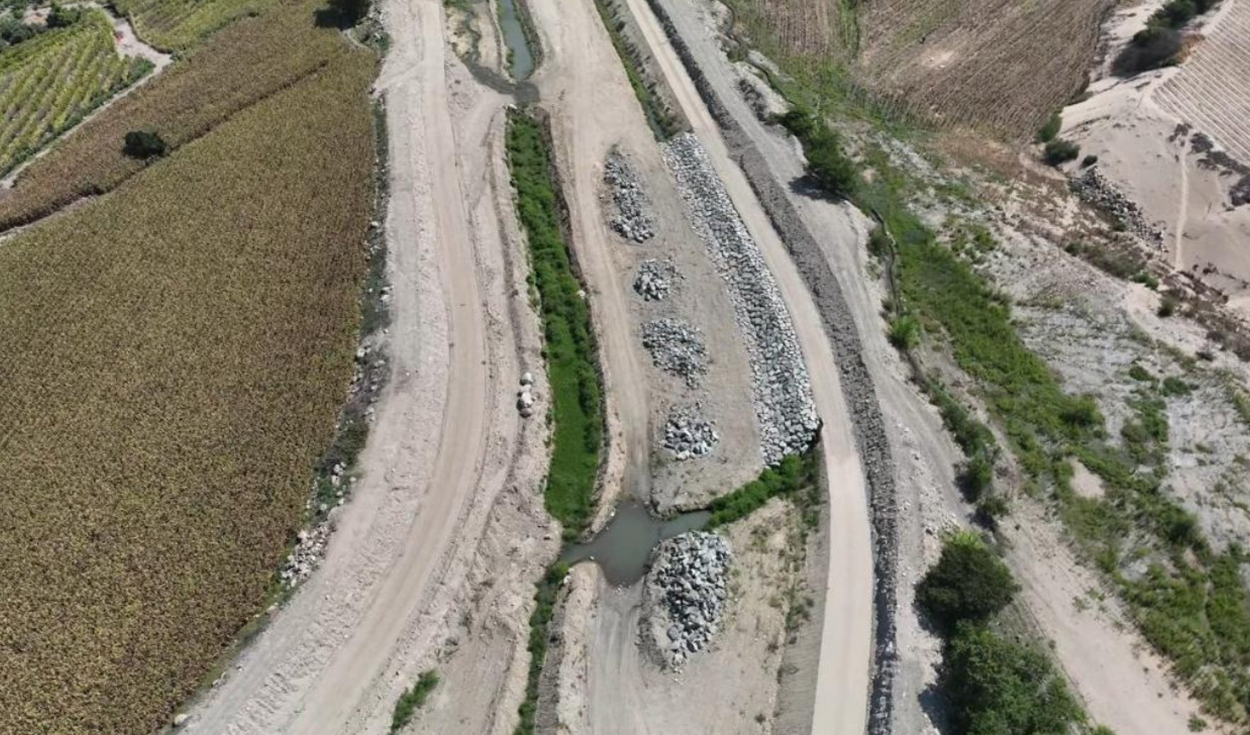
In central and southern regions, protection works on the Lacramarca River in Áncash stand at over 86 percent progress but remain suspended due to legal disputes. ANIN warned of structural deterioration and risks to several bridges, requesting 60 million soles. In Ica, the Cansas ravine control project registers 58 percent progress and requires 290 million soles to finish.
Experts warn of dual El Niño threat
Leane Arias Rojas, a Disaster Risk Management Specialist at Cenepred, warned that upcoming weather conditions could be more severe than those in 2017. She explained that a Coastal El Niño in northern Peru is combining with an El Niño event in the central equatorial Pacific, which could trigger heavy rainfall in the north.
Arias emphasized that Piura, Lambayeque, and La Libertad contain some of the country's most vulnerable populations. She stated that necessary preventive measures have not been taken, leaving over 7.9 million people exposed to disaster risks.