

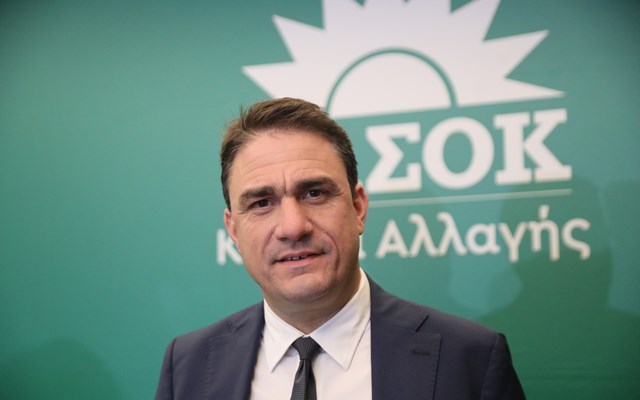
Greek opposition party PASOK has demanded urgent answers from the Greek government regarding sovereign maritime rights and Turkish claims over the Greece to Cyprus electricity cable.
Speaking on state television channel ERTnews, PASOK spokesman Kostas Tsoukalas said the administration of Prime Minister Kyriakos Mitsotakis must clarify whether any country granted permission for a French survey ship to operate in the Eastern Mediterranean. He insisted that Greece should never seek or require permission from foreign powers to conduct works within its maritime domain.
The dispute erupted after Turkey asserted that it had authorized the French vessel to conduct subsea cable surveys on what Ankara claims as its own continental shelf. Tsoukalas described the Turkish assertions as baseless posturing, but warned that diplomatic ambiguities could create dangerous precedents that Turkey might exploit in future international court proceedings.
Questions Over French Diplomatic Note
Tsoukalas reiterated questions first posed in parliament by PASOK leader Nikos Androulakis concerning a diplomatic note verbale issued by the French state. The opposition wants to know whether Athens knew about the communication in advance, whether Greek officials approved it, and what the document contained.
The spokesman urged the government to provide clear answers to Greek lawmakers, offering that the information could be delivered in a closed briefing if national security required confidentiality. He stressed that PASOK had welcomed the formal start of the interconnector project on Friday, but argued that patriotism required holding the executive accountable rather than remaining silent.
Tsoukalas said PASOK represents Greek citizens and exercises its democratic duty by questioning ministers. He added that the ruling New Democracy party was fortunate to face a responsible opposition, contrasting PASOK with the aggressive stance New Democracy took when it was in opposition.
Clash Over Maritime Rights and Turkey
The core of the dispute involves competing maritime boundaries in the waters between Crete, Rhodes, and Cyprus. Turkey does not recognize the full continental shelf of Greek islands and has repeatedly attempted to assert jurisdiction over subsea operations across the Aegean and Eastern Mediterranean.
Tsoukalas expressed deep concern that Turkey rushed to weaponize the French diplomatic document to manufacture maritime claims. He noted that if the delimitation of the continental shelf and exclusive economic zones eventually reaches an international court, Ankara could attempt to present the note verbale as evidence of recognized rights in the area.
While stressing that he was not predicting how an international court might rule, Tsoukalas argued that Greece must not hand Ankara diplomatic instruments to support unsubstantiated territorial claims.
Parliamentary Sparring Over Diplomatic Slips
Tsoukalas sharply criticized New Democracy officials for their handling of the controversy during parliamentary debates. He dismissed suggestions from New Democracy lawmaker Dimitris Kairidis, who admitted he did not know the contents of the French note but assumed it would be harmless, before telling Androulakis to ask Turkish President Recep Tayyip Erdogan for details.
Tsoukalas also condemned analogies used by other government deputies to downplay the diplomatic exchange. Lawmaker Harry Theoharis had compared the note verbale to a routine electricity bill from Public Power Corporation, while lawmaker Tasos Chatzivasileiou likened it to a municipal notice from water utility EYDAP announcing street excavations.
The spokesman called those arguments farcical, pointing out that when a utility sends a bill or notice, it acknowledges legal rights and contractual ties with the recipient. He said applying that comparison to international diplomacy was a deeply unfortunate blunder that undermined Greece's sovereign position.
Great Sea Interconnector Energy Project
The diplomatic friction surrounds the Great Sea Interconnector, a multibillion euro undersea cable project designed to link the power grids of Greece, Cyprus, and eventually Israel. Backed by European Union funding, the high voltage direct current line aims to end Cyprus's status as the only isolated energy grid in the European bloc.
Laying hundreds of miles of deep water cable requires extensive seabed mapping by specialized research vessels. However, operating in the contested waters of the Eastern Mediterranean has repeatedly triggered standoffs with Turkish naval forces, which monitor survey ships navigating international waters over disputed continental shelf zones.
The project is seen by Brussels and Athens as essential for regional energy security and the transmission of renewable electricity, yet its route through complex geopolitical waters continues to test relations between Greece and Turkey.
Political Divisions and Coalition Prospects
Beyond foreign policy, Tsoukalas addressed domestic political tensions and rejected recent overtures from Prime Minister Mitsotakis toward centre-left voters. Mitsotakis had claimed that an unbridgeable gulf separated his government from right-wing figures such as former prime minister Antonis Samaras, Voice of Reason leader Afroditi Latinopoulou, and Greek Solution leader Kyriakos Velopoulos.
Tsoukalas questioned that logic, pointing out that Mitsotakis previously served as a minister under Samaras, that Latinopoulou had run as a New Democracy candidate, and that the government had frequently voted alongside Velopoulos. He noted that Mitsotakis already includes prominent right-wing figures such as Adonis Georgiadis, Thanos Plevris, and Makis Voridis in his cabinet.
The spokesman stressed that PASOK and New Democracy are night and day in their political programs, making talk of a future coalition absurd. He accused Mitsotakis of manufacturing a political fight with former leftist prime minister Alexis Tsipras while flirting with PASOK, in an attempt to capture centrist voters and rally support against a figure rejected by the broad public.
Looking ahead to the next general election, Tsoukalas outlined two potential outcomes for Greece. Either New Democracy finishes first and forms an unequal alliance with conservative and populist right-wing factions, leaving PASOK as the official opposition, or PASOK secures first place and forms a government to carry out its own progressive social program.


