University of Oxford theoretical physicist Subir Sarkar has presented evidence showing that the universe may not be accelerating in its expansion. Working with researchers Animesh Sah and Mohamed Rameez, Sarkar analyzed data from the Pantheon+ supernova catalog to challenge the dominant cosmological model.
Dark energy has long been accepted as the force driving an accelerating universe and representing most of the cosmos. Although never directly detected, dark energy is theorized as vacuum energy, a dynamic field, or wrinkles in space-time fabric.
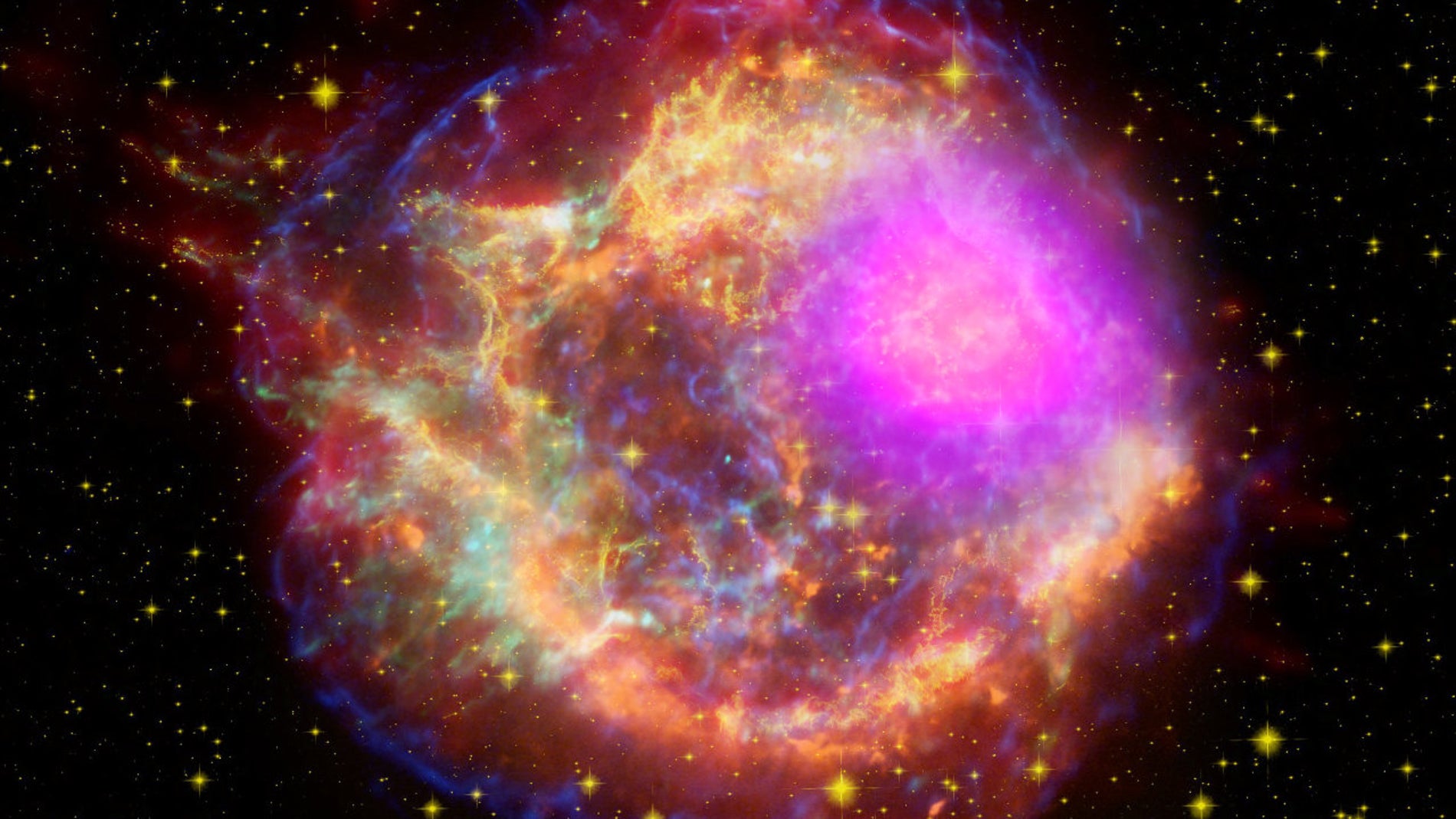
Scientists at the end of the last century concluded the universe was accelerating by studying Type Ia supernovas as cosmic lighthouses. These colossal explosions occur in binary star systems when a white dwarf ingests matter from a companion star or merges with another white dwarf, triggering a runaway thermonuclear reaction. Because these explosions reach a predictable brightness limit, astronomers can calculate their exact distance by comparing brightness with their recession speed.
Correction for progenitor star age
The research team applied a correction previously overlooked by cosmological models: the age of the progenitor stars that produce the explosions. Previous models assumed that the brightness of a Type Ia supernova was independent of the age of its source star.
Sarkar and his team found that supernovas originating from younger stars are systematically dimmer than those coming from older stars. Because looking at extremely distant supernovas means observing the distant past when stars were younger, their lower brightness stems from star age rather than cosmic acceleration pushing them further away.
Asymmetric expansion and cosmological models
The findings suggest the observed cosmic acceleration could be illusory and that the expansion of the universe might actually be slowing down. The team also discovered that the alleged acceleration is asymmetric rather than equal in all directions.
If dark energy were a true cosmological constant, its behavior would be identical in every direction across the cosmos. The observed asymmetry directly challenges the standard cosmological model, which relies on the assumption that the universe is homogeneous and isotropic at a large scale.
Cosmology already faced significant friction from the Hubble tension, which shows a contradiction between expansion speeds measured in the nearby universe and those calculated from the early universe. By eliminating evidence for accelerated and uniform expansion, the study suggests the cosmos is not symmetric and may force scientists to rewrite their understanding of dark energy and the ultimate fate of the universe.