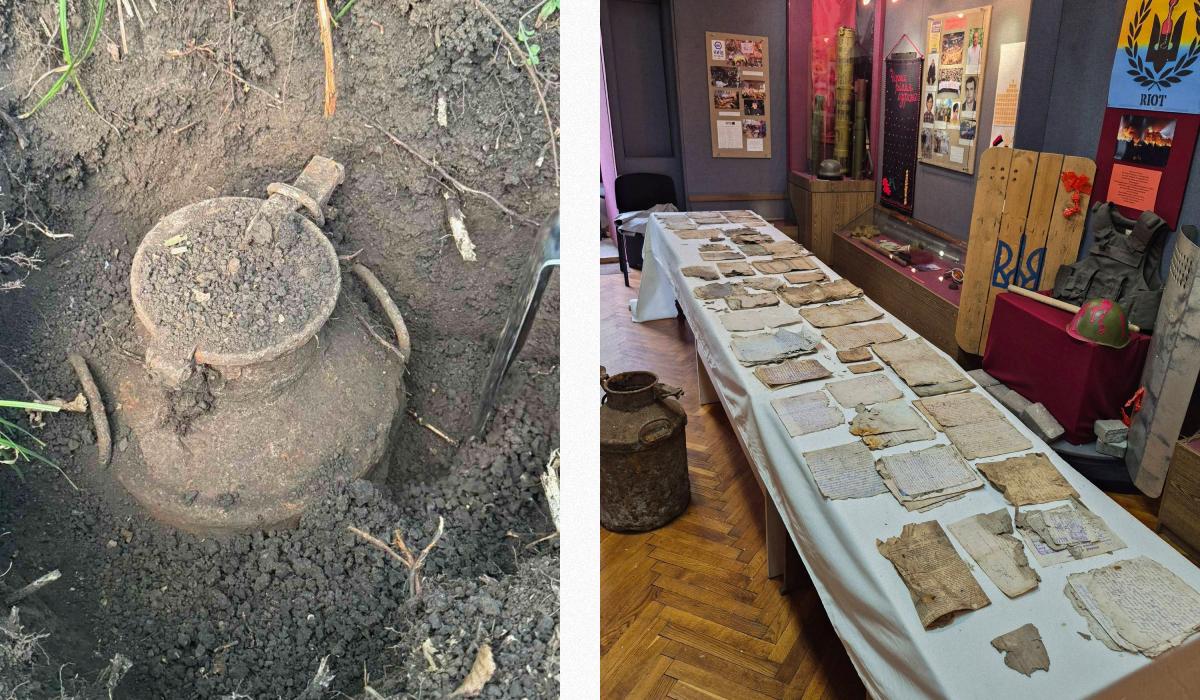
A man walking through a forest in western Ukraine has discovered a sealed metal container containing historical documents from the Organization of Ukrainian Nationalists, according to the Ivano-Frankivsk Regional Museum of Liberation Struggle.
Andrian Shahan, a resident of the village of Zahirya, stumbled upon the buried archive after accidentally catching his foot on an exposed wire while walking through a forest near the village of Stari Skomorokhy in the Prykarpattia region.
The museum, named after Stepan Bandera, reported on its Facebook page that Shahan dug beneath the soil to reveal a sealed metal canister packed with valuable historical documents, primarily dating from 1948 and 1949. The records belonged to the Bolshevtsi district leadership of the nationalist organization.
Prykarpattia is a historical region in western Ukraine along the foothills of the Carpathian Mountains. The Organization of Ukrainian Nationalists was an underground political and military movement active during the 20th century that fought for an independent Ukrainian state. Stepan Bandera was a prominent leader of the nationalist movement.
Following the discovery, a joint working group immediately dispatched to the site to inspect the area and safely extract the container. The historical materials were then transferred to museum scientists for conservation and study.
Museum specialists stated that they had already begun the painstaking process of examining and caring for the fragile documents. The institution promised to share the initial results of its investigation and present details of the unique archive to the public once research is further along.
Recent historical finds in Ukraine
The document discovery follows two other notable historical finds recently reported across Ukraine. In Lviv Oblast, border guard Volodymyr Prots found a massive mammoth tooth in the Stryi River, a tributary of the Dniester.
The Department of Geomorphology and Paleogeography at the Ivan Franko National University of Lviv, where Prots previously studied geography, stated that the fossil would be used as a teaching tool. Prots noted that the tooth measured 35 centimetres in length and weighed 7.440 kilograms, estimating its age at between 10,000 and several hundred thousand years. Mammoths were large prehistoric mammals that inhabited Eurasia before going extinct thousands of years ago.
In Khmelnytskyi Oblast, archaeologists excavating a mound burial site near the village of Maliivtsi discovered a Scythian grave dating back to the fourth century BC.
Researcher Vitaliy Hutsal stated that the site yielded horse harness components and an unusual bronze plate decorated with a ten-petal flower and surrounding dots. Hutsal noted that such floral decoration was previously unknown among Scythian artifacts. The Scythians were an ancient nomadic people who inhabited the Eurasian steppe during classical antiquity.