

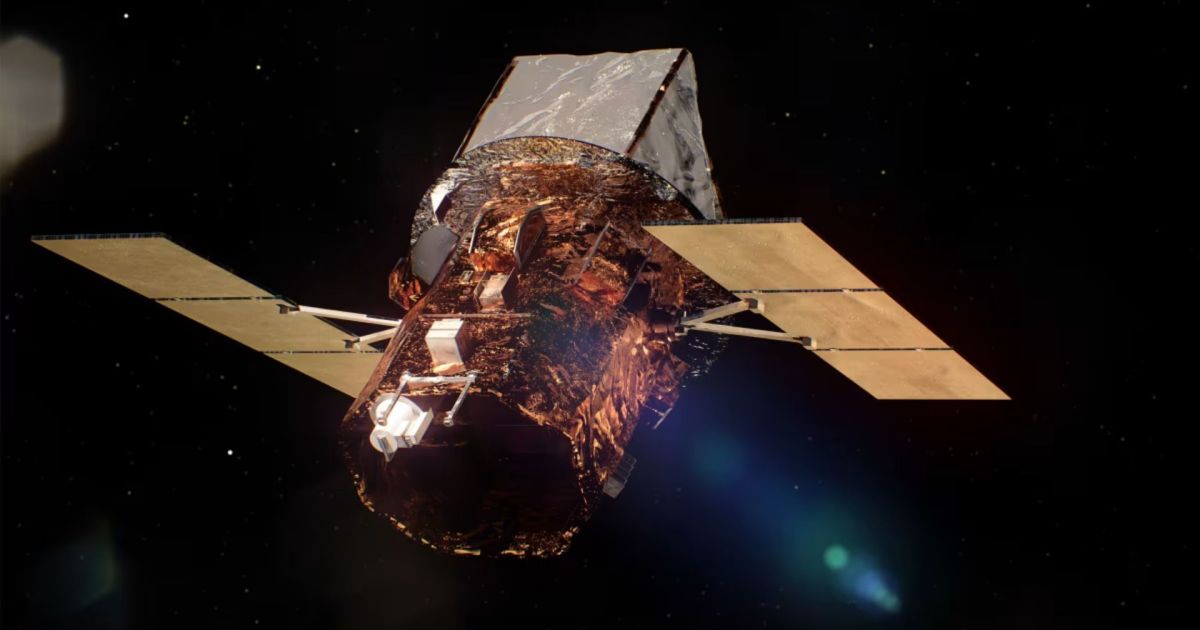
The National Aeronautics and Space Administration (NASA) has cancelled a mission to rescue an aging space observatory, the Neil Gehrels Swift Observatory, it was announced on Wednesday, August 19, 2026. The mission was called off after the rescue spacecraft suffered unrecoverable technical problems in orbit, according to Katalyst Space, the company that owns the vehicle.
The robotic satellite, named LINK, launched on July 3 aboard a Northrop Grumman Pegasus XL rocket, which was released mid-air by the company's modified L-1011 aircraft, known as Stargazer. The satellite was designed to raise the orbit of the aging Swift telescope.
The launch went as expected, but around July 25 the satellite began spinning uncontrollably in space, which NASA said caused a temporary loss of communication.
Katalyst Space said that after continuous monitoring and evaluation of the LINK spacecraft, it and NASA jointly concluded that, because of persistent attitude control problems, the mission would not include capturing or raising the orbit of NASA's Neil Gehrels Swift Observatory.
Weeks of Warning Signs
Katalyst's mission operations team had initially expected LINK to spend weeks undergoing checks of its navigation systems and sensors. About a week after launch, both Katalyst and NASA reported that commissioning was proceeding as planned, with the satellite having deployed its solar panels and begun firing its thrusters.
On July 13, Katalyst and NASA said the satellite was halfway through its activation phase. Two days later, NASA posted a similar update but noted the team had encountered some problems.
By July 28, the company said LINK had been tumbling on multiple axes for three days. NASA said a preliminary investigation showed that two of LINK's three reaction wheels were not operational at the time, and that there was some loss of functionality in its cold gas thruster system. NASA added that Katalyst had a plan to reduce the spin rate and would reassess any plans related to Swift.
Two days after that, Katalyst reported that its team had slowed LINK's spin rate from about 9 degrees per second to 4 degrees per second using a series of thruster firings.
What the Mission Was Meant to Do
LINK had originally been expected to survey the Swift Observatory, probably by the end of July, to determine the best points for attaching to it. Once the observatory's stability was secured, the satellite was meant to fire its three ion thrusters to push Swift back into its original orbit over a period of two to three months.
The Swift Observatory is named after swifts, birds known for fast, agile flight, reflecting the telescope's own ability to rapidly turn and observe cosmic events and their afterglows. It has enabled long-term study of comets, gravitational waves and black holes.


