

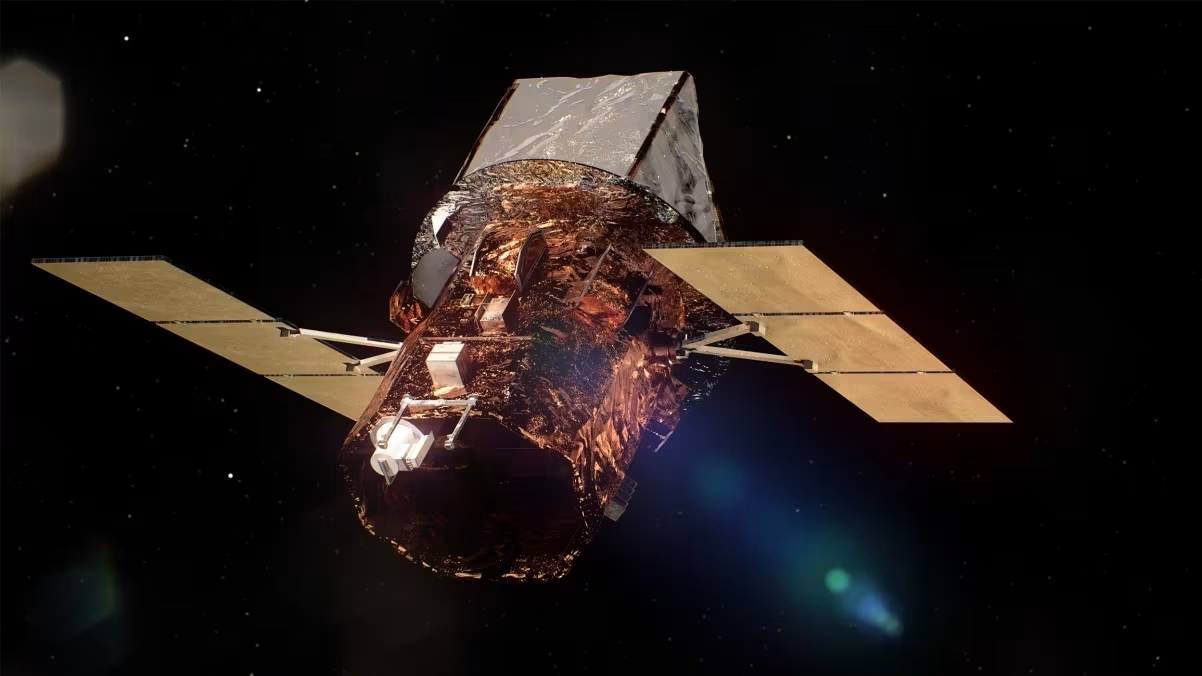
The National Aeronautics and Space Administration (NASA) and Katalyst Space Technologies announced on Wednesday that the LINK satellite will not be able to capture and boost NASA's Neil Gehrels Swift Observatory into a higher orbit, ending a bid to save the decades-old telescope from reentering Earth's atmosphere.
The agencies said the rescue attempt was called off due to continuing problems in attitude control, according to statements released this week. NASA said Swift's scientific mission will now come to an end, with the observatory likely to break apart in Earth's atmosphere later this year.
LINK, built by the Arizona-based company Katalyst Space Technologies, was launched on July 3 with the goal of docking with Swift and pushing it into a safer orbit. Weeks after launch, in late July, the satellite began spinning out of control.
Katalyst regained command of the spacecraft, but the company acknowledged the problem had cost valuable time, pushing back the planned encounter with Swift by about a month. At the time, the delay did not appear to rule out the mission.
Jared Isaacman, the NASA administrator, said the agency had to be willing to act quickly and take calculated risks when the potential payoff was worth it, and that this was exactly what it had done with the LINK mission. They said the outcome was not what the agency had hoped for, but that it did not change why the mission had been worth attempting. Isaacman added that the team had moved with extraordinary speed to give Swift a chance at further scientific research while advancing the capabilities the United States will need for satellite servicing in the future.
Demonstrating future capabilities
Although the rescue is off, the mission team is pressing ahead with its plan for LINK to rendezvous with Swift, now framed as a demonstration rather than a rescue.
Isaacman said the team would learn everything it could from the attempted encounter and put those lessons into practice on the missions that follow.
LINK had originally been expected to survey Swift to identify the best docking points on the observatory, a step that will likely still be part of the planned encounter, though it is not yet clear when the test will take place. Swift was not designed to be serviced in space, meaning the data gathered from the demonstration could be applied to future missions instead.
Ghonhee Lee, chief executive of Katalyst Space Technologies, said the company had designed, developed and launched an experimental spacecraft to carry out an ambitious mission on an aggressive schedule. They said Katalyst had taken on the high-risk, high-reward challenge and was proud of the milestones reached along the way. Lee added that the company had already learned a great deal and that its task now was to turn those lessons into something lasting, building what they described as a replicable playbook to guide future rendezvous, proximity and satellite servicing operations.
Filling the gap
The Swift Observatory, which has no established observational replacement lined up, has served as a multifunctional astrophysics tool in low Earth orbit since its launch nearly 22 years ago, quickly adapting to observe celestial objects and cosmic events.
Atmospheric drag, intensified by solar activity, has worn down the observatory's orbit, leading NASA to predict Swift would reenter the atmosphere once its altitude fell below the optimal level of about 300 kilometers (185 miles) above Earth.
Katalyst designed, built, tested and launched LINK in nine months. The robotic satellite was launched aboard a Northrop Grumman Pegasus XL rocket, which was released in midair by the company's modified L-1011 aircraft, Stargazer.
Before the satellite's launch, members of the Swift and LINK teams acknowledged that the path to boosting the observatory was fraught with risks that could cause the mission to fail.
Shawn Domagal-Goldman, director of NASA's Astrophysics Division at the agency's headquarters in Washington, D.C., said everyone had hoped for more scientific discoveries from Swift. They said the team had known the results of the mission would be valuable regardless, pointing to what had already been achieved through the series of milestones reached so far.
NASA said it would rely on the rest of its active fleet of observatories to fill the gap left by Swift and would continue prioritizing the search for new ways to respond quickly to cosmic events.
Domagal-Goldman said the construction, testing and operation of the mission had already strengthened the value chain of the American space industry, advancing in-space servicing capabilities in entirely new ways. They said NASA was committed to supporting its commercial suppliers as they took on difficult tasks with the agency, pushing the boundaries of what is possible.


