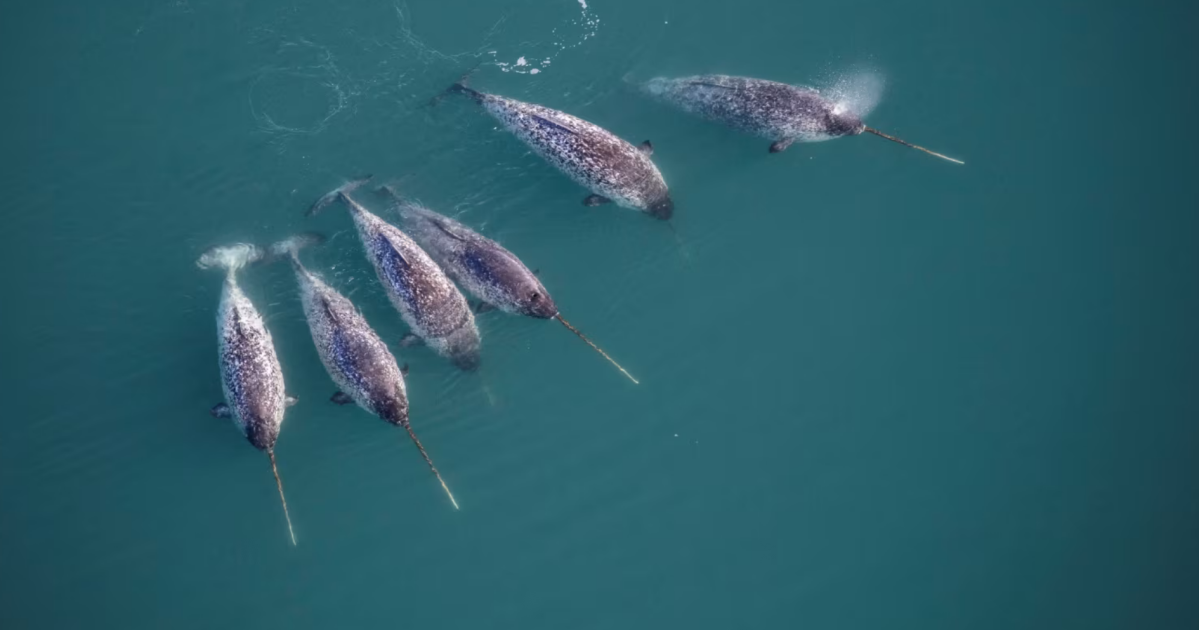
Scientists have used narwhals, the tusked whales known as "unicorns of the sea," to gather three years of ocean data from one of the most remote and least studied parts of the Arctic, and the results point to fast-moving glacier melt driven by warm Atlantic water pushing deep into Greenland's fjords.
Researchers fitted six narwhals with satellite transmitters and tracked the animals as they moved along the rugged coast of East Greenland and dived through the world's largest fjord system, a maze of ice-filled channels. The goal was to collect data on ocean conditions in a region that is both remote and critical to understanding climate change.
The data showed that relatively warm, salty water from the Atlantic Ocean is penetrating deep into the region's fjords, the giant valleys filled with water and ice, where it can erode glaciers and threaten the ice sheet behind them.
Scientists call findings worrying
Eric Achterberg, a professor at the Helmholtz Centre GEOMAR for Ocean Research Kiel in Germany who was not involved in the study, said the findings were very worrying because they pointed to rapid melting of glaciers that end in the sea. He added that the new data reinforced a trend already under way.
East Greenland is home to major glaciers that drain parts of the ice sheet into the ocean. It is also the site of important ocean currents that carry cold polar water south toward the North Atlantic, redistributing fresh water and shaping marine life in the process.
Those currents form part of the Atlantic Meridional Overturning Circulation, a system of ocean currents that has a major influence on global climate and weather but which scientists fear could be heading toward collapse. Such a collapse could bring rapid sea level rise in the United States, intense cold snaps in Europe and droughts in Africa.
Mads Peter Heide-Jorgensen, an author of the study and a professor at the Greenland Institute of Natural Resources, said East Greenland was in many ways a bellwether for the climate changes expected across the North Atlantic.
Why narwhals were chosen
Because the region is so isolated and its conditions so harsh, relatively little research has been done there. Heide-Jorgensen said it was a very understudied region, which was why more data was needed.
Sending research ships is both difficult and dangerous, and expensive icebreakers are needed to navigate the unpredictable ice. Narwhals, by contrast, can reach these areas easily all year round. Heide-Jorgensen said the team could sit at their computers while the narwhals swam through the freezing, dark waters on their behalf.
The whales can dive to depths of nearly 1,800 metres, meaning they sample the entire water column, according to Heide-Jorgensen. They also return repeatedly to the same areas, allowing researchers to take measurements over time.
The narwhals were caught by hunters, who drove them into nets. Scientists then fitted them with instruments weighing less than half a kilogram. Heide-Jorgensen said the team had developed a smaller transmitter that could reliably collect temperature and salinity data over a long period and transmit it by satellite, adding that the process did not harm the animals in any way.
Thousands of readings from the deep
Between 2017 and 2020, the narwhals produced more than 2,000 observations of water temperature and salinity. Scientists then combined this data with information from the World Ocean Database, which is collected mainly by ships.
The study concludes that the region is undergoing a process known as "Atlantification," in which relatively warm, salty water from the Atlantic Ocean pushes into Arctic seas.
Researchers identified a long-term trend of warmer water flowing directly in front of glaciers, where it can melt their lower sections and speed up ice loss. In some cases, Atlantic Ocean water was found to have penetrated more than 290 kilometres (180 miles) into the fjord system, according to the study. Heide-Jorgensen described this as a revelation.
A three-year data set like no other
Achterberg said using narwhals to gather data over three years was unique and elegant. He said the study offered new insight into the melting processes in the region, adding that the winter data in particular were unique, since ships cannot operate there during the winter months.
Helen Coxall, a professor of marine micropalaeontology at Stockholm University who also was not involved in the study, said the narwhals had provided almost as many readings in three years as humans had collected over the past 130 years.
She said the animals had revealed the scale of the impact of ocean melting on parts of Greenland's ice sheet in this region, which she called extremely valuable.
Heide-Jorgensen said much remained to be done to understand the ocean processes in this inhospitable part of the Arctic, adding that the study was only a small piece of the wider picture of what is happening across the North Atlantic.