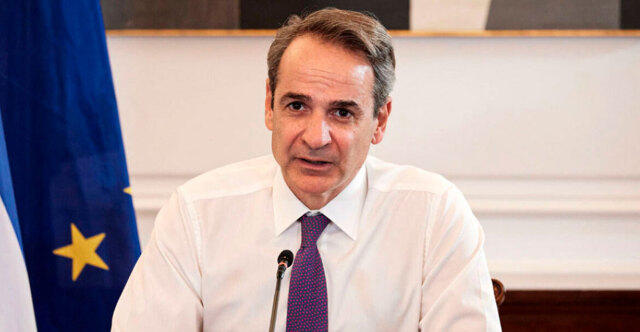
Greek Prime Minister Kyriakos Mitsotakis used his first Sunday review since a two-week August break to tell Turkey that Greece's pursuit of dialogue and good neighbourly relations does not mean backing down from its rights. He also flagged new economic measures to be unveiled at the Thessaloniki International Fair, known by its Greek initials DEZ, in two weeks.
Responding to renewed objections from Ankara over Greece's Special Spatial Planning Framework for renewable energy and the revival of Turkish claims about so-called "grey zones," Mitsotakis said Greece acts on the basis of international law, exercises its rights, and will not let threats or unlawful claims determine its decisions. He said Greece consistently seeks dialogue and good neighbourly relations with Turkey, but stressed that dialogue does not mean retreat, and does not mean Greece will stop doing what it considers right and necessary for the country.
Wildfires and the human toll of August
Mitsotakis said wildfires have become a reality confronting the whole of Europe, especially in summer months. He said climate change does not start fires but makes conditions far more difficult once they break out. According to the National Observatory of Athens, strong winds persisted for 20 days this summer at levels unusual even for the Greek meltemi season, significantly hampering firefighting efforts. In some cases, including in Boeotia and Western Attica, aerial firefighting units could not fly for periods of time.
Despite the difficult conditions, he said the area burned in Greece this summer was smaller than in previous years and compared with other Mediterranean countries. Firefighting forces and volunteers have tackled more than 500 forest fires since the start of August and over 2,700 since the beginning of the fire season. At least 1,000 people were evacuated in time by boat from active fire fronts, and as many homes and businesses as possible were saved.
Mitsotakis said human lives were nonetheless lost, and that this overshadows anything else that can be said about the firefighting effort. He said his thoughts are first with the families of those who died and with everyone who saw their property destroyed or threatened. He said damage assessments in affected areas are continuing so that compensation, benefits and support reach those entitled to them as quickly as possible, and pledged continued support for as long as needed.
Debt repayment and economic outlook
Mitsotakis announced that Greece will make a further early repayment of 13 billion euros in public debt during 2026, on top of 36 billion euros already repaid ahead of schedule since 2019. He said this represents the fastest debt reduction in Europe and marks the end of the period when Greece was the most heavily indebted state in the 27-member European Union.
He described debt reduction as a matter of justice for future generations, saying the country cannot load its children with bills created in the past. He pointed to Japanese credit rating agency R&I, which upgraded its outlook on the Greek economy from stable to positive, citing expectations that growth will remain strong in 2026 thanks to structural reforms and fiscal policy despite global inflationary pressures and tensions in the Middle East. He said he would have more to say on economic matters from the podium of the Thessaloniki fair.
He also announced FinStart, a new Education Ministry initiative launching gradually from the new school year for around 40,000 primary and secondary school students, aimed at teaching practical financial skills, including recognising digital fraud and scams.
Cyprus electricity link and spatial planning
Mitsotakis highlighted an agreement bringing French investment group Meridiam in as majority shareholder in the Great Sea Interconnector, the company behind the Greece-Cyprus electricity link, with French firm Nexans undertaking construction and laying of the cable. He called the deal a strong vote of confidence in Greece's energy infrastructure, saying it would end Cyprus's energy isolation and strengthen Greece's role as a regional energy hub.
He also said Greece's new Special Spatial Planning Frameworks for tourism and renewable energy, first discussed in his review of 24 May, have now taken effect, with an accompanying framework for industry due to be completed within days. He said the tourism framework recognises that some areas have already faced heavy tourist pressure and need greater protection, while others still have room to grow, and that the renewables framework introduces stricter limits in sensitive areas including small islands, Natura sites, forests and archaeological sites.
Crete water projects and farm subsidies
Mitsotakis said work is moving forward on water management projects in Lasithi, Crete, following the signing of a contract covering two independent irrigation networks at the Chochlakia reservoir and the Agios Ioannis dam in Ierapetra. The first section, in the municipality of Sitia, is expected to be operational within 18 months, with the full project completed in 42 months.
He also announced that the new myAGRO digital platform (myagro.aade.gr) is now the point of submission for 2026 agricultural subsidy applications, replacing handwritten lease filings and linking payments to verified data. Farmers who apply by 15 September are expected to receive an advance payment by 31 October, with other applications processed by 30 November. Applications can now also be submitted on farmers' behalf by agronomists, veterinarians, foresters, accountants and accounting firms.
New rules on unpaid energy bills and cancer insurance
Mitsotakis announced a new Environment and Energy Ministry regulation targeting so-called "energy tourism," in which some consumers leave unpaid bills behind and switch repeatedly between electricity providers. Under the new rule, suppliers will be able to flag overdue debts to grid operator DEDDIE, and once a consumer accumulates three such flags, they will be unable to switch provider until the debt is paid or a repayment plan is arranged. He said the rule does not affect people facing genuine financial hardship who are trying to settle their obligations.
He also said the government is enshrining in law a "right to be forgotten" for people with a history of cancer, a step first taken in April 2024 through the insurance industry's code of conduct. Under the new law, five years after completing treatment, provided there is no relapse, data from an earlier cancer diagnosis cannot be used in insurance contracts linked to loans or other credit agreements. Greece chose a five-year period, compared with the up to 15 years allowed under the relevant European directive.
Tributes and sporting successes
Mitsotakis paid tribute to three prominent figures in Greek letters, intellectual life and applied politics who died in August: sociologist Konstantinos Tsoukalas, philosopher Stelios Ramfos and politician Stefanos Manos. He said each offered a different perspective on Greece, with Tsoukalas analysing the contradictions of Greek society within the international environment, Ramfos exploring the country's deeper roots, and Manos seeking practical solutions to longstanding weaknesses.
He closed by congratulating Greek athletes for a string of successes in August in athletics, swimming, rowing, sailing, shooting and gymnastics, following earlier wins in men's and junior women's water polo. He named Miltiadis Tentoglou, Emmanouil Karalis, Eleftherios Petrounias, Anna Rousou, Rodothea Mitropoulou, Nikoleta Iakovaki, Kyriaki Christou, Antonios Siskos, Giorgos Mouselimis, Anastasios Chiotis, Sofia Alexiou, Anna Mouratidou, Elpida Triantou, Konstantinos Samaras, Christina Theodorakopoulou, Petros Gerochristos, Anna Markantonaki, Nikolaos Baxevanakis and Nikolantonakis, thanking them, their coaches and their families.