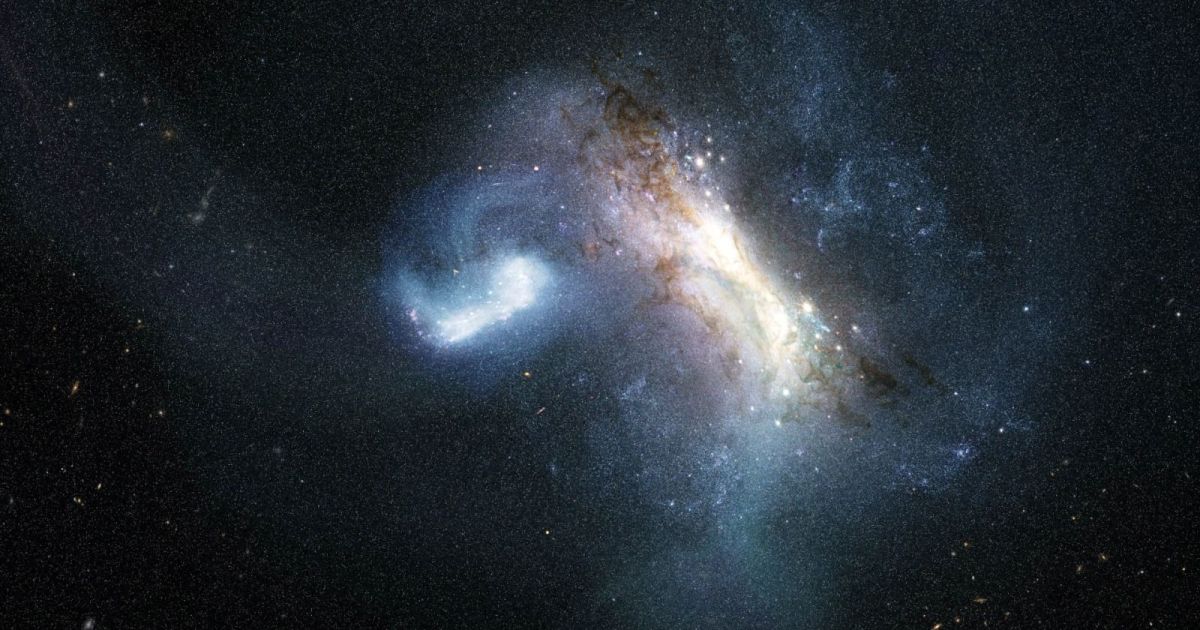
The Milky Way absorbed a smaller dwarf galaxy roughly 11.8 billion years ago, according to new research that documents the oldest known galactic merger in our galaxy's history.
Scientists studying star clusters gathered near the center of the Milky Way found evidence of the ancient collision, which took place when the universe was less than 15% of its current age. Researchers said the discovery shows the Milky Way grew not only by forming its own stars but also by merging with smaller galaxies pulled in by its gravity.
Ancient Merger Uncovered
The smaller galaxy is classified as a dwarf galaxy, distinguishing it from larger galaxies such as the Milky Way. Researchers estimate it held stars with a combined mass equal to about 500 million times that of the Sun at the moment of the merger, roughly a quarter of the Milky Way's size at that time.
Studying Star Clusters with Hubble and Gaia
The researchers used the Hubble and Gaia space telescopes to study star clusters, each containing hundreds of thousands of stars, located within the innermost 20,000 light-years of the Milky Way. They assessed the clusters' age, chemical composition and trajectory. A light-year, the distance light travels in a year, is about 9.5 trillion kilometers.
These stars became part of the Milky Way following a galactic merger that occurred roughly 2 billion years after the Big Bang, the event that created the universe, the researchers said. The dwarf galaxy they came from was named Low-energy-Kraken-Heracles, or LKH, in recognition of three earlier studies that had examined the possibility of such a primordial merger.
Davide Massari, an astrophysicist at Italy's National Institute for Astrophysics (INAF) in Bologna and lead author of the study published in the journal Nature Astronomy, said the main conclusion of the research was the unambiguous discovery of the first merger event experienced by the Milky Way in its infancy.
Whether the Milky Way's early growth was driven by star formation within the galaxy itself or by a galactic merger has long been debated, Massari said. The new study indicates that the merger injected a large volume of stars and interstellar gas, which fuels star formation, as well as the mysterious substance known as dark matter, into the Milky Way early in its history.
Peaceful Stars, Explosive Gas
Massari said that from the stars' point of view, the merger was fairly peaceful, with no collisions between stars. But from the gas's point of view, he said, the merger was more explosive, and the collision between LKH's gas and the Milky Way's gas likely triggered the formation of many new stars.
Massari said there are probably many stars that originally formed in the dwarf galaxy and remain buried in the inner regions of the Milky Way, some within star clusters. Because of the large amount of interstellar dust in that region, however, it is very difficult to identify individual stars, he said.
Other Galactic Mergers
The Milky Way is known to have been involved in two other massive galactic mergers. It absorbed a dwarf galaxy called Gaia-Sausage-Enceladus about 1.8 billion years after the merger with LKH. Over roughly the past 6 billion years, it has also been merging with the Sagittarius dwarf galaxy.
Massari said each of these mergers influenced the events that led to the formation of our own solar system and, ultimately, Earth. He said this is why he believes reconstructing the pieces of the Milky Way's past effectively contributes to answering the larger question of where we came from.