

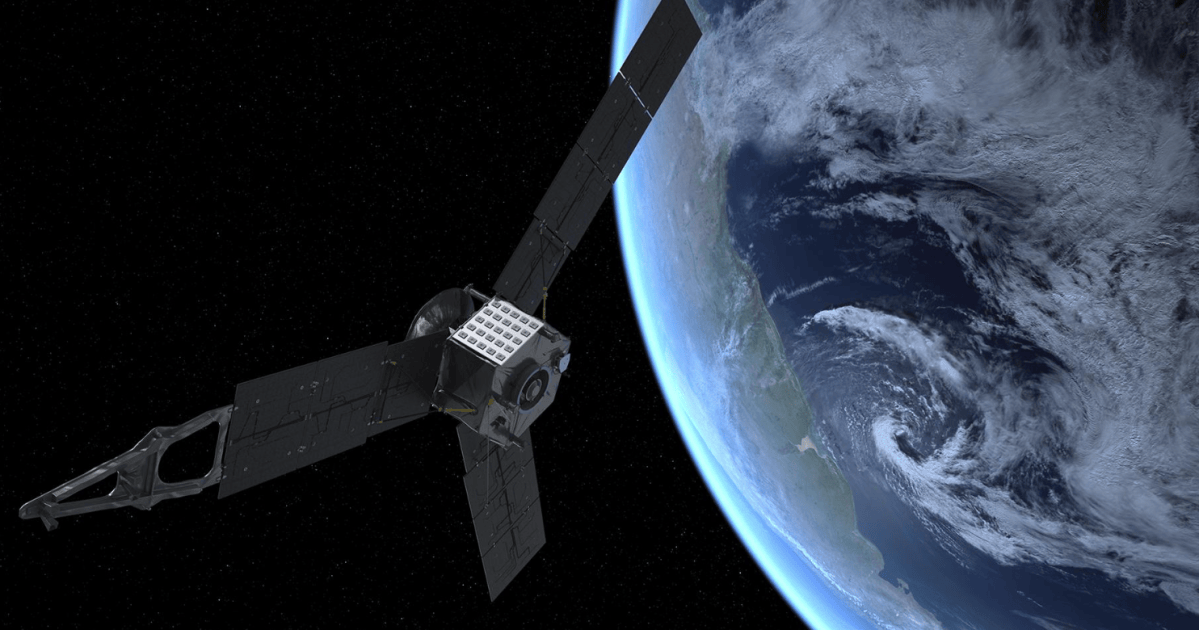
The European Space Agency's Juice spacecraft passed close to the outer edge of Earth's atmosphere on Monday, using planetary gravity to alter its route toward Jupiter with minimal fuel.
According to information from the European Space Agency, the maneuver deflected the Juice spacecraft by an angle of 20 degrees relative to its previous trajectory and increased its speed by 3.5 kilometers per second.
The probe skimmed just 8,640 kilometers above the Indian Ocean during the flyby. In the four weeks leading up to the pass, spacecraft operators executed only a single small adjustment to place Juice on the exact approach path required to maximize Earth's gravity.
Onboard monitoring cameras captured a series of images as the probe flew past the planet. Angela Dietz, the Juice spacecraft operations manager, said the flyby maneuver required ultra-precise real-time navigation, adding that meticulous planning allowed the team to use only a small amount of the propellant reserved for the operation.

Testing instruments in deep space
Although the primary objective was altering the probe's trajectory, the flyby also offered a third opportunity to test Juice's scientific instruments against a real surface in space. Claire Vallat, a Juice project scientist and initiative leader, explained that the journey to Jupiter provides few opportunities to calibrate and validate instruments in well-understood environmental conditions.
The spacecraft completed its first instrument calibration opportunity during a combined Moon-Earth gravity assist in 2024. A second testing window occurred in 2025 during observations of comet 3I/ATLAS.
The Jupiter Icy Moons Explorer, known as Juice, is a deep-space mission operated by the European Space Agency, an intergovernmental organization dedicated to space exploration. Designed to explore Jupiter, the largest planet in the solar system, the spacecraft carries scientific payload suites to study the gas giant and its ice-covered moons.
Preparing for Jupiter's moons
Agency officials noted that despite the operational complexity of Monday's maneuver, an Earth flyby is relatively simple compared to the 35 flybys Juice will carry out around Jupiter's moons, such as Ganymede and Europa. Operational discussions for the Europa flybys began ten years ago and will continue until Juice passes by the moon in the early 2030s.
Passing close to Earth gives engineers a chance to calibrate instruments, determine how best to operate them in deep space, where performance differs from ground conditions, and develop data analysis tools. The close passes by the icy moons, however, will present the true challenge of the mission.
Final Earth flyby and trajectory
In January 2029, Juice will meet Earth for the final time, returning for a third flyby of the planet. That maneuver will place the probe onto its final trajectory to arrive at Jupiter in 2031.



