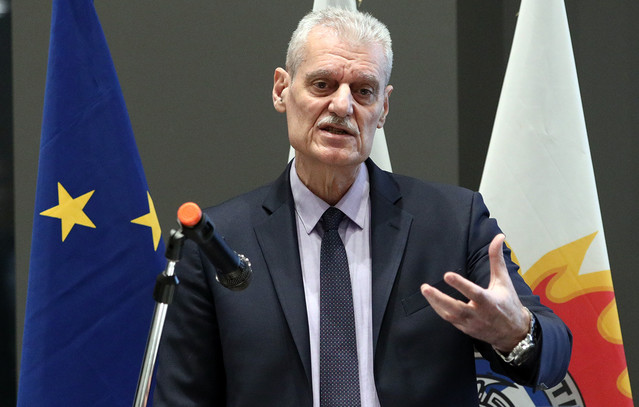
Greek Climate Crisis Minister Evangelos Tournas defended civil protection efforts in Parliament as lawmakers passed new natural disaster recovery legislation. Speaking during the closing parliamentary debate on housing and state assistance following natural disasters, Tournas outlined the government strategy for handling summer wildfires and presented operational statistics from the current fire season.
The post-disaster assistance bill passed on principle by a parliamentary majority, supported by the ruling New Democracy party while opposition parties voted against it. A related amendment containing emergency measures for foot-and-mouth disease also secured majority approval, receiving support from New Democracy, opposition from the Communist Party of Greece, and present votes from other political parties.
Tournas reported that Greek emergency forces responded to 3,250 wildfires during the current fire season, which runs from May 1 to the present. Describing Greece as a Mediterranean wildfire hot spot, the minister noted that countries across Europe faced severe weather conditions this year. Nations that historically do not experience widespread blazes, including England, Wales, Belgium, and Germany, recorded unusual fire activity alongside heavy damage across southern Europe.
Across the Mediterranean region, wildfires burned 3 million stremmata of land in Spain, 1 million stremmata in France, 900,000 stremmata in Italy, and 650,000 stremmata in Portugal. In comparison, Greece recorded 300,000 stremmata of burned land. A stremma is a traditional Greek unit of land area equal to 1,000 square metres or one tenth of a hectare.
Wildfire damage concentrated in four major blazes
The minister told lawmakers that 99.7 percent of the 3,250 wildfires in Greece were tackled immediately and effectively during the initial response phase, relying on established civil protection doctrine and operational planning. However, two thirds of all burned territory in the country was destroyed during a single four-day period across just four major fires. Those four blazes accounted for 200,000 stremmata of the 300,000 stremmata burned nationwide.
Two of the most destructive fires broke out on July 29 and July 30 in Southern Rethymno on the island of Crete, affecting the Municipality of Agios Vasileios, Krya Vrysi, and Kourtaliotiko Gorge. Extreme weather conditions fueled the flames, with wind speeds exceeding 120 kilometres per hour that physically knocked people down and prevented aerial units from operating.
Four helicopters dispatched to Rethymno immediately after the blazes broke out were unable to descend due to violent winds and severe air turbulence. Flight crews reported dangerous conditions and were forced to abort their mission and land. Additional aircraft sent from Elefsina Air Base near Athens, including two Canadair CL-415 water bombers and six Air Tractor fire-retardant planes, were also unable to drop their payloads. The Air Tractor aircraft were forced to dump their retardant into the sea to safely return to Tatoi Airfield.
Ground crews fought the Rethymno fires without aerial assistance for the following three days, with the blazes ultimately burning 50,000 stremmata of countryside. The disaster resulted in three firefighter deaths. Two operational firefighters lost their lives in the flames while on duty in Rethymno, while a third firefighter, an officer, died on the same day fighting a separate wildfire in Gytheio in the southern Peloponnese region. Tournas expressed deep sorrow over the loss of the three officers, describing their deaths as a profound shock to the Fire Service.
Severe weather hampers firefighting in Attica and Boeotia
Similar weather conditions affected central Greece during the same period. According to meteorological data from the national weather service METEO, wind speeds surpassed 110 kilometres per hour across the Parnitha and Penteli mountain ranges near Athens. On July 31, two major blazes erupted in Western Attica and neighboring Boeotia.
The first blaze started at Xiromoni in Boeotia between 7:00 and 7:30 in the morning, followed by a second fire 20 kilometres south on Mount Kithaironas, above the village of Agios Vasileios. Gale-force winds drove the flames rapidly up steep mountain slopes, moving faster than ground units could deploy.
Airborne firefighting aircraft heading toward Xiromoni and units on routine patrol were diverted to Mount Kithaironas. However, high winds prevented pilots from collecting water from the sea or making targeted drops. Between the outbreak of the fire and 12:30 PM on the following Saturday, command authorities issued 51 aerial dispatch orders, but none of the aircraft could operate safely due to severe weather. Tournas noted that the forced grounding of aircraft illustrated how vital aerial support is for ground crews fighting fires on difficult terrain.
Across the remaining 3,245 wildfires where ground and air units operated together without weather restrictions, fires were contained in their initial stage. Those blazes burned a total of 100,000 stremmata, averaging 31 stremmata per incident. Tournas highlighted that figure as proof of system capability when all civil protection assets can deploy effectively.
Defense of the 112 emergency warning system
Addressing parliamentary debate over public safety protocols, Tournas defended Greece's 112 emergency warning system against political criticism. Some critics had labeled the text-alert system an excuse for official inaction or a lazy command to flee. The minister argued that public criticism of emergency warnings creates dangerous hesitation among citizens when deciding whether to follow evacuation orders.
Tournas cited four separate instances during the fire season where emergency services had to launch sea rescues for people who remained on beaches despite receiving evacuation alerts. In Agios Vasileios, Boeotia, a village situated in a mountain basin with a single access road, a wildfire broke out at 9:04 AM. Civil protection authorities logged a preventive evacuation message via 112 at 9:37 AM, refuting claims that alerts were delayed until noon.
While some motorists evacuated immediately, many visitors, beachgoers, and local residents remained in the village. By afternoon, the fire descended the slopes of Mount Kithaironas toward the settlement. Anticipating that trapped individuals could not escape by land, emergency officials dispatched newly acquired Fire Service vessels, including the Mouzakitis ship and a fast Rafnar craft.
Working with the Regional Governor of Central Greece and the Mayor of Thebes, authorities coordinated a sea evacuation from Agios Vasileios to nearby Livadostrata, where waiting buses transported evacuees to safety. Similar coastal evacuations were conducted during wildfires in Salamina, on the island of Lemnos near Thanos beach, and at Siviri in Kassandra on the Halkidiki peninsula.
Concluding his address, Tournas emphasized ongoing structural upgrades under the national Aegis civil protection program, including investments in new vessels, personnel recruitment, and preventive infrastructure work alongside local municipalities. According to reports from the Athens-Macedonian News Agency, the minister urged all political parties to treat emergency alert systems with care to maintain public trust and prevent future tragedies.