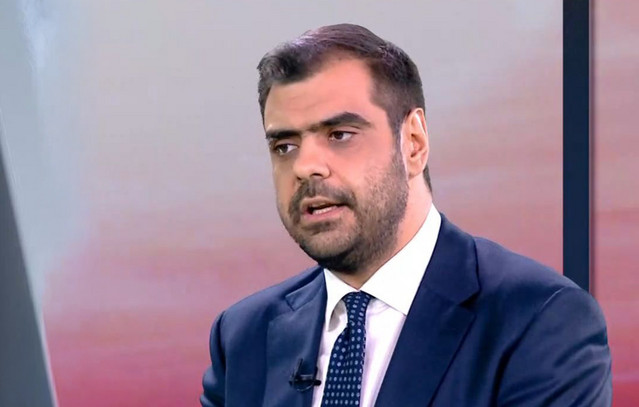
The Greek government has dismissed any possibility of a post election coalition with former Prime Minister Antonis Samaras, declaring that New Democracy seeks a single party majority.
Government spokesman Pavlos Marinakis told Mega Radio there was absolutely zero chance of working with Samaras. He said the disagreement was political and stemmed from the former leader criticizing the government over its foreign policy.
Marinakis said a politician who describes the most effective foreign policy since the restoration of democracy as treasonous could never sit at the same table as the current administration. He added that no one could discuss sharing power while calling a foreign minister a traitor or an appeaser.
Samaras, a former New Democracy leader, was expelled from the ruling conservative party following his criticism of the government.
Marinakis said the conflict was not personal and that Prime Minister Kyriakos Mitsotakis had not questioned the contribution Samaras made during his time in office. He said the government did not escalate the dispute, calling the expulsion an inevitable development.
Samaras ran as a New Democracy candidate in the 2023 elections and helped secure the result. Marinakis said the party did not dismiss anyone's contribution but could not sit idle when facing political attacks.
When asked if Samaras could demand Mitsotakis step down as a condition for a coalition, Marinakis reiterated that there would be no joint government.
He said New Democracy aims for an absolute majority, calling it the only clear proposal for governance. If the party finishes first without enough seats to govern alone, it will use its first exploratory mandate to try to form an administration.
Marinakis said he does not underestimate public opinion polls, but believes New Democracy can perform better in elections by working harder and keeping a low profile. He said a government should be built around the winning party, with that party's leader serving as prime minister. Touching on a debate over the party charter, he noted Mitsotakis had highlighted its rules and said citizens chose prime ministers, not closed offices.
Differences with political rivals
Following remarks by an associate of Alexis Tsipras, the spokesman also ruled out a coalition with the former prime minister and former leader of the left wing Syriza party. He cited major political differences, particularly regarding economic policy.
Marinakis said the current government generated revenue without raising taxes or debt, attributing a different economic approach to Tsipras. He also noted that the center left Pasok party, now the main opposition, had moved closer to the political space represented by Tsipras.
Addressing the potential for Ilias Kasidiaris, a jailed former lawmaker for the neo-Nazi Golden Dawn party, to participate in future elections, Marinakis said the matter rested with the Supreme Court.
He noted the government had passed legislation allowing a party to be banned from running if its actual or nominal leader had been convicted of specific crimes. He said he was not the judge and that the court would decide.
To combat the far right politically, Marinakis pointed to the government record on migration. He said the number of irregular migrants staying on Greek islands had dropped from about 50,000 to roughly 3,000.
Inflation and the cost of living
On the economy, Marinakis acknowledged that Greece was experiencing one of its most persistent periods of price increases, with the pressure falling heaviest on middle and low income households.
He said high living costs were an objective fact and a government obligation to address, rather than an exclusively Greek problem. He added that the national economy was improving and incomes were rising despite an inflation crisis affecting all of Europe, though he said wages needed to increase faster.
Marinakis cited Eurostat figures showing Greece below the European inflation average in some sectors and above it in others. He said Greece ranked higher than more than 10 countries in net income for single households and for couples with or without children.
The spokesman called the economy a two sided coin and said highlighting only economic disaster painted an incomplete picture.
Cumulative inflation in Greece over recent years has topped 20 percent, while the average wage has increased by about 31 percent. Marinakis acknowledged that these averages did not reflect every household, as some citizens faced steeper cost increases for expenses like rent.
He noted Greece had entered the inflationary period after a long economic crisis that wiped out incomes. The current government is reducing public debt and avoiding new borrowing to fund state interventions, he said.
Tax cuts and market controls
Support measures depend on European fiscal rules and additional state revenue. Marinakis pointed to a 400 euro payment to pensioners as an example, saying it was not enough and more interventions were needed, provided they were fiscally viable.
Responding to criticism that the government acted too late on prices, he said 91 tax cuts had been implemented or planned over the past seven years. Tax revenues are increasing despite lower rates because of job creation, investment, higher exports and efforts to tackle tax evasion, he said.
The government has room for 2.2 billion euros in additional interventions in 2027. The prime minister has announced about 1.25 billion euros in new measures, alongside steps already in place.
Market inspections are continuing. Marinakis said Greece lacked a properly staffed market control service until 2020. He said authorities had imposed tens of millions of euros in fines, with inspections revealing that about one in ten businesses broke the law, though he stressed that not all supermarkets were violating the rules.
Relations with Turkey
Discussing Greek relations with Turkey, Marinakis said ties went through periods of high and low tension, adding that calm waters were not an end in themselves.
He said the goal was to strengthen Greece while maintaining dialogue and a good climate, but noted that seeking good neighborly relations did not mean compromising on red lines.
Greece recognizes only the delimitation of the exclusive economic zone and the continental shelf as a dispute with Turkey, which Marinakis said must be resolved under international law.
He highlighted exclusive economic zone agreements signed with Italy and Egypt, maritime spatial planning, and the expansion of territorial waters in the Ionian Sea to 12 nautical miles. He also listed defense upgrades including F-16, F-35 and Rafale fighter jets, Belharra frigates, and the Shield of Achilles program.
Greece has strengthened its strategic partnerships and believes in dialogue with its neighbors, including Turkey, he said.
Marinakis said there was no sign of a diplomatic or military incident on the horizon, urging against creating panic, though he cautioned against complacency.
Referring to remarks by the justice minister, Marinakis said Greece's geographic location and the international climate required a stable government capable of managing crises, citing the 2020 border emergency in the Evros region. He said it was better to have an administration experienced in handling national issues effectively.
Wiretapping investigation
Addressing a state wiretapping scandal, Marinakis said he did not underestimate the issue but stressed that the matter was in the hands of judicial officials.
He noted that selecting the leadership of the justice system involved the plenary of the Supreme Court expressing its opinion.
The government will not tell the justice system what to do, he said, adding that party offices and television debates could not substitute for court rulings.
He said the government would respect court decisions regarding the surveillance cases, according to the Athens Macedonian News Agency.