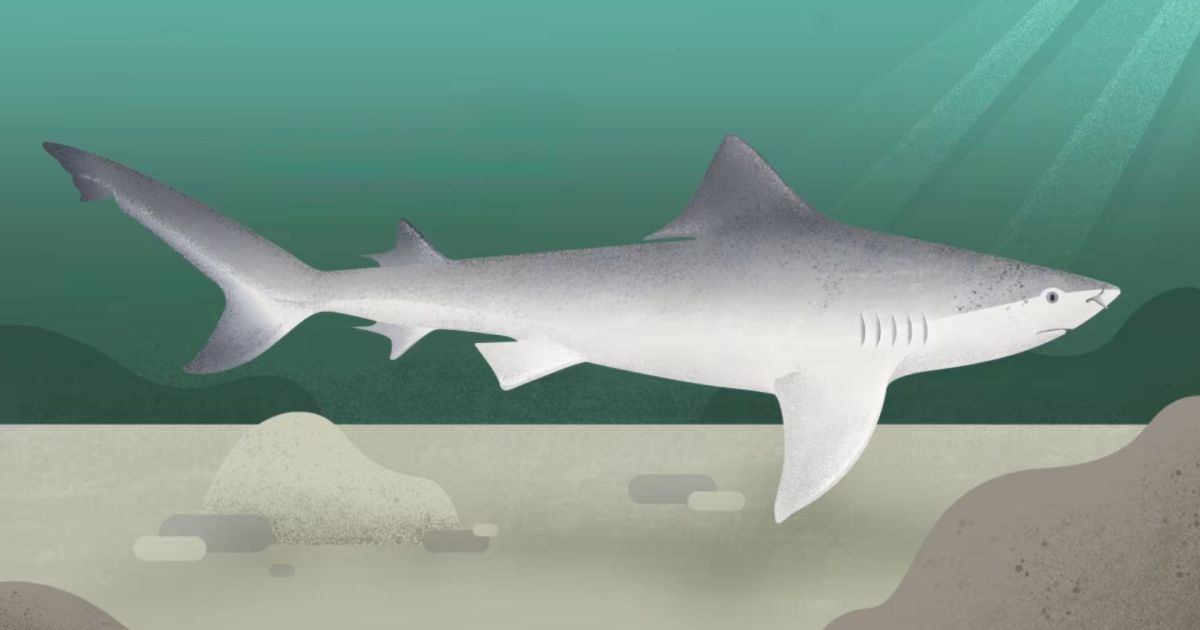
A potentially viable population of critically endangered Ganges sharks has been discovered in the Sesayap River in North Kalimantan, Indonesia.
Led by Australian researcher Michael Grant, scientists identified 43 specimens across two expeditions to Indonesian Borneo, a region where the species was not previously known to live.
The Ganges shark is one of only three river shark species in the world, inhabiting murky, brackish waters. Biologists estimate that roughly 240 adults remain across Pakistan, India, Bangladesh, Malaysia and Myanmar, with the last published sighting near the Ganges River recorded in 2017.
First sightings in Borneo
In 2023, Grant, a researcher at James Cook University in Australia, led an exploratory team alongside colleagues from the University of Borneo Tarakan and Hasanuddin University to North Kalimantan.
While visiting a village along the Sesayap River, Grant met a local fisherman who had accidentally caught 17 Ganges sharks in a single week. Grant noted that this single catch exceeded the total number of Ganges sharks identified worldwide over the previous 20 years.
Grant explained that researchers had long suspected the sharks were present in the rivers of Borneo, but no scientific expedition had previously searched for them.
Indonesian doctoral student Benaya Simeon of Charles Darwin University, who participated in the field trip, described the find as an exciting and important breakthrough. Simeon said she had not expected such habitat to persist in North Kalimantan given human population density and pressures from mining and palm oil plantations.

Following the initial discovery, the International Union for Conservation of Nature Species Survival Commission Shark Specialist Group designated the Sesayap River as an Important Shark and Ray Area in 2024.
The research team returned to North Kalimantan in May 2026 to conduct further field investigations and initiate conservation measures for what Grant described as potentially the last viable population in the world.

Threats from fishing and bycatch
Grant declared the 2026 expedition a resounding success, adding that most local communities were happy to act as guardians for the species. He explained that the sharks are unlikely to be targeted deliberately because local villagers do not like their taste and their thin fins hold little value in commercial markets.
Although risks from illegal hunting or trafficking remain small, accidental mortality from fishing activity poses an ongoing threat.

The fisherman who captured 17 sharks in 2023 used a standard hook and line intended for snapper and croaker, as well as a gillnet. Fieldwork in 2026 uncovered additional dried fins in local villages, bringing the total documented specimens to 43 across both trips.
Grant warned that local fisheries can be highly dynamic and fishermen might switch to targeting other species using gear that increases accidental shark catches. He emphasized that establishing legislation, including gear prohibitions or exclusion zones, is vital before fishing practices change.
Sarah Fowler, a scientific advisor at the Save Our Seas Foundation who was not involved in the research, described the number of Ganges sharks found in North Kalimantan as extraordinary.

Fowler expressed concern over an emerging threat driven by the multi-billion dollar dried fish swim bladder industry, a Chinese delicacy that is partly harvested illegally. She reported hearing accounts of commercial trawlers moving into areas of Kalimantan that had been sustainably fished for generations.
Fowler noted that fish swim bladder harvesting has a much wider bycatch footprint than shark finning, placing the Ganges shark directly in the line of fire.
Challenges in securing legal protection
Protecting the elusive species presents significant scientific and regulatory challenges. Simeon said researchers currently possess very limited data while racing against the threat of extinction.

Dr. Fahmi, a principal researcher at Indonesia's National Research and Innovation Agency who joined the May 2026 expedition, stressed that extreme rarity is not an obstacle to legal protection. He pointed out that Indonesia already protects rare species such as the sawfish and the Kai stingray.
Dr. Fahmi said the research team will share findings and recommendations with local government officials to build national urgency for regulations. The process will involve public consultations and evaluations of the economic impact on rural communities with limited employment outside fishing.
While Grant described the legal pathway for protection as straightforward, Dr. Fahmi cautioned that the government requires comprehensive data on species status, distribution, population trends and community value, which remain scarce.
Dr. Fahmi suggested that area-based protections might prove more effective than species-specific rules, as the Ganges shark shares its habitat with already protected species including Irrawaddy dolphins and giant freshwater stingrays.
Enforcing future regulations presents another hurdle. A 2023 survey of 221 local fishermen in North Kalimantan found that only one person knew three local stingray species were nationally protected.

Community incentives and future outlook
Simeon observed that while scientific records of the Ganges shark in the area did not exist before 2023, local residents have likely known of the species for generations. She stressed that modern science cannot work in isolation and advocated for government incentives such as improved schools, healthcare and public services.
Simeon added that conservation efforts will prove far more sustainable if protecting the species delivers tangible benefits to local people.
With other Ganges shark populations potentially pushed beyond recovery, researchers remain optimistic that the population in northeastern Borneo is large enough to make a final stand. Grant noted that he has never seen a live Ganges shark, adding that upcoming actions along the Sesayap River will determine if he ever does.