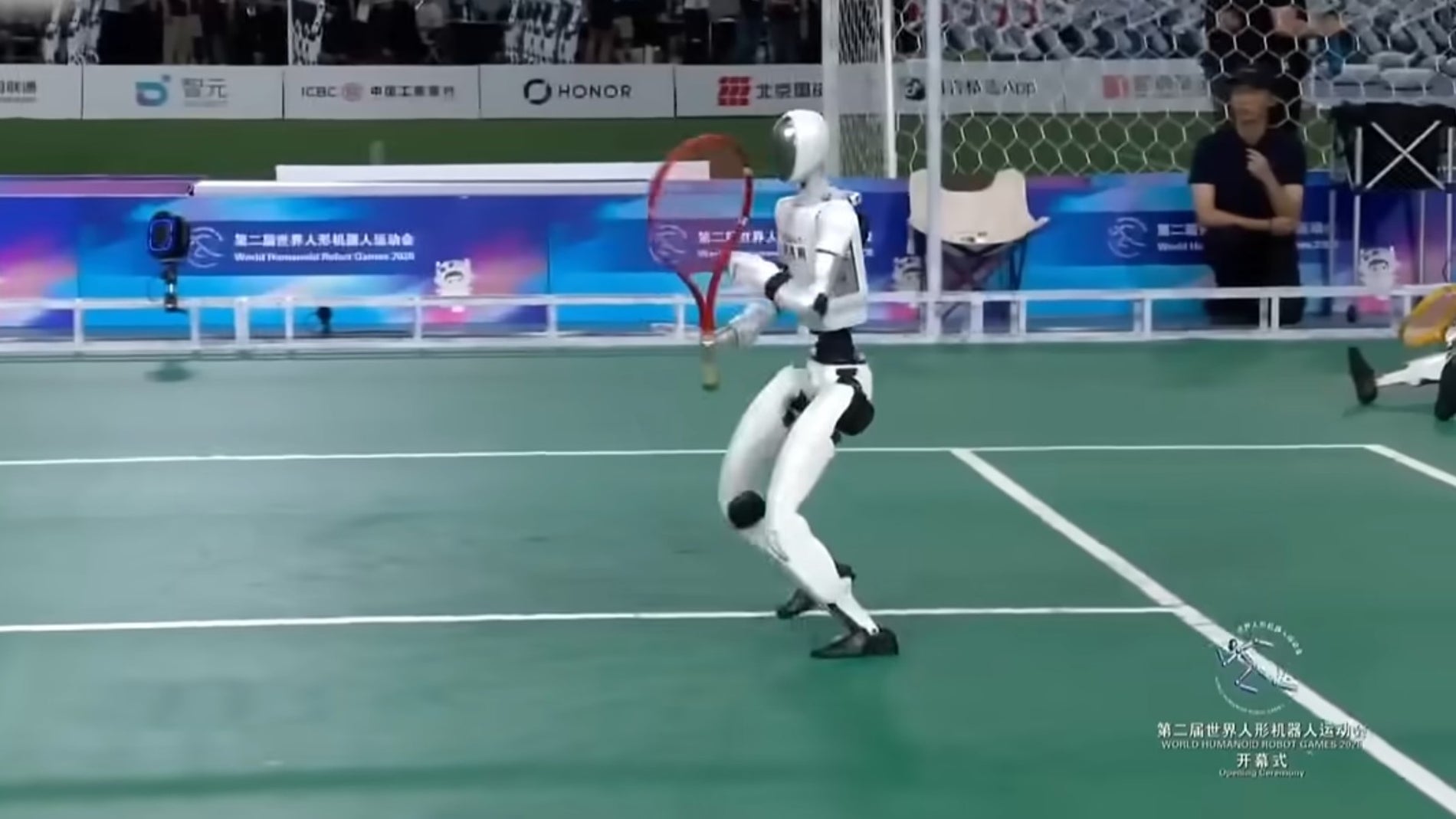
Chinese robotics company Galbot has showcased a humanoid robot that completed more than 100 consecutive rallies in a live tennis match against human players.
The demonstration took place at the Second Humanoid Robot World Games, where the machine played both singles and mixed doubles matches. Its opponents on the court included retired professional tennis player Zheng Jie.
Performance on the court
During the exhibition in Beijing, the robot demonstrated its ability to predict ball trajectories at high speed, adjust precision shots, and maintain dynamic body balance. Galbot said the machine maintained a single continuous rally exceeding 100 hits during the match.
Humanoid robot development has historically focused on industrial assembly lines and manufacturing tasks, raising concerns over potential job displacement. However, sports applications require real-time processing and complex movement that go far beyond structured factory environments.
Tennis demands rapid trajectory prediction and body coordination similar to the physical standards set by elite players such as Rafa Nadal, Roger Federer, Serena Williams, and Venus Williams. Galbot designed its android to handle these athletic demands through rapid posture adjustments and precise racket impacts.
Training with LATENT technology
To prepare the robot for the sport, the company used a specialized training system called LATENT. The software breaks tennis practice down into small, independent foundational tasks, which the robot then combines into more complex movements.
Galbot said the machine required only five hours of basic movement training, using data gathered from amateur tennis players as its baseline. This initial training enabled the robot to execute the various strokes and reactions needed to return shots across the net.
The system complements LATENT with reinforcement learning and large-scale simulations, allowing the robot to evaluate changing match conditions in a fraction of a second. Reinforcement learning is an artificial intelligence method that trains autonomous systems through trial and error feedback.
Fall recovery and entertainment robotics
Although the mechanical athlete suffered occasional trips and falls during the exhibition, it was able to stand up and recover by itself immediately. The system adjusted its stance and hit selection according to the trajectory of incoming balls while maintaining natural biomechanics.
Galbot said the demonstration shows that robotics technology is successfully transitioning from industrial applications into leisure and sports entertainment. The progress reflects a broader diversification of research efforts among Chinese technology companies.