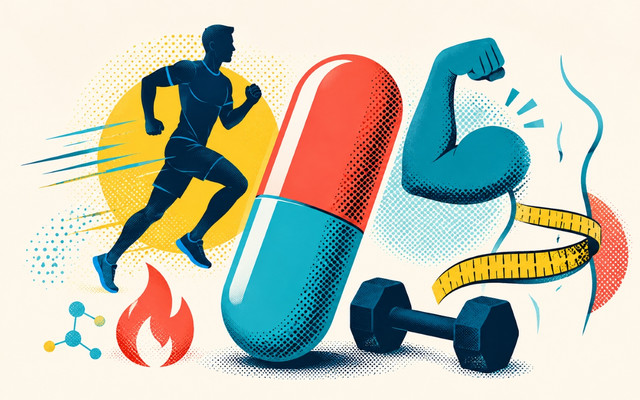
Scientists have moved a step closer to what once sounded like science fiction: a pill that could safely deliver some of the benefits of exercise, including muscle growth and weight loss.
Pharmaceutical company Enveda announced the results of a Phase I clinical trial for its experimental drug ENV-308, which is designed to mimic a substance the body produces during physical exercise.
In the trial involving healthy volunteers, ENV-308 appeared to be safe and effective. According to the company, the goal is essentially to translate the chemistry of exercise into a daily pill, offering a sustainable and practical option that could fit into everyday routines and support long-term health.
How ENV-308 works
ENV-308 mimics a molecule discovered relatively recently called N-lactoyl-phenylalanine, or Lac-Phe for short. The human body appears to produce larger amounts of Lac-Phe during intense exercise as well as after eating. Studies have shown the molecule helps suppress appetite, and obese mice given Lac-Phe lost weight.
Those findings sparked scientific interest in the molecule's potential as an obesity treatment. However, the Lac-Phe naturally produced by the body remains in the system for only a short time. ENV-308 was designed to last long enough to be taken as a once-daily pill.
What the first human trial found
The first clinical trial of ENV-308 in humans involved 88 healthy adults, who received different doses of the drug. Phase I clinical trials are primarily aimed at assessing the safety of an experimental drug, and according to the initial results, the "exercise pill" passed this first test successfully.
No serious adverse effects were reported among the volunteers, and no participant stopped taking the drug. The company also said ENV-308 showed an excellent gastrointestinal safety profile. The trial provided some early signs that Lac-Phe works the way researchers hope.
The link to leptin
People with obesity are known to often have elevated levels of leptin, a hormone that helps send signals of fullness during eating. One prevailing hypothesis is that this happens because the bodies of people with obesity gradually stop responding to leptin as effectively as they should.
In studies conducted on obese animals, ENV-308 rapidly reduced leptin levels, suggesting it may be able to reverse this dysfunctional response. During the human clinical trial, researchers also found lower leptin levels in participants' blood.
A benefit for muscle mass
Loss of muscle mass during drug treatment is a significant problem for people using GLP-1 drugs for weight loss, particularly for more vulnerable groups such as older adults.
For them, an obesity treatment that could better preserve muscle mass could offer significant benefits. ENV-308 appears to achieve exactly that.
Can it really replace exercise?
The research is still at a very early stage, and experts note that even if ENV-308 proves as beneficial as scientists currently believe, it will not be able to fully replace the need for physical exercise, whose benefits are numerous and not limited to preserving muscle mass.
Enveda plans to continue testing ENV-308 in a larger Phase II clinical trial, aiming to further investigate its effectiveness and whether it could also be used for other conditions that might benefit from effects similar to those of exercise.
The ultimate goal is to prove that the drug can safely reproduce, or even enhance, some of the most beneficial effects of physical exercise. What is certain is that the idea of pharmaceutically mimicking some of the mechanisms activated when we exercise is no longer just a science-fiction theory.