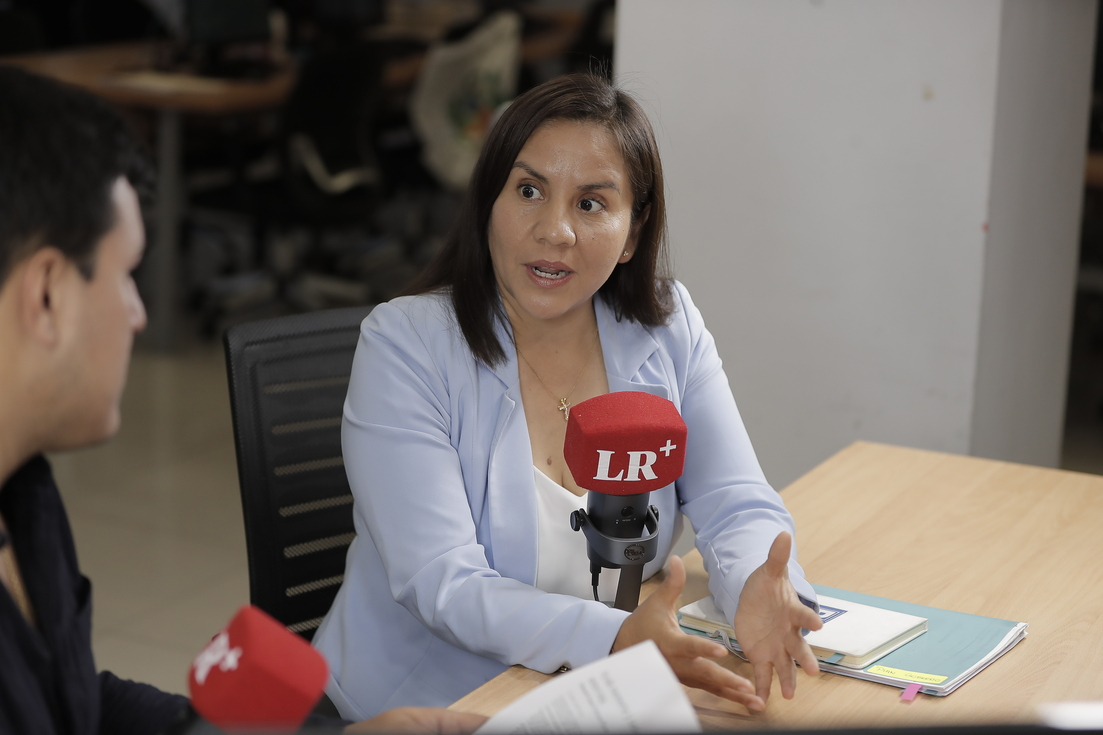
Popular Renewal mayoral candidate Elizabeth Cabezas has challenged Marco Vidal to a public debate, accusing current Ate Mayor Franco Vidal of seeking re-election through his father.
Speaking on the Elige Bien 2026 electoral platform hosted by newspaper La República on Monday, September 21, 2026, Cabezas urged Marco Vidal to stop hiding behind his son's screen and address district voters directly. Cabezas, a current Ate councilwoman on leave, said she is running to offer clean leadership in Lima's third most populous district, emphasizing that she holds no criminal or judicial record.
Reflecting on her tenure as councilwoman, Cabezas stated that she was one of the few local officials who fulfilled oversight duties. In 2023, during the first six months of the current administration, municipal security cameras were entirely out of service until she publicly exposed the failure. Last year, she also denounced the mayor's administration for using the municipal institutional image department to build up the mayor's personal social media accounts. Cabezas noted that her oversight work resulted in death threats and intimidation, but said she remained firm in filing formal complaints.
Cabezas said Ate residents currently face a choice between ongoing neglect and a push for security and order. She described how street vendors, local merchants, and daily commuters live in fear due to rising crime, extortion networks, and demands for protection payments.
Security Proposals and Public Safety Reform
Addressing the district's public safety problems, Cabezas noted that despite turning 205 years old, Ate still lacks a proper municipal monitoring center. Her security plan includes creating a fully equipped monitoring facility featuring artificial intelligence cameras, panic buttons, and surveillance drones.
To combat violence against women and families, Cabezas proposed establishing Punto Violeta assistance centers to support victims from initial reports through legal resolution. Drawing on her experience as a former judicial advisor for the Judiciary, a community agent, and a mentor for the Ministry of Women, she noted that many victims abandon complaints due to a lack of guidance, which sometimes leads to femicides. She clarified that the municipal program would operate alongside existing Women's Emergency Centers run by the Ministry of Women.
Cabezas also outlined a triangular security strategy involving the Ate municipality, local police stations, and neighborhood watch committees. Under the plan, the municipality will take charge of leading the District Committee for Citizen Security, which she accused the current mayor of neglecting. She added that while police affairs are not a municipal responsibility, she would use political management to seek support from the Renovación Popular congressional caucus.
As part of her security reforms, Cabezas pledged to regularize municipal security officer salaries. She pointed out an internal pay disparity where long-serving officers earn between 1,200 and 1,300 soles per month, while newly hired officers receive 2,500 soles.
Municipal Budget and Infrastructure Projects
Addressing how she would fund her proposals under tight fiscal conditions, Cabezas emphasized that Ate has a large municipal budget ranging between 300 million and 500 million soles. However, she criticized the current administration for allocating only 38 million soles to citizen security and executing just over 60 percent of that allocation with three months left in the year. She stated that previous administrations similarly failed to execute full budgets, resulting in returned or carried-over funds. Cabezas pointed to her professional background as a licensed administrator as key to managing public funds effectively.
To tackle unauthorized land invasions and address the lack of water and sewage systems, Cabezas announced a plan to issue a municipal ordinance on January 1, 2027. The measure will create a technical office responsible for preparing engineering files for retaining walls and stairways in hillside communities.
Under the initiative, the municipality will allocate 5 million soles from its budget to supply 200 communities with 1,000 bags of cement each during her first year in office. Cabezas explained that local residents would provide the labor, offering a fast alternative to bureaucratic processes where community leaders report winning projects in participatory budgeting only to be told funds are unavailable. She projected that the cement program would expand to benefit 400 communities within two years.
Cabezas specified that the cement distribution will prioritize high-altitude areas across the district's 7 zones and 48 sectors. Initial projects will focus on upper sections of Huaycán, Horacio Zevallos, Zone 3 in Túpac Amaru, and Zone 5 in Santa Clara's Hijos de Apurímac neighborhood, contrasting their urgent needs with more developed areas like Salamanca.
Transit Infrastructure and Political Comparisons
Regarding traffic congestion caused by an informal bus stop on the Carretera Central in Huaycán, Cabezas promised to enforce order and municipal authority. She stated that her initial approach would involve dialogue with bus operators, proposing that they acquire private land to build a proper terminal with safety features. However, she warned that if operators fail to comply after discussions, her administration will apply firm measures to clear the roadway.
When asked to address her criticism of Franco Vidal in light of similar political criticism surrounding Renovación Popular leader and Metropolitan Lima Mayor Rafael López Aliaga, Cabezas defended López Aliaga. She argued that previous Lima mayors lacked the resolve to address major urban issues for decades. She cited the Ramiro Prialé expressway, opened over 25 years ago, as a key route that continues to assist traffic in eastern Lima despite remaining incomplete.
Cabezas contrasted regional projects with local management in Ate, criticizing Franco Vidal for leaving local works half-finished, such as projects at Cerro Candela that left houses precariously exposed. She stated that if López Aliaga secures leadership in Metropolitan Lima, proposed projects will include a direct access bridge connecting Huaycán to the Ramiro Prialé expressway and a road link between Javier Prado Avenue and the Ramiro Prialé highway.
Highlighting transportation difficulties as a mother whose university-aged son spends up to two hours commuting daily on stalled buses, Cabezas stressed the need for better public transit. She noted that construction on Metro Line 2 remains stalled under national government jurisdiction and pledged to lobby central authorities to fully reactivate the subway project.
Cabezas concluded the interview by renewing her challenge to Marco Vidal to engage in a public debate regarding public safety plans and commitments to protect children and families in Ate.