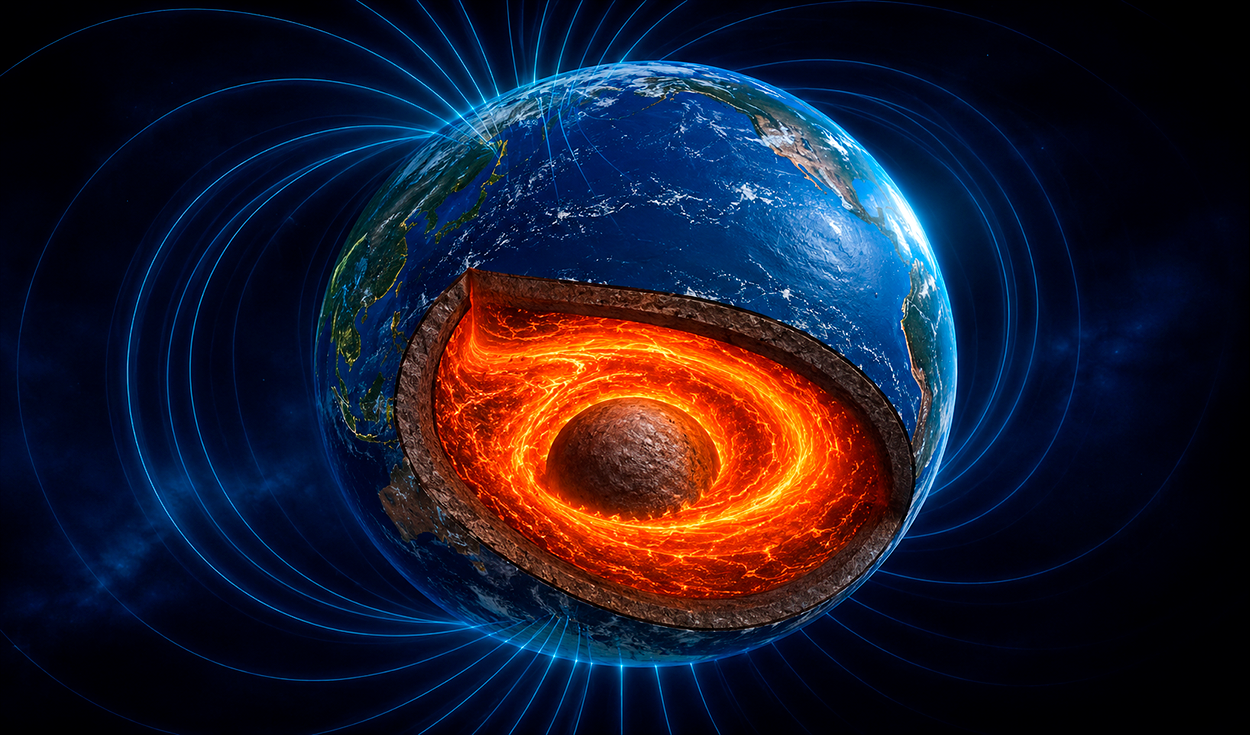
A liquid iron current in Earth's outer core, more than 2,000 kilometers beneath the Pacific Ocean, reversed direction to flow east, European Space Agency data showed.
The findings, published in the Journal of Studies of Earth’s Deep Interior, challenge the theory that molten metal currents maintain stable patterns over extended eras. Analysis of satellite data demonstrates that certain regions undergo drastic reorganizations within a few years.
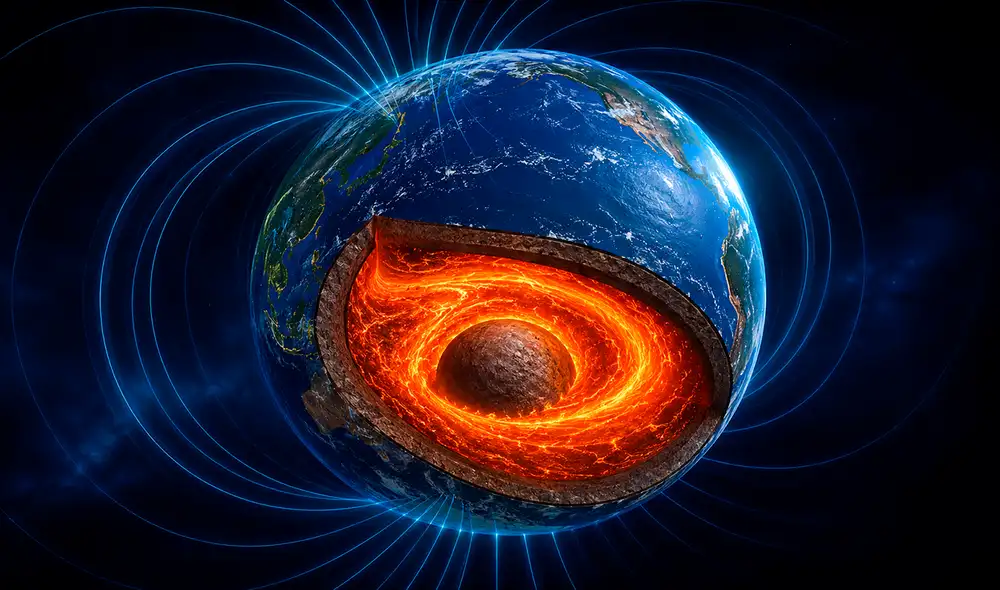
A team from the University of Edinburgh and the British Geological Survey evaluated satellite and surface records from 1997 to 2025. By studying secular variation, which is the alteration in planetary magnetism caused by conductive matter, scientists reconstructed circulation near the core-mantle boundary using data from the Ørsted, CHAMP, CryoSat-2, and Swarm satellite missions.
Reversal of the Pacific iron stream
Models show that the deep tide historically moved westward. However, under the equatorial Pacific, a slowly moving band inverted its route toward the east around 2010.
Frederik Dahl Madsen, the project leader, said in an ESA statement that the large-scale flow reversal under the Pacific raises new questions about the behavior of Earth's deep interior. The cause of the phenomenon remains uncertain, though experts connect the acceleration to seismological fluctuations in Earth's core.
Simulations show that the eastward push began losing strength after 2020, with no confirmation of a return to its previous trajectory. Madsen said scientists must still clarify whether the event is a short-duration fluctuation, part of a repetitive oscillation, or a new stable equilibrium.
Impact on Earth's magnetic shield
The European Space Agency clarified that the discovery rules out any immediate risk of magnetic pole reversal or the disappearance of Earth's magnetic field. The shift is a localized change in the liquid iron layer beneath the Pacific Ocean, while the rest of Earth's deep structures maintain normal, stable behavior. The alteration presents no direct threat to the population and does not alter the planet's climate balance.
The process remains critical because the electrically conductive liquid flowing around the solid inner core generates the geodynamo. This geodynamo builds the natural shield that deflects solar radiation particles to prevent severe damage to the atmosphere and modern technological infrastructure.
The recorded magnetic fluctuations affect the precision of navigation instruments, satellite operations, and near-space climate simulations. Understanding the change will help scientists forecast future geomagnetic behavior and investigate interactions between the lower mantle and inner layers.
Elisabetta Iorfida, a specialist with the Swarm mission, said the study shows regional changes can emerge quickly, in just a decade. Subsequent orbital tracking will determine whether the stream loses power, regains strength, or forms part of an undocumented cyclic oscillation.