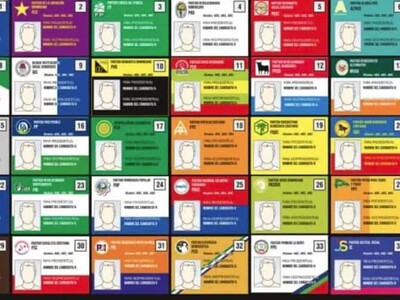
More than 60 percent of people in the Dominican Republic do not identify with a political party, a new national poll has found.
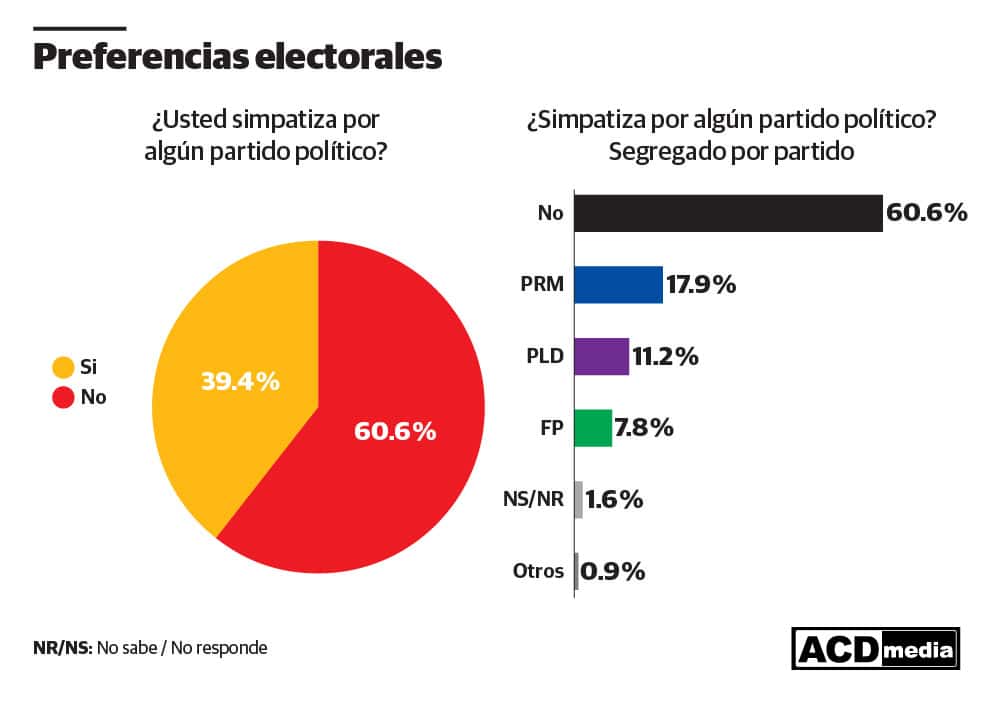
The ACD Media survey recorded 60.6 percent of respondents saying they have no sympathy for any political organization. The figure represents a 6.1 point increase in just three months, rising from 54.5 percent in May and 55.6 percent in July.
Just 39.4 percent of the country acknowledges supporting a specific party. Despite the loss of partisan loyalty, most citizens remain willing to vote for the country's major political organizations.
The ruling Modern Revolutionary Party, known as the PRM, drew just 17.9 percent of sympathy in the poll. The opposition Dominican Liberation Party, the PLD, recorded 11.2 percent, and the Fuerza del Pueblo party registered 7.8 percent.
However, when asked who they would vote for if presidential elections were held today, the three parties gathered a combined 68.1 percent of the vote.
The PRM captured 29.1 percent of voting intention, the Fuerza del Pueblo took 20.5 percent, and the PLD drew 18.5 percent.
Fading political identities
The gap indicates that a large proportion of the electorate is willing to vote for organizations they do not belong to.
For decades, the major Dominican parties functioned as political communities and electoral machines. Being a member of a party was often part of a voter's personal and family identity, supported by active local branches, political education programs and deep loyalties passed down through generations.
Voters are increasingly treating parties as temporary vehicles to cast a ballot rather than permanent spaces for political participation.
The change follows a blurring of ideological lines. The major organizations now compete largely on their candidates, government performance and ability to manage the state, rather than on clearly distinct social projects. With doctrinal boundaries fading, there is less incentive to build a permanent identity around a party acronym.
Changing party structures
A generational shift has also weakened traditional party ties. A growing part of the electorate did not live through the major political conflicts of the 20th century and did not develop their identity around founding leaders like Joaquin Balaguer, Jose Francisco Pena Gomez or Juan Bosch.
Younger generations increasingly inform themselves, debate and organize in digital spaces, where it is more common to temporarily support people and causes than to adopt lasting party loyalties.
The major political organizations have responded by transforming from groups of activists into largely electoral structures. Routine community organizing and discussion have lost importance, with party structures only activating in the lead up to primary votes, candidate selections and general elections.
Divisions within the Dominican Revolutionary Party, the PRD, and later the PLD have further fragmented historic loyalties. The splits showed voters that leaders and activists could easily move between organizations.
Party switching, unfulfilled promises, and a perception that political activity is heavily focused on accessing public jobs and government contracts have contributed to a more transactional relationship with voters.
Regional comparisons
A Dominican paradox has emerged, where parties are losing their social roots while maintaining considerable institutional strength through public funding, elected offices and government positions.
The Latin American experience shows this process does not necessarily lead to the immediate disappearance of political parties. Chile experienced a deep erosion of its old political identities before the subsequent fragmentation of its political system, while Peru offers a more extreme case of weakened organizations and short-term electoral vehicles.
The Dominican Republic is still far from those scenarios, but the 60.6 percent figure recorded by ACD Media points to a crisis of representation, even if it does not yet indicate a terminal crisis for the parties.
The poll surveyed 1,200 people between August 8 and August 11, with a 95 percent confidence level.