

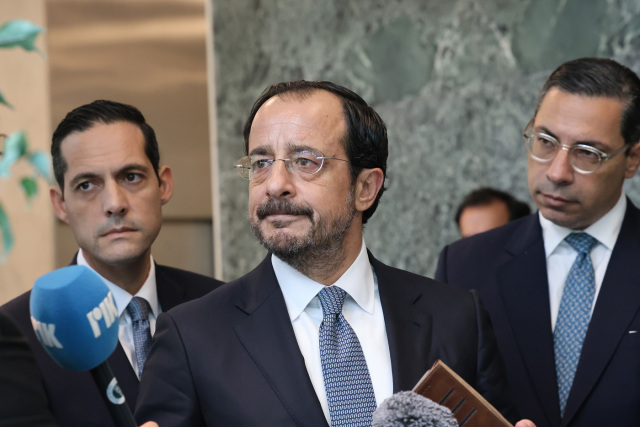
Cypriot President Nikos Christodoulides will meet Turkish Cypriot leader Tufan Erhurman and United Nations envoy Maria Angela Holguin in Nicosia on Monday for tripartite talks.
The meeting is scheduled for 11:00 am at the residence of the head of the United Nations mission, inside the protected buffer zone in the capital.
Expectations for the talks remain low, although the session could produce an agreement on opening new crossing points across the dividing line and clearing landmines.
Deeper political differences continue to block the resumption of formal peace negotiations, with Turkey reiterating its demand for a two-state settlement that sits outside United Nations Security Council parameters.
Cyprus has been divided since 1974, when Turkish forces invaded the north following a Greek-backed military coup. The Republic of Cyprus holds international recognition and European Union membership, while only Ankara recognises the breakaway Turkish Cypriot administration in the northern third of the island.
Proposed border crossings and demining
Diplomatic activity in recent days has centered on confidence-building measures, specifically a package to ease travel between government-controlled areas and the northern territory.
According to information released by Turkish news agency ANKA and reported by Cypriot media, Holguin is seeking agreement on a package that includes four new crossing points and demining operations.
Public consultations have focused on proposed crossings at Mia Milia, between Athienou, Pyrogi, and Aglantzia, in the Louroujina and Lympia area, and between Kampos and Karavostasi. The proposal for Kampos and Karavostasi is linked to an alternative route bypassing the Kokkina pocket.
These locations remain proposals rather than a final agreed list. The Greek Cypriot side supports the package, with the Cypriot government stating that Christodoulides submitted several alternative suggestions to resolve differences over crossing points.
Erhurman said he is ready to discuss confidence measures, but insisted that negotiators must examine the specific proposals already on the table.
Demining talks have faced disagreements over the extent of areas to be cleared. By Saturday morning, neither side had issued an official joint announcement confirming that disputes were resolved, and officials noted that any political deal will require technical arrangements and an operational timetable before checkpoints can open.
Agreements on culture and Famagusta proposal
Recent diplomatic work has already produced modest cooperative steps. A joint United Nations announcement confirmed that both leaders agreed on October 20 to advance initiatives on the environment and the exchange of cultural artifacts.
Christodoulides and Erhurman followed that agreement on October 27 with joint contacts involving the Technical Committee on Cultural Heritage, the Technical Committee on Youth, and civil society representatives.
Cypriot presidential press office director Victoras Papadopoulos said yesterday that the government has also raised a proposal to return the fenced-off city of Famagusta under United Nations administration and open its port under European supervision.
That proposal remains the subject of political debate, with no confirmed agreement from the Turkish Cypriot side for its implementation.
Dispute over negotiating methodology
The most significant political dispute concerns the negotiating methodology, which will establish the rules for talks, the sequence of issues, and the consequences of any future breakdown.
Erhurman has put forward four basic positions. He demands prior confirmation of political equality, including a rotating presidency and effective Turkish Cypriot participation in decision-making, and the preservation of convergences reached up to the 2017 Crans-Montana conference so past progress is not renegotiated.
His third position calls for negotiations with a strict timeframe and a results-oriented focus. His fourth aims to prevent Turkish Cypriots from returning to the same status if talks collapse through no fault of their own.
Erhurman maintains that these four points represent methodology rather than preconditions. However, in an interview with the newspaper Politis on October 18, he called for an in-principle acceptance of the rotating presidency before substantive negotiations begin.
The Greek Cypriot side rejects that approach. While accepting political equality as defined by United Nations resolutions, Christodoulides maintains that power-sharing arrangements must be negotiated alongside all other aspects of a settlement.
Christodoulides has proposed cross-negotiation, where different chapters are discussed in parallel so concessions on one issue are tied to arrangements on others. In addition, Erhurman's fourth point remains vague, with no agreed mechanism governing the practical fallout of another failure.
Crans-Montana records and federal solution
Deeper divisions persist over the substance of the problem. The Cypriot government wants negotiations to resume from where they collapsed in 2017 at Crans-Montana, preserving all previously achieved convergences.
The United Nations has completed recording those past convergences, but the two sides have not re-agreed on their full content, and a dispute has broken out over when the document should be delivered.
The Greek Cypriot government wants the text before negotiations restart to ensure a shared starting point. Holguin said the document will only be handed over when talks begin, warning that early circulation could spark new disputes over the interpretation of past agreements.
United Nations Security Council Resolution 2815 of 2026 reaffirmed the basis of a bizonal, bicommunal federation with political equality. Critical issues remain completely unresolved, including security guarantees, the presence of Turkish troops, territorial boundaries, property restitution, and power allocation.
Turkish foreign minister visit and future talks
Ankara highlighted its direct role yesterday when Turkish Foreign Minister Hakan Fidan visited northern Cyprus while Holguin was awaiting responses to her proposals.
Fidan met Erhurman, as well as northern Cyprus prime minister Unal Ustel and foreign minister Tahsin Ertugruloglu. While no comments were made immediately after the meetings, Fidan issued a statement later that evening describing his visit as productive.
Fidan reiterated Ankara's long-standing policy, stating that Turkey views two states living side by side as the most realistic solution and demanding recognition of sovereign equality and equal international status for Turkish Cypriots.
His remarks demonstrated that progress on confidence measures does not mean Turkey will soften its stance on the final settlement. Turkey is a guarantor power alongside Greece and Britain, meaning its participation is required at any conference dealing with security and troops.
Erhurman has avoided adopting Fidan's explicit two-state language in public, focusing instead on methodology and political equality, but officials noted this difference in phrasing does not indicate a policy break from Ankara. Official statements also gave no indication whether Fidan approved or rejected Holguin's specific proposals.
United Nations Secretary-General Antonio Guterres has stated that an expanded five-plus-one conference, involving the two Cypriot sides, Greece, Turkey, Britain, and the United Nations, will only take place after thorough preparation on confidence measures, methodology, and substance.
Holguin expressed optimism after meeting Erhurman on November 2, while Christodoulides said two days ago that the process appeared to foreshadow positive developments. Papadopoulos added that 19 proposals submitted by the Greek Cypriot side offer genuine avenues for progress.
Monday's meeting will not settle the Cyprus problem, but it will test whether both sides can move beyond exchanging proposals to concrete commitments, establishing the groundwork required to restart formal negotiations.


