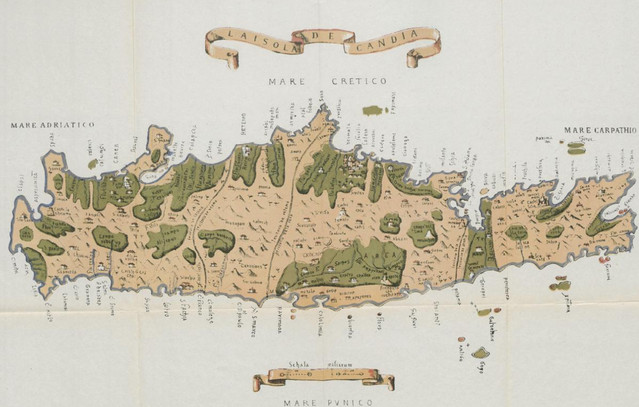
On August 12, 1204, a few months after Crusaders first sacked Constantinople, Crete changed hands in a deal that shaped its history for more than four centuries. Boniface of Montferrat ceded his rights to the island to the Republic of Venice for 1,000 silver marks and other concessions.
The agreement was one of several geopolitical bargains following the Fourth Crusade's capture of Constantinople in April 1204. Western powers and rulers divided the Byzantine Empire's territories, claiming ports, islands and strategic passages in the eastern Mediterranean.
Boniface of Montferrat, a major Crusade leader, held rights to Crete without possessing actual control. For Venice, the island held enormous value as a central hub for its commercial network, sitting on sea routes connecting Constantinople, Alexandria, Syria and the western Mediterranean.
Genoese resistance
Signing the deal did not automatically give Venice control of Crete. The Genoese, Venice's major commercial rivals, moved quickly and seized a significant part of the island under Enrico Pescatore. Years of conflict followed before Venetian rule was established in the early 13th century.
Crete became one of the Most Serene Republic's most important overseas possessions, known to Venetians as the Regno di Candia, or Kingdom of Candia. The Venetian presence faced resistance, with repeated Cretan uprisings and clashes with the Venetian administration.
Over the centuries, a unique coexistence of Greek, Byzantine and Western influences emerged. Crete became a major commercial and artistic centre in the eastern Mediterranean. During the 16th and 17th centuries, the island experienced the Cretan Renaissance, seeing developments in painting, theatre and literature by figures such as Domenikos Theotokopoulos, Georgios Chortatsis and Vitsentzos Kornaros.
Venetian rule ended in 1669 when the present day city of Heraklion surrendered to the Ottomans following a long war and the siege of Candia. More than 450 years had passed since the 1204 agreement placed Crete at the centre of the Venetian Mediterranean empire.
Sewing machines to dinosaurs
In 1851, Isaac Singer patented the pedal sewing machine, leading to the foundation of his namesake company and revolutionising domestic and industrial sewing.
The last known quagga, a subspecies of plains zebra with stripes mostly on the front of its body, died at the Amsterdam zoo in 1883. The animal, which lived in South Africa, went extinct following extensive hunting.
Significant archaeological discoveries were made in the Ancient Agora in 1932, including ostracism ballots belonging to Aristides, offering valuable evidence about political life in classical Athens.
In 1953, the Soviet Union conducted its first thermonuclear weapon test, the RDS-6s, at the Semipalatinsk test site, escalating the Cold War nuclear arms race. On the same day, a 7.2 magnitude earthquake struck the Ionian Islands, completing a destructive seismic sequence that flattened much of Kefalonia, Zakynthos and Ithaca, leaving hundreds dead.
Led Zeppelin and IBM
Jimmy Page, Robert Plant, John Paul Jones and John Bonham played together in a London studio for the first time in 1968, marking the birth of Led Zeppelin.
IBM introduced the IBM Personal Computer in 1981, with an initial price of 1,565 dollars. The IBM PC played a decisive role in the mass popularisation of personal computers.
Japan Airlines Flight 123 crashed in Japan in 1985, leaving 520 people dead and four survivors. It remains the deadliest aviation accident in history involving a single aircraft.
Fossil hunter Sue Hendrickson discovered the largest and most complete Tyrannosaurus rex skeleton ever found in South Dakota in 1990. The skeleton is 65 million years old.
The Russian nuclear powered submarine Kursk sank in the Barents Sea in 2000 following explosions during a naval exercise, killing all 118 crew members.
In 2004, the Kenteris and Thanou doping scandal broke one day before the opening ceremony of the Athens Olympic Games. The two Greek sprinters missed a doping test, followed by a widely discussed motorcycle accident.
Births of Soros and Hollande
George Soros was born in Budapest in 1930. The Hungarian American businessman, investor and philanthropist survived the Nazi occupation thanks to his family's resourcefulness, migrated to London in 1947, and studied economics at the London School of Economics. He founded the Open Society Foundations and became a Wall Street legend, known as the man who broke the Bank of England after shorting the pound in 1992, directing billions to humanitarian causes.
Francois Hollande, French President from 2012 to 2017, was born in Rouen in 1954. He studied at the ENA and became a leading figure in the Socialist Party, managing the European debt crisis, advocating for a united Europe and legalising same sex marriage, known as marriage for all.
Footballers and actors
French footballer Djibril Cisse was born in Arles in 1981. Known as a killer striker for his speed and power, he won the Champions League and FA Cup with Liverpool, was the Greek Super League top scorer in 2010 and 2011 with Panathinaikos, where he was adored as the Mbappe of his time, and played for Auxerre, Marseille, Lazio and Queens Park Rangers despite serious injuries.
Greek goalkeeper Alexandros Tzorvas was born in Athens in 1982. He played for Panathinaikos, OFI, Palermo, Genoa, Apollon Smyrnis and NorthEast United, and was the starting goalkeeper for Greece in all matches at the 2010 World Cup, also appearing at Euro 2008 and Euro 2012. After retiring, he established the Tzorvas Estate in Laconia and appeared as a foreman on the television show The Farm in 2024.
Italian footballer Mario Balotelli was born in Palermo in 1990 to parents of Ghanaian origin. He won the Champions League with Inter in 2010, the Premier League with Manchester City, and scored twice against Germany in the Euro 2012 semi final. Known for his catchphrase asking why it was always him, the striker became a symbol for his talent and eccentric reactions, with his shirtless celebration becoming widely shared.
English actress and model Cara Delevingne was born in Hammersmith, London, in 1992. Named Model of the Year in 2012 and 2014, she starred in Suicide Squad and Valerian, modelled for Victoria's Secret, Burberry and Chanel, and became a millennial icon known for her gender fluid aesthetic and candid discussions about mental health, pansexuality and depression.
Deaths of Kornaros and Lambrakis
Cretan Renaissance poet Vitsentzos Kornaros died in 1613. Born in Sitia in 1553, he wrote the masterpiece Erotokritos, a cornerstone of Cretan literature that combined the demotic language with ideals of love, heroism and freedom. His rich expression still inspires modern Greek poetry and music, helping establish the Cretan dialect as a national literary tool.
Greek journalist and publisher Dimitrios Lambrakis died in 1957. Born in Vamos, Chania, he served as a nurse in the Macedonian Struggle, fought for freedom, and was imprisoned for his political views. He founded the Lambrakis Press Group, publishing To Vima, Ta Nea and Oikonomikos Tachydromos, profoundly influencing Greek public life and journalism.
Today is the name day for Fotis and Foteini.