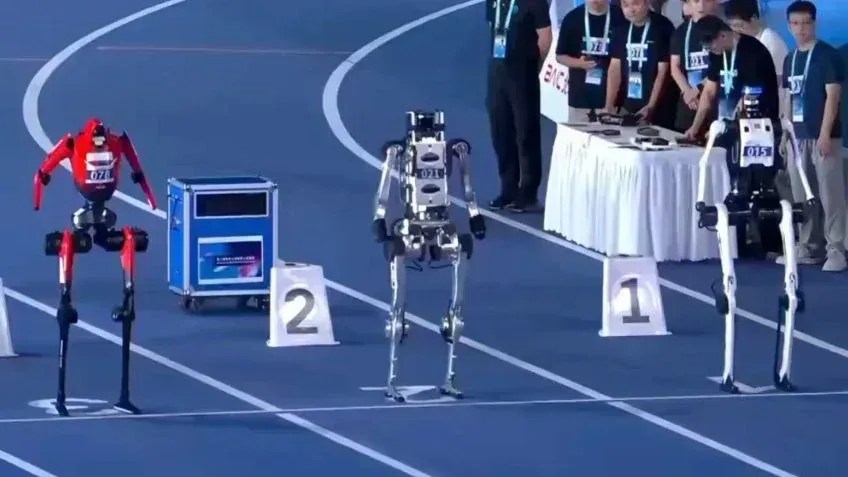
A Chinese humanoid robot named Tiangong Ultra has set a new world record in the 100-metre sprint after completing the race in 8.86 seconds at the World Humanoid Robot Games in Beijing on Tuesday, August 25.
The machine ran more than seven-tenths of a second faster than the human world record of 9.58 seconds set by Jamaican sprinter Usain Bolt at the 2009 World Athletics Championships in Berlin. However, the record run ended with mechanical damage when the robot crashed into a thick safety mat placed beyond the finish line, collapsed on impact, and caught fire in its torso.
Unlike Bolt, who launched powerfully from starting blocks before opening up long strides and swinging his arms for balance, Tiangong Ultra started the race in an upright stance. Its torso remained relatively motionless while electric motors propelled rapid, controlled steps along the track.
The sprint took place during the semi-finals of the large robot category at the five-day tournament in Beijing, the capital of China. The performance marked a significant improvement over the robot's previous mark of 9.39 seconds, which was recorded on the opening day of the competition on Saturday, August 22.
The World Humanoid Robot Games brought together more than 2,000 robots representing 666 teams to compete in a range of athletic and industrial tasks. Bipedal sprint races emerged as one of the primary attractions for spectators throughout the five-day event.
Tiangong Ultra was not the only machine to surpass the fastest human sprint time during the tournament. Another robot developed by Chinese smartphone manufacturer Honor also broke Bolt's world record, although it was unable to run under nine seconds.
Biomechanical differences from human sprinters
According to the Beijing Humanoid Robot Innovation Centre, the research facility that developed Tiangong Ultra, the machine accelerates more slowly from the starting line than several rival robots. However, it possesses a higher top speed, enabling it to recover ground in the closing stages of the sprint.
This acceleration profile differs significantly from the mechanics of Bolt's historical run in Berlin, where the eight-time Olympic gold medallist reached a top speed with stride lengths measuring approximately 2.8 metres. Bolt relied on the full extension of his long legs to cover maximum ground with each stride, supported by flexible joints in his ankles, knees, and hips that absorb impact forces and return kinetic energy.
By contrast, Tiangong Ultra achieved its speed through shorter and faster steps while maintaining minimal arm movement and body rotation. Biomechanical analysis shows that humanoid robots operate under vastly different physical constraints than biological sprinters.
Parunchaya Jamkrajang, a lecturer specializing in sports biomechanics at Mahidol University in Thailand, said that robot developers had done an impressive job of making athletic machines appear more human-like. However, Parunchaya noted that significant technical limitations remain before robots can match human movement.
Parunchaya explained that the upper body of a humanoid robot is typically quite large, while the lower limbs remain relatively small despite the machine's overall height. To maintain balance while running, the robot increases its step frequency rather than extending its stride length, continuously adjusting its base of support so it does not fall over.
Park, a biomechanics expert, noted that human sprinters generate explosive force through muscles and tendons acting on flexible joint systems. By contrast, a bipedal robot relies entirely on electric motors, gear assemblies, battery packs, environmental sensors, and control software.
Park added that a robot generates force most efficiently when its legs move within a smaller range of motion, as extending the limbs further places far greater demands on the joint motors. Recent engineering advances in high-torque joint motors have been critical in enabling rapid running in humanoid machines.
Engineering modifications and physical limits
To prepare Tiangong Ultra for the sprint competition, developers at the Beijing centre redesigned sections of the robot's torso and waist. The structural modifications reduced overall weight and minimized the physical effort required to move the body forward at high speeds.
Guo Yijie, manager of the humanoid robot innovation department at the Beijing centre, said that engineers had also upgraded the robot's motors, expanded its joint range of motion, and refined its control software ahead of the tournament.
Despite the record performance, the 8.86-second sprint highlighted the current physical boundaries of specialized racing robots. After crossing the finish line, Tiangong Ultra was unable to decelerate or alter its path on its own, colliding with a thick stopping mat before collapsing and catching fire.
Other competing machines experienced mechanical failures during the event as well. In another semi-final sprint, a rival robot broke apart mid-race while attempting to run down the track.
Parunchaya told Reuters that while human sprinters possess the innate ability to slow down, turn, and regain balance, current humanoid robots lack multi-directional coordination. Parunchaya said that future developments should focus on smoother movement across multiple spatial planes, enabling robots to change direction or make real-time decisions to avoid crashing into obstacles.