A Chinese Long March 7A rocket exploded about 85 seconds after takeoff on August 10 from the Wenchang space center on Hainan island, marking one of China's major space program setbacks in recent years. The accident destroyed the ChinaSat-4B communications satellite that the rocket was carrying.
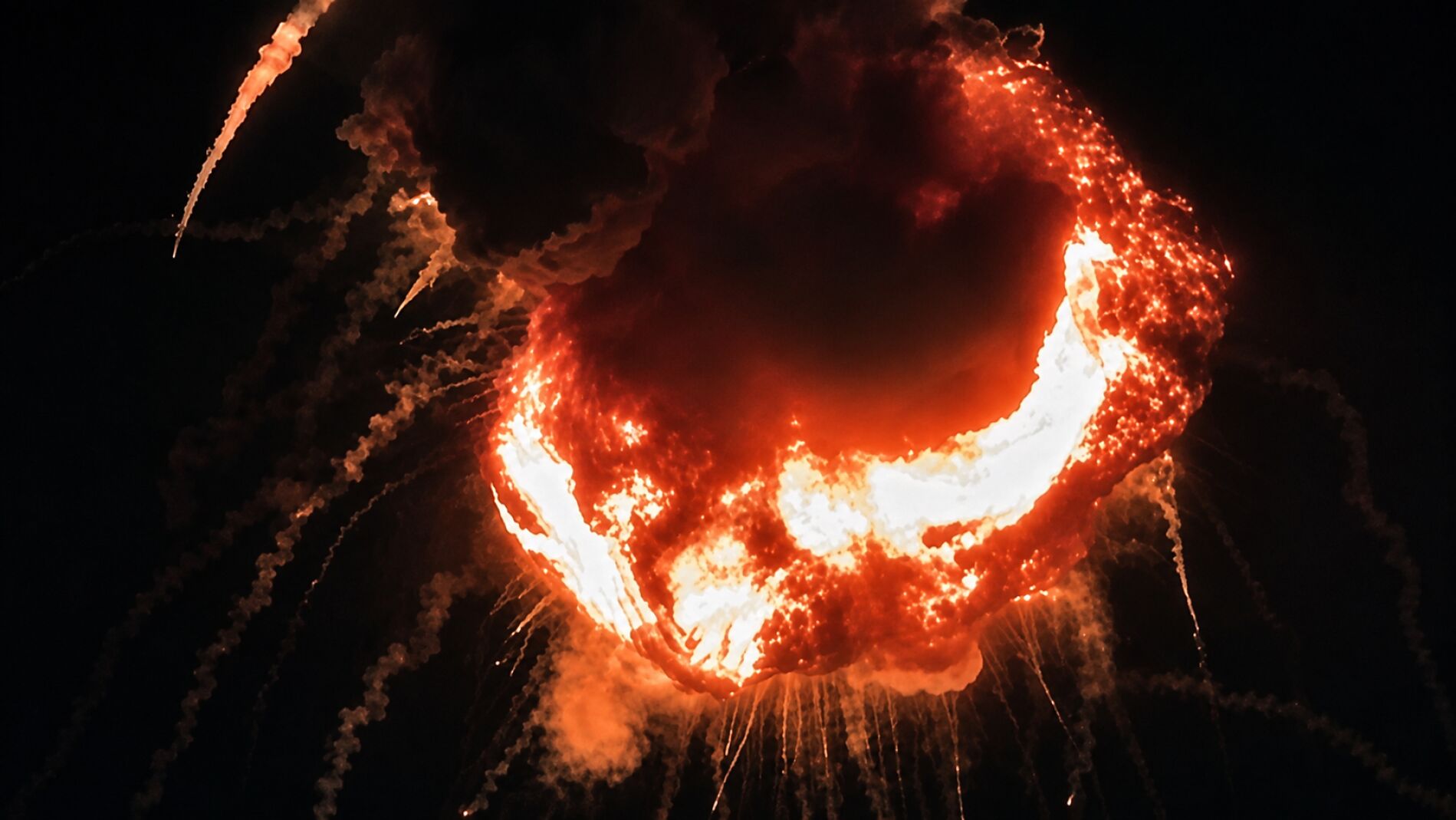
The launch began at 20:02 local time and appeared to progress normally for just over a minute. Ground footage shows the vehicle turning into a massive fireball while still at a relatively low altitude and speed.
Chinese authorities confirmed that an anomaly occurred during flight and that the cause is under investigation, according to Reuters. The accident happened during the first stage of ascent while the primary stage and its four side boosters were operating together.
Some observers suggested that the large visible explosion might correspond to the activation of the rocket flight termination system after a serious failure was detected.
Focus on YF-100 engines
The timing of the failure places attention on the propulsion system. Six YF-100 engines were firing during that phase of flight, with two on the first stage and one on each of the four side boosters.
There is no official confirmation that an engine caused the accident, and other vehicle systems could also be involved.
The Long March 7A is one of China's main launch vehicles for placing large satellites into high orbits. It stands 60.1 meters tall, has a takeoff mass of about 573 tons, and can carry around 7 tons to a geostationary transfer orbit.
The vehicle uses three stages and four side boosters. After the first phase YF-100 engines, it uses four YF-115 engines on the second stage and two YF-75 engines powered by liquid hydrogen and liquid oxygen on the third stage. It is a conventional single-use rocket with non-recoverable stages.
This launch was the 18th mission of the Long March 7A. Its debut in March 2020 ended in failure, but it returned to service in 2021 and completed 16 consecutive successful launches before this week. The 7A variant added a third stage to the original Long March 7 to specialize in high-orbit satellites.
ChinaSat-4B satellite loss
The lost payload, the ChinaSat-4B satellite, is also known as Zhongxing-4B. Beijing has offered few details about the communications satellite.
It belongs to the same series as ChinaSat-4A, which launched in 2024 for voice, data, radio, and television services. Some sources and analysts link these satellites to government or military communications, though China has not confirmed that ChinaSat-4B had that mission.
Potential impact on space operations
The consequences for China's broader space program depend on the investigation findings. If the fault is exclusive to the Long March 7A, the impact could be limited to temporarily grounding this model and delaying planned satellite launches. The loss does not directly affect low Earth orbit constellations, which use different launch vehicles.
A wider problem could emerge if the issue originates in the YF-100 engine or shared components. YF-100 engines and derived variants are used on numerous Chinese launchers, including the Long March 5, Long March 6, Long March 7, Long March 8, and Long March 12.
The engine technology is also key for the future Long March 10 rocket intended for the crewed lunar program. A design or manufacturing flaw could force authorities to inspect a much larger portion of the rocket fleet before authorizing new launches.
One mission under close watch is Chang'e 7, which China is preparing to explore the south pole of the Moon during the second half of this year. The probe will use a Long March 5 rocket, but its four side boosters also rely on YF-100 engines. There are no official indications of a delay, but a systemic engine defect would require inspection and potential modifications before launch.