Chinese scientists led by Kang Wang have developed a microscopic magnetic sensor small enough to fit inside a smartwatch that can detect steel-hulled submarines underwater.
The device was created by researchers at the Hefei Institutes of Physical Science and the Ningbo Institute of Materials Technology and Engineering, both branches of the Chinese Academy of Sciences. According to the official statement from the institutes, the sensor measures just 20 by 20 microns, a size comparable to a grain of dust, where one micron represents one millionth of a metre.
Despite its tiny size, the study authors stated that the sensor possesses superior sensitivity reaching beyond 500 metres. This capability allows the device to detect extremely weak magnetic fields, including the subtle magnetic signature produced by a submarine with a steel hull submerged deep beneath the surface.
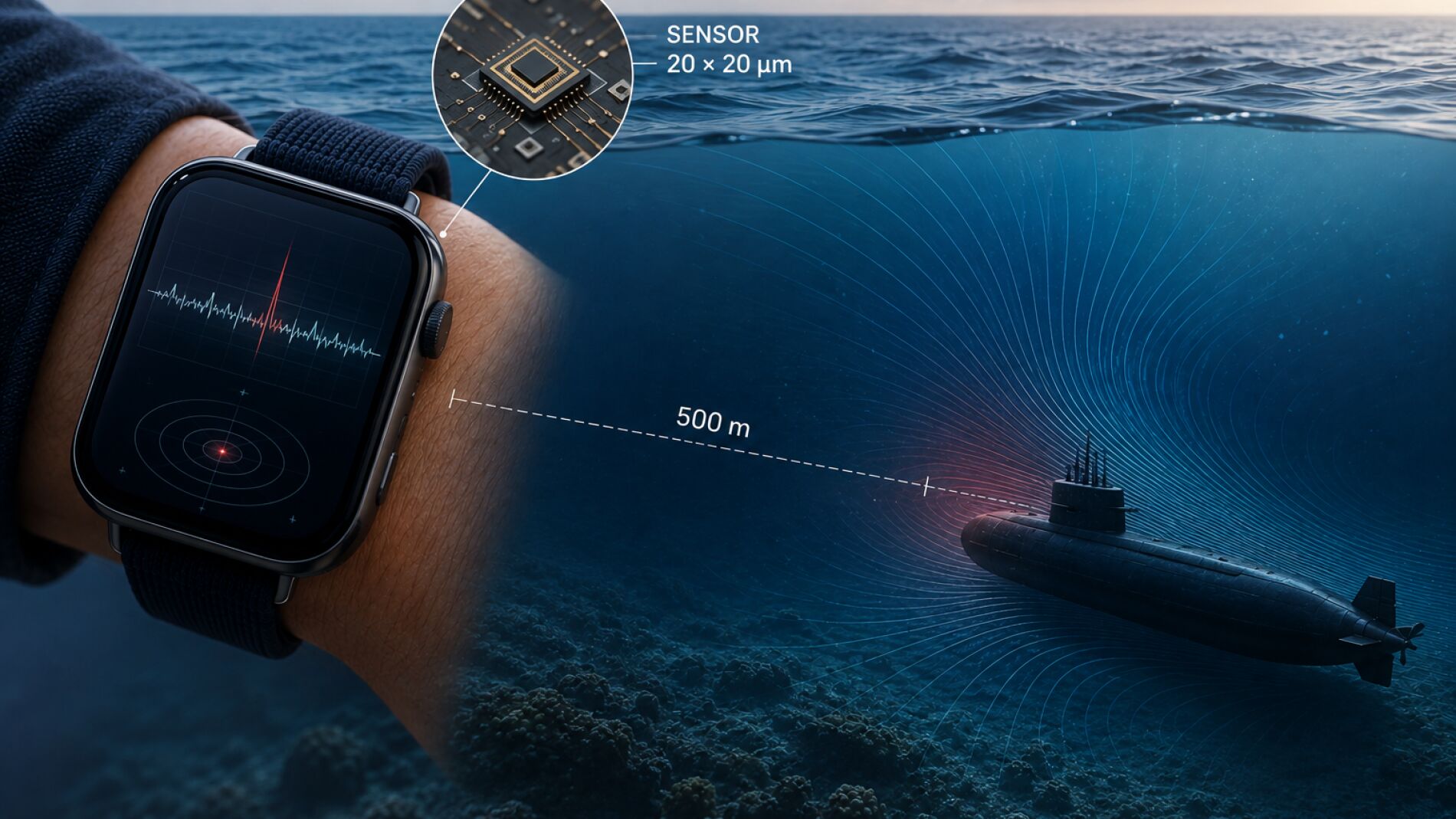
The researchers clarified that the breakthrough does not turn a smartwatch into a traditional acoustic sonar system. Instead, it places a sensor capable of perceiving extraordinarily faint magnetic signals into an everyday electronic component.
The Chinese Academy of Sciences is China's premier national institution for natural sciences, operating specialized research institutes across the country. The Hefei facility in Anhui province focuses on physical science research, while the Ningbo institute in Zhejiang province specializes in advanced materials technology and engineering.
How magnetism reveals hidden submarines
Modern submarines employ sophisticated stealth techniques to evade detection by naval sonar. Submarine designers routinely reduce mechanical noise, install specialized acoustic rubber tiles that absorb sonar waves, and shape propulsion systems to operate silently in deep water.
However, concealing a vessel's magnetic footprint is far more difficult. A submarine contains massive quantities of steel and other metals that disturb the local magnetic field of the Earth. As the large metallic structure moves through this geomagnetic environment, it creates tiny perturbations in the surrounding magnetic field lines.
Military forces have long relied on magnetic anomaly detection to track underwater targets. Because metal hulls distort natural magnetic fields, specialized sensors mounted on maritime patrol aircraft can spot submerged vessels even when their engines are quiet. However, traditional magnetometers are heavy, complex instruments that require substantial mounting hardware.
The magnetic signal generated by a submerged submarine is extremely small and does not cause a standard compass needle to spin. Detecting these subtle variations requires instruments of extraordinary sensitivity that can distinguish genuine target signals from ambient magnetic noise present in the natural environment.
Overcoming the Hall effect noise barrier
The newly developed Chinese sensor relies on the Hall effect, an electromagnetic phenomenon discovered in 1879 by American physicist Edwin Hall. The principle describes how an electric current passing through a conductor experiences a sideways deflection when exposed to a perpendicular magnetic field, generating a measurable voltage difference across the material.
Edwin Herbert Hall discovered this physical effect while conducting doctoral research at Johns Hopkins University in Baltimore. Today, Hall effect sensors are widely deployed across electronic devices, electric motors, position monitoring tools, and automotive control systems to measure magnetic strength and mechanical position.
Engineers attempting to measure extremely weak magnetic fields face a fundamental physical obstacle. Increasing the sensitivity of a traditional Hall sensor normally amplifies background noise, making faint signals harder to isolate. Shrinking the physical dimensions of a sensor typically degrades performance further, compounding the noise problem.
The research team led by Kang Wang successfully overcame this trade-off by engineering a miniaturised Hall sensor that generates a minimal electrical signal without introducing additional noise. This architectural design allows the microscopic device to maintain high sensitivity to minute magnetic variations while remaining small enough to integrate into portable consumer hardware.

Wearable sensors and networked detector swarms
High-sensitivity magnetometers have historically been restricted to large laboratory setups or specialized military platforms due to their size. Bringing this advanced magnetic detection capability to everyday devices could allow mobile phones, autonomous aerial drones, and personal smartwatches to monitor environmental magnetic changes.
The published study did not explicitly detail the effect of linking multiple smartwatches together into a cooperative detection network. However, physical laws dictate that while pairing two watches would not double the overall detection range, deploying an array of 10 interconnected sensors would reduce environmental background noise by up to five times.
Positioning multiple miniaturised sensors at different geographic locations would allow a networked system to collect richer contextual data regarding a detected object. By sharing magnetic data across different points, such a network could provide detailed information about the movement and location of a submerged vessel.