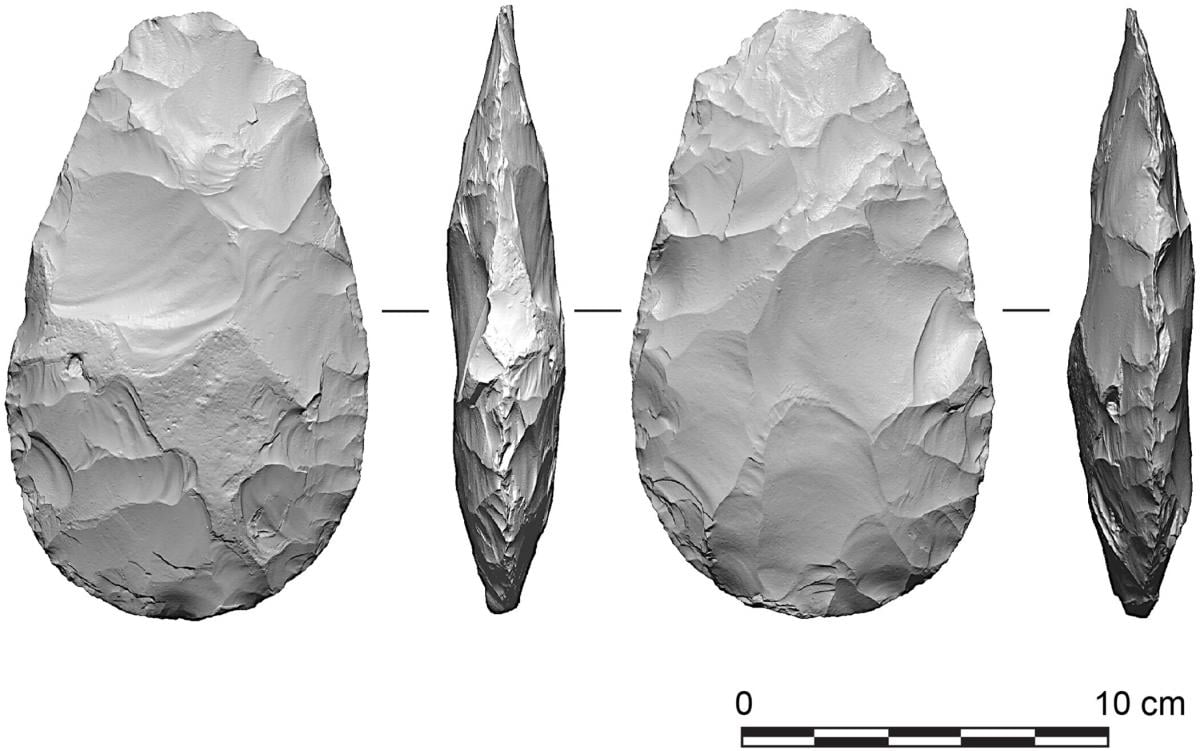
Researchers from University College London and the Natural History Museum have identified a 500,000-year-old ivory tool at Boxgrove in West Sussex, southern England. The rare artifact, reported by Daily Galaxy and published in the journal Science Advances, changes existing ideas about early human technology.
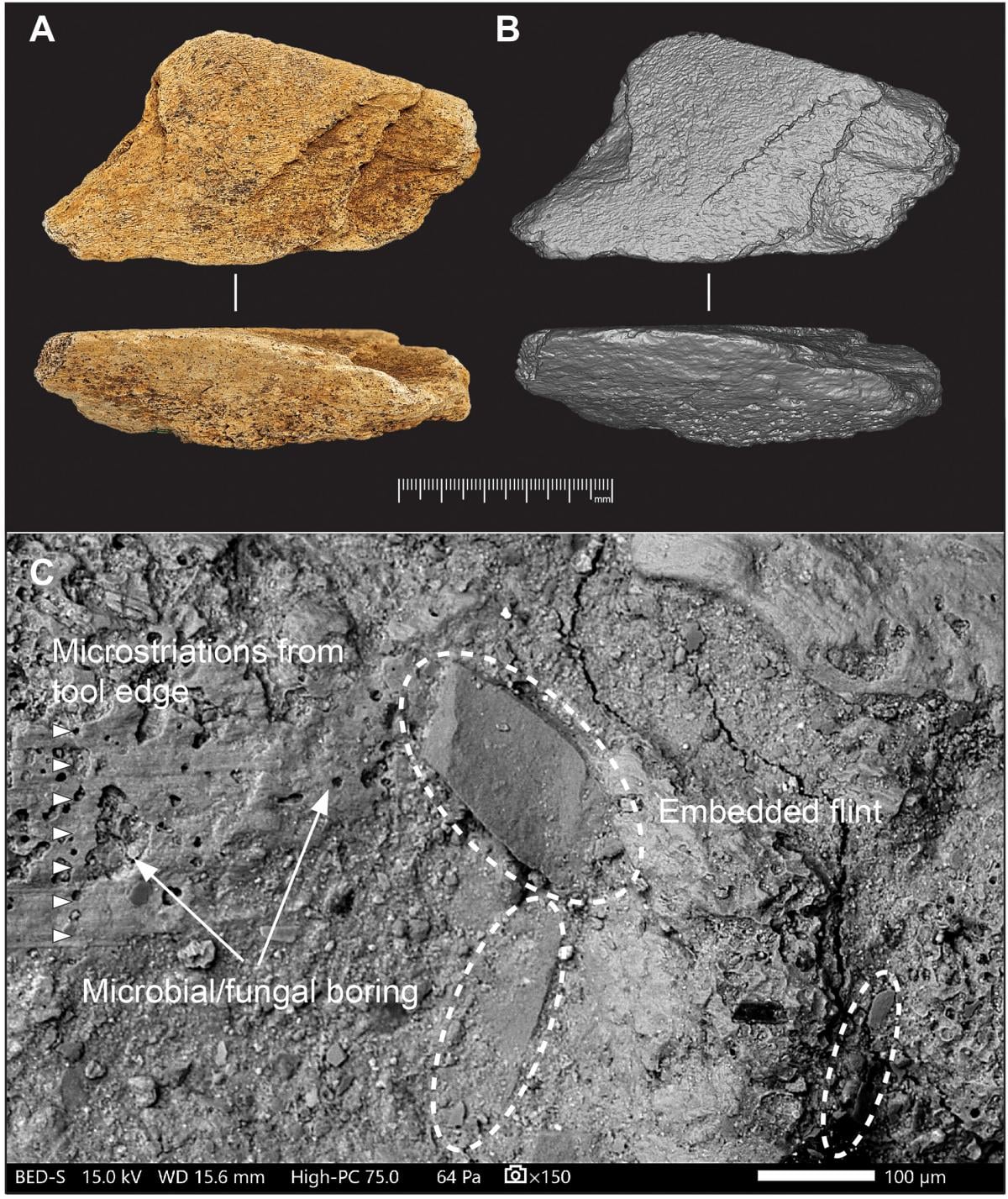
The triangular object measures about 11 centimetres long, 6 centimetres wide, and 3 centimetres thick. Surface marks indicate someone intentionally worked the fragment before using it. Scientists determined it was crafted from cortical bone, the thick outer layer of a large animal. Its size and density point to an elephant or mammoth, though researchers cannot identify the exact species or skeletal origin.
Early Neanderthals or Homo heidelbergensis made the hammer to repair stone cutting tools. Instead of striking heavy blows, the tool delivered controlled impacts to hand axes. Because bone is softer than stone, it chipped small pieces from damaged edges without fracturing the ivory hammer, helping prehistoric craftspeople use their stone tools longer.
Boxgrove excavation and microscopic analysis
Archaeologists first discovered the object in the early 1990s at the Boxgrove site near Chichester, where a unique Roman villa was also uncovered. Researchers did not recognize it as a tool at the time, and its function only became clear during a recent re-examination. Boxgrove has produced many flint, bone, and antler tools, but this is the site's first ivory tool.
The research team analyzed the bone using 3D scanning technology and electron microscopes. The analysis revealed nicks, impact damage, and tiny pieces of flint embedded in the surface marks. These signs proved early humans used the instrument repeatedly to reshape stone equipment rather than throwing it away after a single job.
Lead author Simon Parfitt said the finding demonstrates the cleverness of ancient ancestors, noting they possessed deep knowledge of local materials and sophisticated toolmaking skills. He added that ivory was a rare, highly useful resource, making the tool significantly valuable. Damage indicates the bone was fresh when worked, though scientists do not know if early humans killed the animal or scavenged it.
Ivory working history in Europe
Dr. Silvia Bello from the Natural History Museum explained that gathering, shaping, and repeatedly using ivory to sharpen stone tools displays complex, abstract thinking. She added that early humans were resourceful gatherers who used available materials skillfully. The discovery extends the known history of European ivory technology, where previous oldest tools dated to 450,000 years ago, compared to 1.5-million-year-old specimens from Olduvai Gorge in Tanzania.
In other archaeological news, researchers recently found 8,000-year-old fingerprints on pottery and clay artifacts at Ulucak Mound in western Turkey. The discovery, located in the Kemalpaşa district of İzmir province, offers new insights into how early communities organized pottery production.