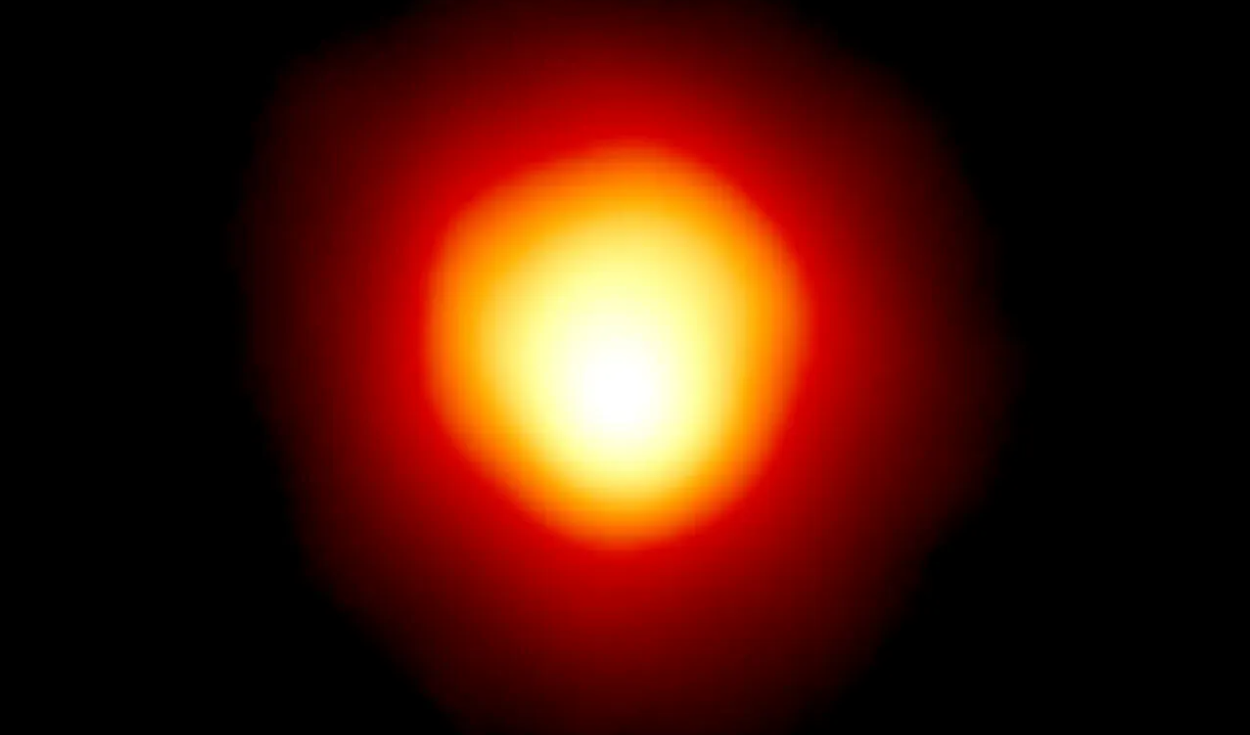
Astronomers have captured the clearest image yet of what appears to be a companion star orbiting Betelgeuse, the famous red supergiant in the constellation Orion, using the Very Large Telescope at the European Southern Observatory in Chile.
Miguel Montargès, an astronomer at the Paris-PSL Observatory in France and lead author of the study, said the finding was the culmination of a search that had lasted a century. He said he jumped from his chair when he saw the processed images.
The hunt for Betelgeuse B
Scientists had repeatedly proposed that Betelgeuse has a companion, but those claims lacked independent confirmation. Interest grew after researchers linked the star's longer brightness cycle to a possible orbiting object.
Betelgeuse shows several semi-regular variations. Three shorter periods of roughly 420, 230, and 180 days are generally linked to pulsations within the star. A longer cycle lasts approximately 2,200 days, or about six years. Two studies published in 2024 in The Astrophysical Journal and arXiv proposed that an unseen companion could be contributing to that longer secondary period.
Those calculations predicted the object would reach its greatest apparent separation from Betelgeuse in December 2024, giving astronomers the best opportunity to distinguish its light from that of the bright supergiant. Montarges and his team observed Betelgeuse on December 3 and 6 using the telescope's SPHERE instrument, then spent months trying to separate a potential companion from instrumental effects and Betelgeuse's intense glare.
A heavier-than-expected companion
The brightness of the candidate companion challenged earlier predictions. Astronomers had expected a companion with a mass comparable to the Sun, but the observations point to a star with a mass roughly 2.6 to 3.1 times that of the Sun.
The estimated age of the system places the companion near the beginning of its life on the main sequence. Betelgeuse, by contrast, has already expanded into a red supergiant after beginning its life with an estimated mass of between 18 and 21 solar masses. The absence of hydrogen-alpha emission, far ultraviolet light, and X-rays is consistent with the companion being a young main-sequence star rather than a still-forming object.
Questions remain
Betelgeuse will eventually explode as a supernova, but the presence of a companion raises new questions about the path toward that explosion. Close binary systems can exchange matter, alter stellar rotation, or merge before one star reaches the red supergiant phase.
The candidate companion is far enough away that its precise influence remains uncertain. Astronomers said they still need additional observations to establish its orbit, confirm its physical properties, and determine whether it has interacted with Betelgeuse.