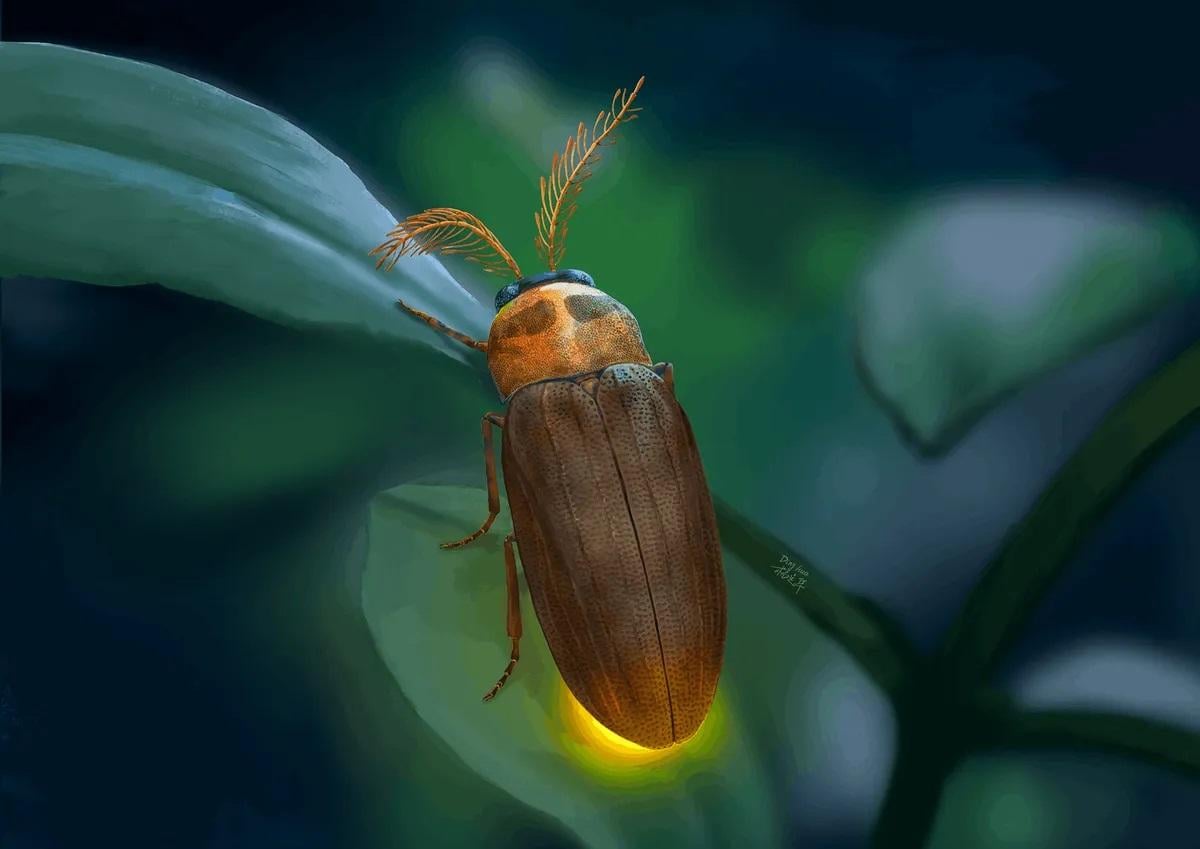
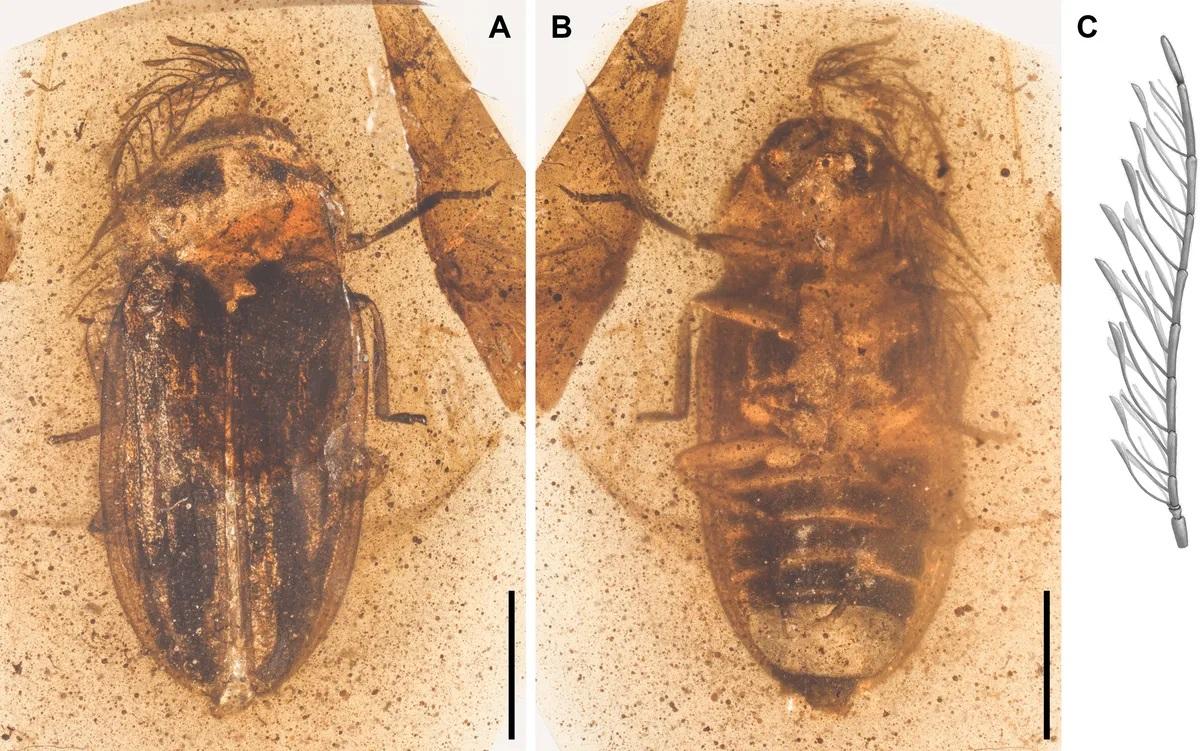
Scientists have discovered a 100-million-year-old fossil beetle named Icaroramus perisi trapped in Cretaceous amber from Kachin in northern Myanmar. The remarkably preserved specimen features both a fully intact bioluminescent light organ and an antenna structure never before seen in science, according to a report by IFLScience.
Analysis of the sample revealed that the extinct insect belongs to the order Coleoptera, the vast classification comprising all beetles, and specifically to the extinct family Cretophengodidae, a lineage closely related to modern fireflies and click beetles. The fossil represents a newly identified genus of lampyrid beetles.
Researchers were particularly intrigued by the insect's unusual antennae, which consist of 12 distinct segments. Each individual segment possesses two pairs of sensory branches known as lamellae, with each pair displaying a different physical shape.
Writing in the journal Proceedings of the Royal Society B, the study's authors stated that the beetle's 12-segmented, four-branched antennae possess a structural architecture completely unknown among both modern and fossil beetles.
Kachin State in northern Myanmar is famous among paleontologists for its extensive deposits of mid-Cretaceous amber, which have yielded thousands of exquisite fossil specimens encased in ancient tree resin. Coleoptera is the largest order in the animal kingdom, accounting for roughly 40 percent of all known insect species. In bioluminescent beetles, light is produced through chemical reactions within specialized abdominal organs.
Scientists believe the insect used its highly developed antennae to locate potential mates by detecting chemical signals, or pheromones, carried in the air. The distinct parts of the unusual antennae may have allowed the beetle to distinguish between different airborne chemical compounds.
While modern fireflies typically rely on simple antennae and light signals for courtship, Icaroramus perisi combined complex antennae with light-emitting organs. Because of this rare combination, the study's authors suggested that the beetle may have used its light primarily as a defense mechanism against predators rather than for attracting mates.
The age of the amber fossil indicates that light signals and specialized chemical-recognition antennae developed in firefly ancestors at least 100 million years ago, long before the emergence of modern insect species.
Recent Fossil Discoveries in Myanmar Amber
The finding represents the second firefly-like fossil recovered from Myanmar amber this year. In May, researchers described another new species, named Cretoluciola birmana, identifying it as a true Luciolinae fossil dating to the mid-Cretaceous period.
The discovery also follows a 2023 finding of a fossil micro-wasp from the same region that possessed extraordinarily complex antennae. Lead study author George Poinar suggested at the time that the unique, miniature cloud-like structures attached to the antennae undoubtedly caused physical inconvenience to the tiny parasite.
Researchers noted that the antenna layout found in Icaroramus perisi has never been observed in any other species, living or dead. The unique structure demonstrates the remarkable complexity of insect communication systems already present during the Cretaceous period, which spanned from roughly 145 million to 66 million years ago and ended with the extinction of the non-avian dinosaurs.
Archaeological Discoveries in Ancient Artifacts
In a separate archaeological finding noted in regional reports, archaeologists excavating a rock-cut chamber on the west bank of Luxor in Egypt discovered a clay vessel containing eight ancient papyri. Researchers reported that they were unable to immediately read the documents, several of which remained preserved with their original clay seals intact.