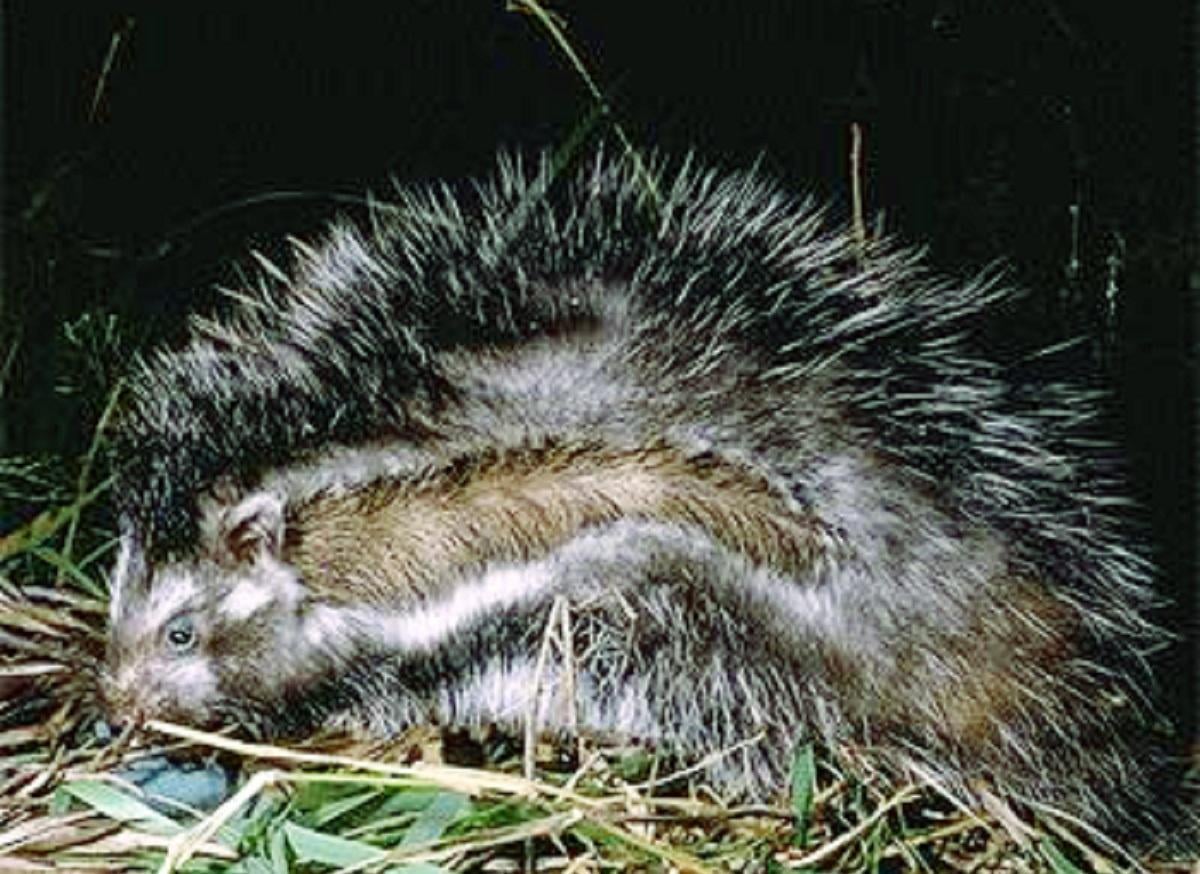
The African crested hamster is the only known mammal on Earth capable of harvesting lethal plant poison and applying it to its fur to protect itself from predators across East Africa, according to Discover Wildlife.
The rodent, which possesses a relatively harmless appearance, relies on one of the most unusual chemical defense systems in the animal kingdom.
Adult crested hamsters measure between 36 and 53 centimetres in length including their tails. Their bodies are covered in dense grey and white fur, featured alongside a prominent mane of long black and white hairs running along the back.
When sensing danger, the hamster fluffs up its fur to display a striking high-contrast visual pattern as a warning to approaching predators. Beneath this mane lies specialized skin containing glands, overlaid by uniquely structured hair capable of absorbing toxic substances.
Poison harvesting and application
To load its chemical defense, the crested hamster seeks out the bark of Acokanthera schimperi, a tree native to eastern Africa. Acokanthera schimperi is widely known as the poison arrow tree because its tissues contain high concentrations of cardenolides.
Cardenolides are toxic cardiac glycosides that alter heart function by disrupting sodium-potassium pumps in muscle cells, which can prove fatal to mammals in large doses.
The hamster chews the toxic tree bark and licks the specialized hairs located on its flanks. Through this grooming process, salivary secretions transport the plant toxins directly onto the side hairs, where the microscopic structure of the fur absorbs and retains the poison.
When a predator attempts to bite the rodent, the stored toxin transfers into the attacker's mouth, resulting in severe poisoning.
Defense against natural predators
The crested hamster relies on this toxic shield to deter major African predators, including honey badgers, caracals, servals, hyenas and leopards. Researchers consider the unique defense system to be a significant evolutionary advantage for the rodent.
Domesticated animals are also vulnerable to the toxin. Documented cases show that hunting dogs attacking crested hamsters have died from poisoning, while surviving dogs subsequently learn to avoid the rodents entirely.
In addition to its toxic coat, the crested hamster has physical adaptations that help it survive predator attacks. The species possesses exceptionally thick skin and an unusually flexible spine, which absorb physical impacts during bites.
Scientific theories on poison tolerance
How the crested hamster chews and ingests the lethal Acokanthera schimperi bark without dying remains a major scientific mystery. Researchers currently have no definitive explanation for the animal's resistance to cardenolides.
Scientists have advanced several hypotheses to explain the rodent's survival. One theory suggests that specialized biochemical traits within the hamster's physiology grant it enhanced resistance to cardiac toxins.
Another hypothesis points to the rodent's unusual multi-chambered stomach. In many mammals, multi-chambered digestive systems harbor specialized gut bacteria, which researchers speculate may break down the toxic plant compounds before they enter the bloodstream.
Habitat and dietary habits
The crested hamster is distributed across eastern Africa, with documented populations in Somalia, Ethiopia, Sudan, Tanzania, Kenya, Djibouti and Eritrea. Within these regions, the animals inhabit forests, savannas and brush-covered shrublands.
The rodents construct shelters inside hollow tree trunks, underground burrows and other protected covers. Although their diet consists primarily of plant materials such as leaves and fruits, crested hamsters are omnivorous and also feed on root crops, insects and meat.