Dr. Adrianos Golemis, a doctor who has spent years caring for the health of European astronauts, will become the first Greek citizen to travel to space, flying to the International Space Station on the PAM-6 mission in the second half of 2027.
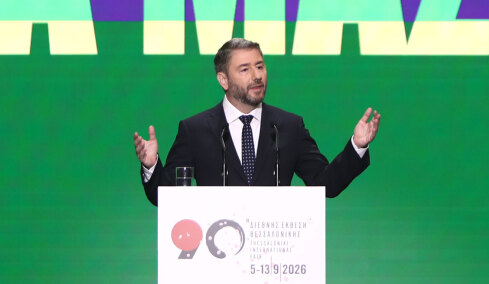
The announcement was made in Paris by Greek Prime Minister Kyriakos Mitsotakis, standing alongside French President Emmanuel Macron at the International Space Summit. The mission is an initiative of France and Germany aimed at strengthening Europe's presence in the space industry, and Greece's participation was confirmed at the summit. Mitsotakis said Golemis would make the country proud.

Golemis, who trained in medicine and has worked as a flight surgeon for the European Space Agency (ESA) supporting the agency's astronauts, described the mission as the step Greece needed. He said the country already had a satellite programme and that Greek scientists had contributed to astronomy and other fields, making the astronaut opportunity a logical next step.
He will serve as a mission specialist on PAM-6, which is expected to take place in the second half of 2027 if all goes according to plan. The crew will fly aboard a SpaceX Dragon spacecraft launched on a Falcon 9 rocket, most likely from Cape Canaveral in the United States.
Historic milestone for Greece
ESA described the mission as a historic milestone for Greece, marking the country's shift from space ambition to a concrete crewed mission. The agency said its cooperation with American company Vast and NASA also opens the door for Greek scientific experiments and technological applications aboard the ISS. NASA has welcomed Greece into the broader international effort to explore space; Greece joined the Artemis Accords in 2024 as the 35th signatory nation, and NASA congratulated the country on its historic participation in the mission.
Golemis, a graduate of the Aristotle University of Thessaloniki, has already trained in space science and taken part in research on how space conditions affect the human body. During the roughly two-week mission, assigned by NASA to Vast as part of the first private astronaut mission to the ISS, he will carry out scientific experiments on behalf of European and mainly Greek research institutions and companies. He said space research is conducted to extract knowledge that can be applied on Earth, and that every astronaut carries out experiments in whichever science is needed, including biology, chemistry and physics, adding that medicine holds particular significance for him given his background.
Flying with a familiar crew
Golemis will not be a stranger among strangers on the mission. Its commander is French astronaut Thomas Pesquet, whom Golemis knows well, having served as his doctor during Pesquet's previous mission. It was in that role that the wider public came to know Golemis as "the astronauts' doctor." Pesquet reportedly told him that he would now see things from the other side once he learned they would travel to the ISS together. Also joining the crew will be Czech astronaut A. Svoboda and another European astronaut who has not yet been announced.
Golemis has said the mission is not simply about observing the universe or sending back photographs of how Earth looks from above. He explained that the bodily changes experienced in space closely simulate extreme conditions, including ageing and certain pathologies, so that addressing symptoms that appear in space gradually helps in treating the same symptoms on Earth. As an example, he cited the field of pharmacology and the cancer drug pembrolizumab, whose method of administration was improved thanks to research conducted on the ISS. He said substances behave differently without gravity, which helps scientists better understand their properties, improving patient health, easing the burden of treatment, and reducing the workload on hospital staff.
From Larissa's plains to the stars
Golemis grew up in Larissa, a city on the Thessalian plain in central Greece, where clear night skies over the nearby town of Platamonas first connected him to the cosmos as a child watching the stars with his parents. He has said he considers it fortunate to have grown up there rather than in the impersonal sprawl of a large city such as Athens.
He will soon travel to the United States for the next phase of his preparation, joining a training programme with teams from Vast, SpaceX and NASA. He will begin specialised training for the ISS mission covering every phase from launch to return, building on modules from ESA's Astronaut Reserve training earlier this year.
The pull toward exploration runs in the family. Golemis's grandfather was a doctor and a respected scientist in Larissa, and his parents instilled a love of exploration and open horizons in both their children, fully supporting unconventional ambitions even when such paths seemed remote by Greek standards. His brother, Aris, a civil engineer, shares the same drive: while Golemis spent a year isolated at the Concordia research station in Antarctica as part of an ESA selection exercise, Aris was working on a research programme in the Arctic, placing the two brothers from Larissa simultaneously at the two most remote and frozen points on the planet.
As a child in the late 1980s, influenced by the pop culture of the era, Golemis developed a passion for "exotic" career ideas such as astronaut or paleontologist, and his early love of watching the stars later grew into his hobby of astrophotography. While studying in Thessaloniki, he joined the Thessaloniki Amateur Astronomy Club, which he has said put him on track toward a dream focused less on becoming an astronaut and more on Greece's place in astronomy and space.
Path to the ESA astronaut corps
After completing his studies at the Aristotle University of Thessaloniki's medical school, Golemis moved to France, which became the base for his later space career. He earned a Master of Space Studies from the International Space University in Strasbourg, focusing on medical research related to space, and wrote his thesis in collaboration with ESA on the medical and psychological criteria for selecting astronauts for long-duration missions, such as a future trip to Mars, a topic that proved prophetic for his own path.
He then worked in Toulouse at the French Institute of Space Medicine and Physiology (MEDES), designing and overseeing clinical studies, including prolonged bed-rest studies, that simulate the negative effects of microgravity and the space environment on the human body. MEDES seconded him to the European Astronaut Centre, where he worked as a flight surgeon and later as lead flight surgeon, closely monitoring the health, physical condition and psychology of European astronauts before launch, during their time in space, and through the critical recovery period after their return to Earth.
Since 2018 he has worked at ESA as an astronauts' doctor, providing medical support for seven space missions by European astronauts and working closely with NASA's mission control in Houston and ESA's centre in Cologne. His work brought him into close contact with some of Europe's best-known astronauts, including Pesquet, Italian astronaut Luca Parmitano, a former ISS commander who survived one of the most dangerous spacewalk accidents on record when his helmet filled with water, and German astronaut Matthias Maurer.
One in 22,500 odds
That close experience with the space "elite" gave Golemis the grounding to take the leap himself. In 2021, ESA opened a new astronaut selection process for the first time in 13 years, drawing more than 22,500 applications from across Europe.
Golemis recalled that the selection process began with 22,500 candidates. Greek outlet protothema.gr reported in June 2021 that 280 Greeks, 220 men and 60 women, were among the roughly 22,000 candidates, noting that ESA already had astronauts such as Pesquet. At the time, neither the outlet nor Golemis himself imagined a Greek candidate would emerge from the gruelling process.
His odds of success stood at roughly one in 22,500, or about 0.0044 percent, comparable to the lifetime odds of being struck by lightning, roughly one in 15,000, or of matching all six numbers plus the bonus ball on a single line of the Greek Joker lottery. In terms closer to his own field, the figure matches the estimated 0.0044 percent chance that asteroid 2024 YR4 will strike Earth in 2032, while the odds of a civilisation being wiped out by an asteroid within a century, or of astronomers randomly discovering a second, observable Earth-like planet with water, atmosphere, oxygen and life, are each estimated at about one in 20,000.
Golemis said that by the end only 25 candidates remained, and that he sometimes thought the odds were too low to be worth it, but that the experience taught him it is worth trying even when success is unlikely, because good and difficult efforts alike tend to pay off eventually.
Securing a seat on PAM-6
Golemis went through an exhausting six-stage selection process lasting more than a year, including demanding medical exams, cognitive ability tests, psychometric assessments, crisis-management exercises and interviews with senior officials. He became the first Greek in history to complete all six stages successfully, earning a place among the 25 astronauts selected to ESA's Reserve/Project Astronaut list with a score in the top 0.1 percent across Europe.
Two advantages set him apart, according to the account: his year of isolation at the Concordia station in Antarctica, which showed he could withstand the extreme physical and psychological conditions associated with spaceflight, and his role as a flight surgeon, which meant he already understood the systems, procedures and risks of space missions better than external candidates.
Passing ESA's selection places a candidate in the astronaut pool, but flying to space still requires funding and an assigned mission. Greece's government decided to significantly boost its participation in ESA, and in September 2026 an official agreement was signed between ESA, Greece and the American space company Vast, securing Greece a seat on a research mission, PAM-6, to the ISS in 2027.
Because Golemis was the only Greek candidate who had already completed the full evaluation and begun preliminary training, he was automatically designated as the Project Astronaut representing the country, with the announcement made officially in Paris by the Greek prime minister. Golemis has said he believes more Greeks will inevitably follow him into space, and that the greater the benefit this first mission brings to the country, the more opportunities will be created in the future.