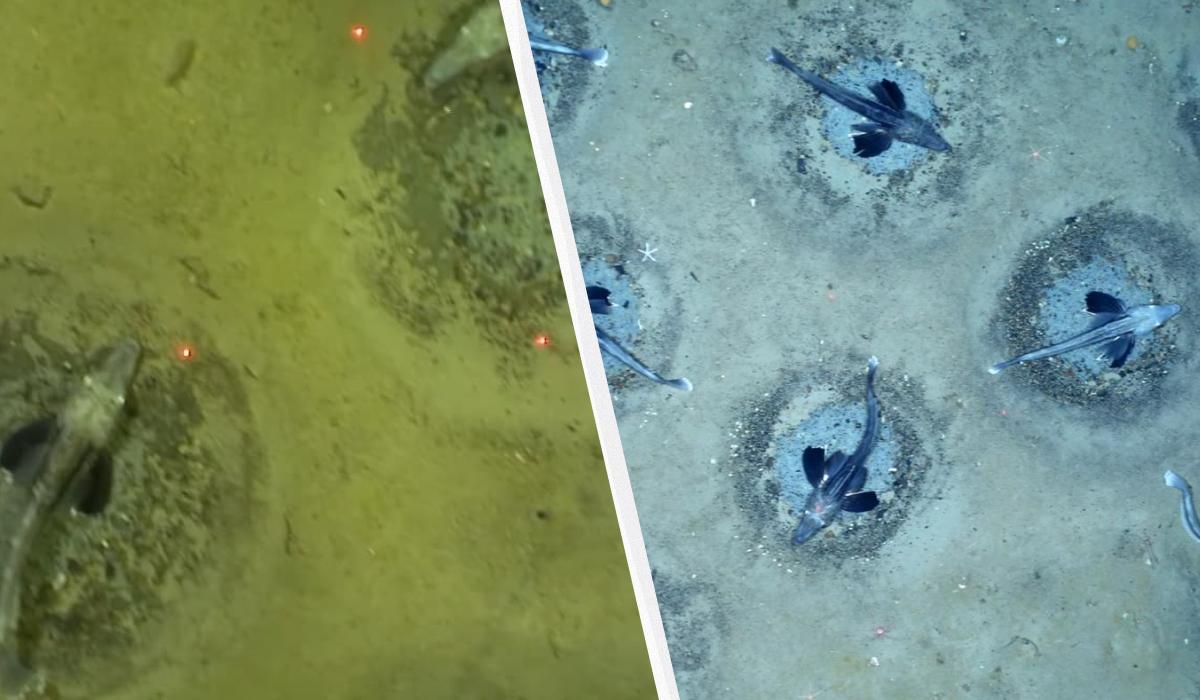
An international team of scientists has discovered a colony of roughly 60 million icefish nests hidden beneath the ice of the Weddell Sea in Antarctica, spread across an area of at least 240 square kilometers at depths reaching 535 meters.
The find was made by researchers aboard the German research icebreaker Polarstern in February 2021. Cameras from a towed system known as OFOBS, dragged just above the seabed, repeatedly picked up circular depressions in the sediment that turned out to be fish nests.
Within one surveyed patch covering about 45,600 square meters, the team counted 16,160 nests. Follow-up acoustic mapping of the wider seafloor revealed more than 100,000 similar structures, allowing the researchers to estimate the colony's full size at around 60 million nests.
Thousands of eggs in every nest
Each nest measures roughly 75 centimeters across and about 15 centimeters deep. The fish clear sediment away from the seabed to form the depressions, lining them with small stones before laying their eggs inside.
Active nests examined by the researchers held an average of 1,735 eggs, and adult fish were frequently found guarding them nearby. The total mass of fish making up the colony is estimated at more than 60,000 tons.
The colony is formed by the Antarctic icefish species Neopagetopsis ionah. The species has an unusual trait: it lacks functional hemoglobin and mature red blood cells, so oxygen is carried directly through its blood plasma instead, a process aided by the extremely cold, oxygen-rich waters around Antarctica.
Why the fish chose this spot
The researchers noticed that the nests were arranged along a deep-water current, where the water was around 2 degrees Celsius warmer than in surrounding areas.
Scientists believe this temperature difference may create more favorable conditions for egg development, which could explain why so many fish have concentrated in this particular location.
The colony matters beyond the icefish themselves. Researchers say it could be a major food source for other animals in the region. Data from tracking tags attached to Weddell seals showed the animals frequently dive to the exact depth where the huge colony was found.
The Weddell Sea is one of the southernmost seas on Earth, bordering the Antarctic continent, and its icy, largely unexplored waters have long made large-scale seafloor surveys difficult.
What happens next
Scientists have left observation cameras in the area to track how the colony changes over the course of the year and to find out whether the fish return to the same site to breed.