


Vivo has released its new X500 Pro Max Android flagship smartphone with an introductory flash discount on Amazon, reducing the price to 1,499 euros.
The promotion trims 100 euros from the manufacturer suggested retail price of 1,599 euros and includes free shipping, although pricing remains subject to change without notice.
The release comes as premium smartphone prices across the mobile market continue to climb, with top-tier Android devices increasingly matching the pricing tiers long associated with Apple. Modern flagship handsets increasingly function as near-professional cameras, with Vivo pitching its newest device to compete at the very top of the market throughout 2026 and into 2027.
Writing for Spanish news organisation La Razon, technology reporter Roberto Mendez evaluated the hardware upon its retail debut. Vivo, based in Dongguan, China, is one of the world's largest smartphone producers and develops high-end consumer electronics designed to rival devices from Samsung, Google and Apple.
Pricing and launch discount
The X500 Pro Max represents the largest and most expensive entry in Vivo's latest product family, sitting above the standard version in both physical footprint and technical capabilities.
Under the introductory flash sale hosted on Amazon, purchasers can obtain the 12 GB RAM and 256 GB storage configuration for 1,499 euros. Mendez observed that while the handset remains a substantial financial investment, its specifications and expected longevity justify the premium price tag.

Processor and performance
At the core of the smartphone is the MediaTek Dimensity 9600 Pro processor, an advanced chipset manufactured using a cutting-edge 2-nanometer process. MediaTek, a semiconductor company headquartered in Taiwan, designs high-performance mobile chipsets to rival processors from American chipmaker Qualcomm.
The 2-nanometer fabrication architecture is engineered to deliver high power efficiency while providing ample processing speed to handle intensive workloads. Vivo pairs the silicon with 12 GB of system memory and 256 GB of onboard storage.
During hands-on evaluation, Mendez reported that the handset handled all routine operations with rapid response times. However, testing also revealed that the phone can become noticeably warmer than desirable during brief periods of heavy, demanding usage.
Display and audio hardware
The front of the phone is dominated by a 6.85-inch AMOLED display that offers Quad High Definition resolution. AMOLED technology uses individual light-emitting diodes for each pixel, producing deep black tones and sharp contrast ratios.
The screen features an adaptive refresh rate reaching up to 144 Hz, updating the display 144 times every second for fluid visual animations. It also achieves a peak brightness rating of 5,000 nits, allowing clear visibility even under harsh direct sunlight.
Vivo includes extensive visual customisation settings within the operating system, alongside a comprehensive Eye Care mode designed to reduce visual fatigue during prolonged sessions. In contrast to the visual quality, Mendez noted that the integrated dual stereo speakers deliver acceptable sound but lag behind the audio fidelity offered by competing flagship models.
Battery life and charging speed
To keep the hardware powered, Vivo equipped the device with a 6,750 mAh battery. The capacity allows the smartphone to sustain long, demanding workdays without interruption and can stretch to two full days under moderate operating conditions.
The European edition of the handset features a slightly lower battery capacity than the variant marketed domestically in China. Even with that regional distinction, the phone provides significant endurance improvements over earlier product generations.
Charging is handled through a 90 W wired fast charger that replenishes the battery in approximately 45 minutes. The handset also supports wireless induction charging at roughly 40 W. Mendez noted that the substantial battery and robust internals contribute to a total weight of 226 grams, which remains manageable given the physical scale.
Chassis design and build quality
Vivo assembled the device around a bevelled aluminium frame constructed from aerospace-grade alloy, flanked by a dual-tone glass rear panel.
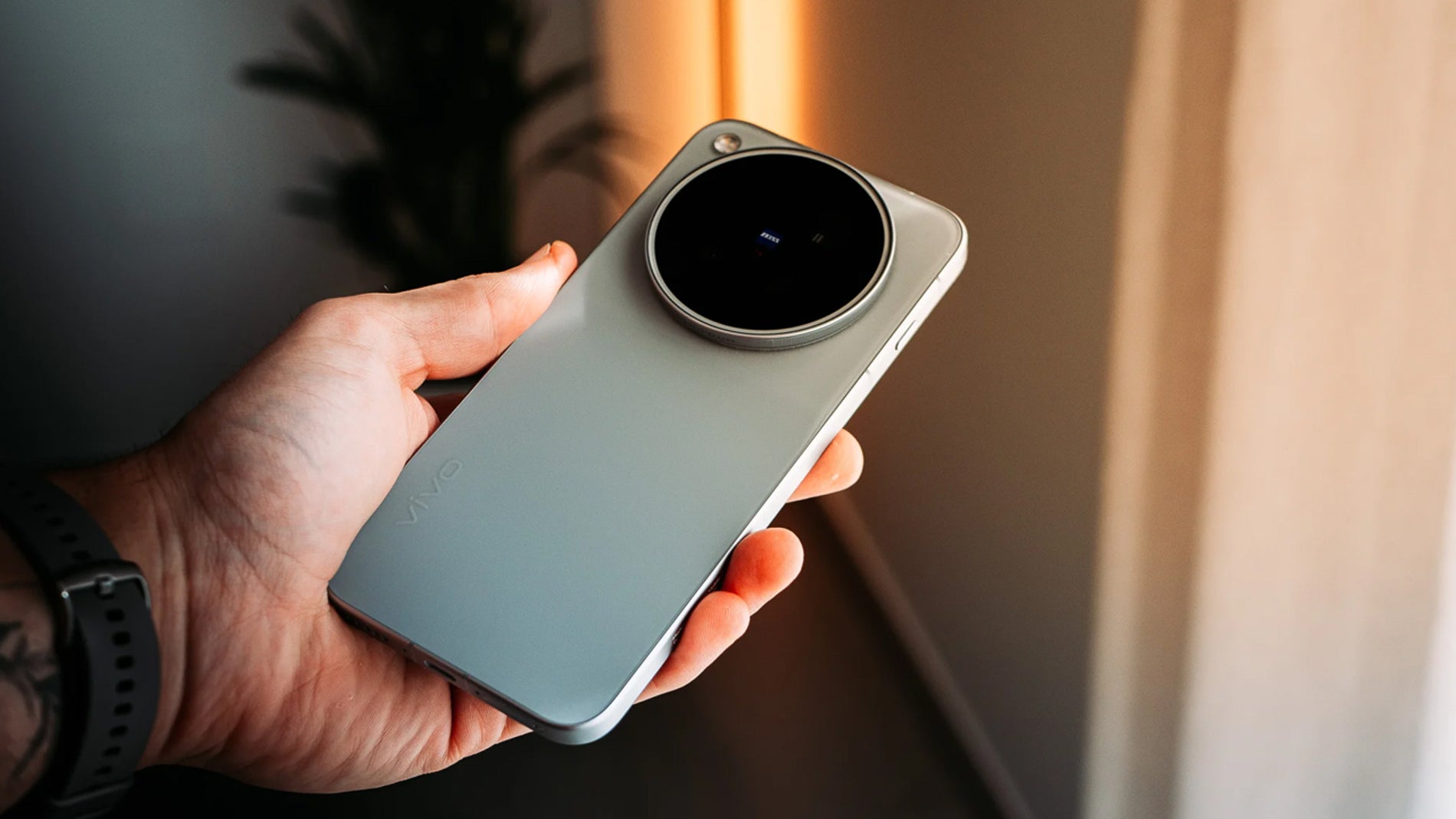
The standout external element is a prominent circular metal camera housing positioned along the central axis of the back plate. The module features an outer metallic ring with fine striations and stands out as one of the thickest camera bumps seen on a modern smartphone.
Mendez noted that because the camera module is mounted centrally rather than in an upper corner, the phone remains stable and does not wobble when placed flat on a table.
Zeiss camera system and zoom capabilities
Optics remain the central selling point of the handset, marked on the chassis by the blue emblem of German optical specialist Carl Zeiss. Vivo partnered once again with Zeiss to co-engineer the optical components and software image processing.
The rear photographic array contains three distinct sensors. The primary camera uses a 50-megapixel sensor, accompanied by a 50-megapixel ultra-wide-angle lens for landscape and group photography.
Zoom duties are managed by a 64-megapixel telephoto camera delivering 3.5x optical magnification and up to 100x digital zoom. Self-portraits and video calls are handled by a 50-megapixel front-facing sensor.
Mendez concluded that the combination provides the most complete photography and video capture suite currently available on an Android device. Vivo also offers an optional professional photography accessory kit, sold separately, which incorporates a physical telephoto extender.
Software and artificial intelligence features
On the software side, the smartphone launches running OriginOS 7, a proprietary user interface built on top of Google's Android 17 operating system.
The operating system includes several integrated artificial intelligence utilities, though Mendez stated that Vivo's AI capabilities still trail the broader feature sets offered by competitors such as Samsung and Oppo.
The visual layout of OriginOS 7 incorporates interface elements that closely mirror Apple's iOS, a design choice that may divide user preferences. Vivo backs the device with a commitment to deliver five years of software updates. Mendez concluded that despite the high retail cost, the smartphone represents a secure long-term investment for consumers seeking top-tier mobile hardware.


