A delegation of United States congressmen met with Dominican Foreign Minister Víctor "Ito" Bisonó on Monday in Santo Domingo as negotiations continued over tariffs affecting Dominican exports to the United States.
The Dominican foreign minister received a delegation led by Republican congressman Dan Meuser, who represents Pennsylvania's 9th district and chairs the Oversight and Investigations Subcommittee of the US House Financial Services Committee.
Also taking part were Democratic congresswoman Sylvia Garcia, of Texas's 29th district, and congressman Vicente Gonzalez, of Texas's 34th district, accompanied by congressman Adriano Espaillat, who is of Dominican origin, and his chief of staff, Johanny Adames.
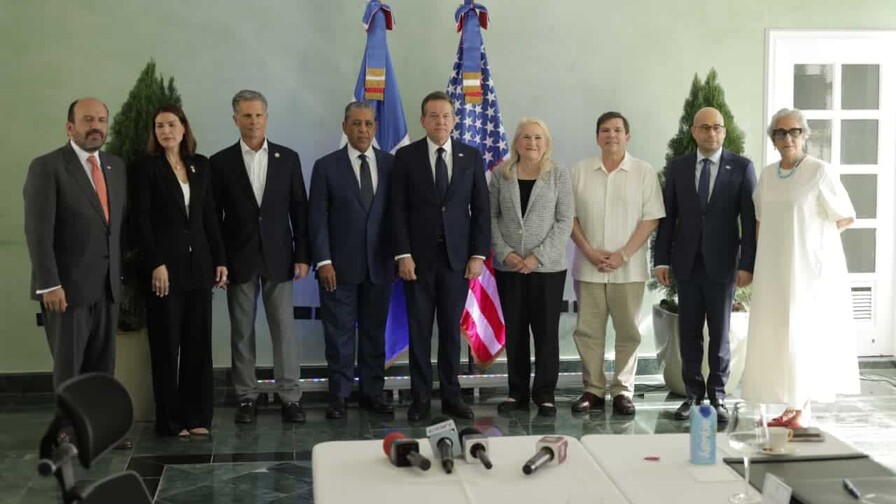
The talks covered the main issues tied to trade agreements between the two countries, although the state of the negotiations was not detailed.
Tariffs under review
Dominican authorities are seeking to revise the 12.5% tariffs affecting Dominican exports, while the United States is pushing to eliminate import licenses that restrict the entry of American rice into the Dominican market.
Bisonó said the Dominican Republic was part of a package involving 62 other countries, not just itself, but that it remained in direct talks with US officials. Asked about progress on the Dominican Republic-Central America-United States Free Trade Agreement, known as DR-CAFTA, he said the discussions were part of the same broader review of bilateral trade relations.
Impact on cost of living
Espaillat warned that US tariff policy does not only affect the Dominican Republic but also drives up the cost of living for American consumers. He said the tariff issue affects both the Dominican Republic and the cost of living and household budgets in the United States.
Espaillat said the next US Congress would need to address the situation, citing rising prices for basic goods and the broader effects of tariff measures on trade.
Rice import licenses
The trade talks are taking place as the United States continues to raise concerns over barriers it says still restrict the access of American rice to the Dominican market.
DR-CAFTA called for the progressive elimination of tariffs on rice, with free access due to take effect on January 1, 2025, after a 20-year phase-out period. The Dominican government instead issued Decree 693-24, setting a tariff-free quota of 23,300 metric tons of rice and a 99% tariff on imports above that amount.
That decree was repealed on September 9, but US authorities and representatives of the American rice sector have insisted that restrictions persist through a system of non-automatic, discretionary import licenses. According to reports from the US Department of Agriculture, these licenses continue to function as non-tariff barriers despite the repeal of the tariff set out in the decree.
On September 11, the Office of the US Trade Representative said it had raised the issue during a virtual meeting with Bisonó, in which it welcomed the repeal of the decree and raised the possibility of moving toward a reciprocal trade agreement.
Visits to free trade zones
Dominican authorities are seeking an understanding that would reduce additional tariffs on their exports while protecting domestic rice production and honoring trade commitments made with the United States.
During their stay in the Dominican Republic, the US lawmakers will also visit free trade zones and industries and meet with representatives from sectors linked to trade and investment, according to Bisonó.
The delegation is being accompanied by the Dominican ambassador to Washington, María Isabel Castillo, and will also have the chance to visit cultural sites, including the Colonial City of Santo Domingo.
Bisonó stressed the importance of maintaining dialogue with the US lawmakers and said there was an intention to continue the exchanges with a future visit to Washington.
Also taking part in the meeting were Vice Minister of Bilateral Foreign Policy Francisco Caraballo, Vice Minister for Economic Affairs and International Cooperation Vilma Arbaje, and Vice Minister of Management and Operations of the Foreign Service Ramón "Monchy" Pérez, among other officials.
What happens next
Bisonó said there is an intention to continue the exchanges with a future visit by Dominican officials to Washington, and the US delegation will continue its agenda visiting free trade zones and industries in the Dominican Republic.
Test yourself
Who led the US congressional delegation that met with Víctor Bisonó?
What tariff rate are Dominican authorities seeking to revise?
What did Decree 693-24 establish before it was repealed?
Have your say
Should the Dominican Republic ease its rice import licensing rules to help resolve the tariff dispute with the US?
Where it happened
Santo Domingo, Dominican Republic