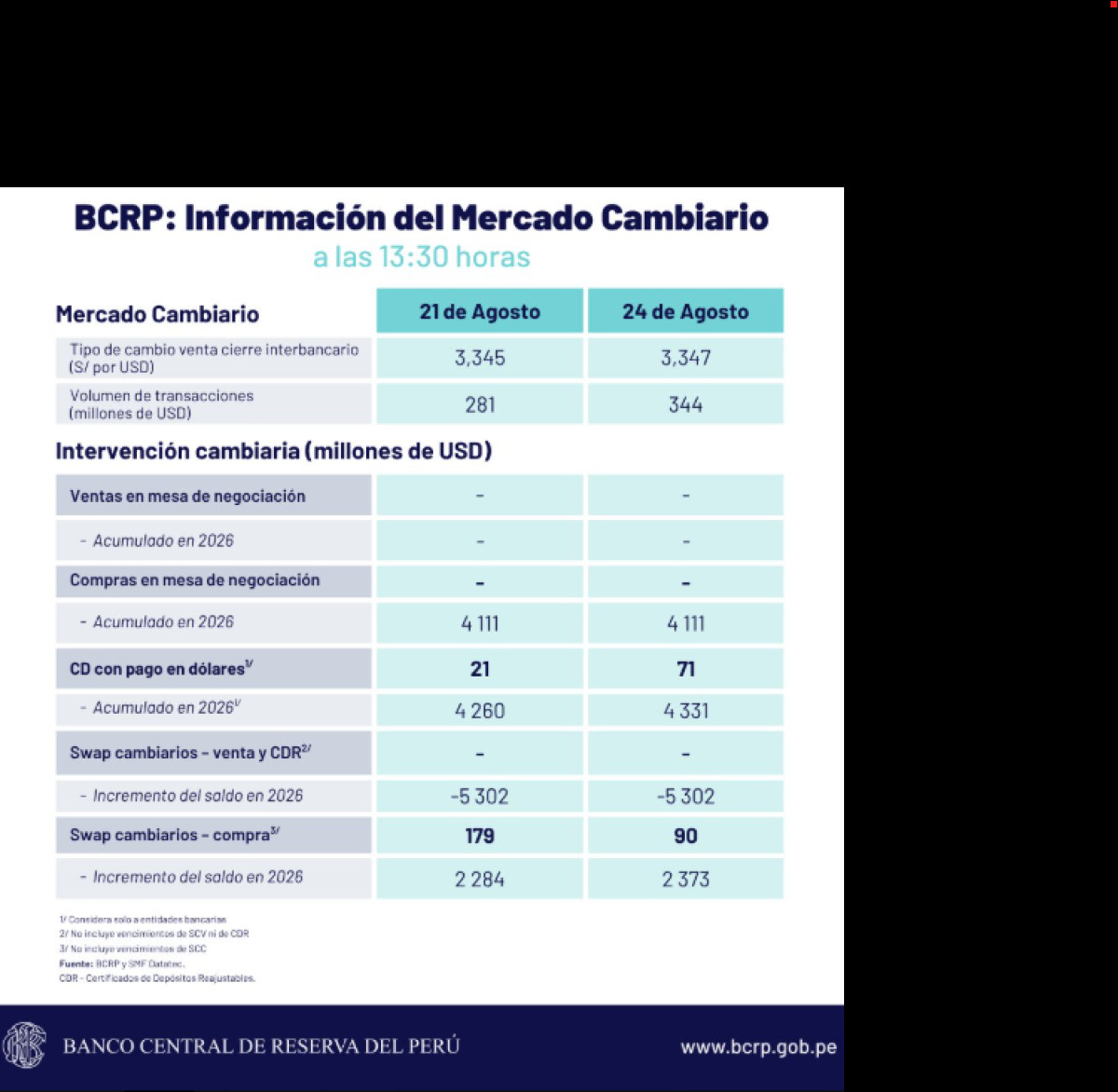
The United States dollar closed lower at S/3.347 soles in Peru on Wednesday, August 26, 2026, according to official market figures from the Central Reserve Bank of Peru.
The central bank, known locally as the Banco Central de Reserva del Perú (BCRP), stated that the closing price marked a drop from the previous day, when the dollar was recorded at S/3.345 soles. The central bank acts as the monetary authority of Peru, managing national foreign exchange reserves and regulating currency stability across the South American nation.
Earlier in the day, wholesale market trading opened at S/3.3433 soles, according to data from the Bloomberg financial news portal. Meanwhile, Peru national tax and customs administration, Sunat, set its official daily accounting exchange rate at S/3.339 soles for purchase and S/3.350 soles for sale.
Commercial banking institutions across the country displayed a much wider spread between purchase and sales rates throughout the trading session. Customers converting currency at retail bank counters or through digital banking platforms faced higher prices than wholesale benchmark rates.
Bank exchange rates in Peru
Banco de Crédito del Perú (BCP), the largest commercial lender in the country and part of the Credicorp financial group, quoted a buy rate of S/3.525 soles and a sell rate of S/3.540 soles. Interbank, one of the primary retail banks in Peru, listed its purchase rate at S/3.493 soles and its selling rate at S/3.576 soles.
State-owned Banco de la Nación, which handles public sector financial services, set a purchase rate of S/3.480 soles and a sale rate of S/3.600 soles. BBVA Perú, the local subsidiary of Spanish banking group Banco Bilbao Vizcaya Argentaria, posted a buy rate of S/3.468 soles and a sell rate of S/3.608 soles, representing the highest selling price among major banks. Scotiabank Perú, owned by the Canadian multinational lender, quoted S/3.519 soles for purchase and S/3.558 soles for sale.
Parallel market rates and informal trading
Outside formal financial institutions, informal money changers and private exchange houses offered narrower profit margins. Financial comparison portal cuantoestaeldolar.pe reported parallel market exchange rates of S/3.330 soles for purchase and S/3.355 soles for sale.
In Peru, the informal exchange rate is widely known as the dólar Ocoña, referring to street-level currency trading conducted outside the official banking system. The phrase is named after Jirón Ocoña, a street in the historic center of Lima near Plaza San Martín, where currency exchangers established operations during the hyperinflation and economic volatility of the 1980s.
Origin of local exchange terminology
Peruvians also frequently use the informal slang term coco to refer to the US currency. Commercial banks have integrated the colloquial term into financial products, including BCP exchange service known as Cocos y Lucas, which facilitates swaps between dollars and soles.
The nickname derives from the image of George Washington on the United States one-dollar bill. In Peru, the English name George translates to Jorge in Spanish, and individuals named Jorge are traditionally given the informal hypocoristic nickname Coco.
Verifying genuine banknote security
Because foreign currency circulates heavily alongside the local sol, financial education guides published on YouTube detail instructions for inspecting banknotes. The video tutorial demonstrates physical and visual security features to help members of the public detect counterfeit US bills.